"Wars are decided in the breasts of men before they are decided on the battlefields"...
And as we continue with Rumours and Psychological Warfare, we want to go back to remarkable events.. many know them because they saw the film connected to them about the Second World War.. the film "Enemy at the Gates"...
We are specifically on September 19, 1942..
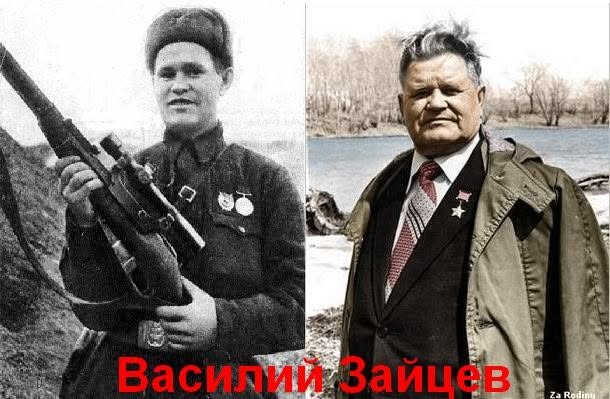
And an employee in the Soviet Navy named "Vasily Zaytsev".. the one in the picture.. is submitting a volunteer request as a fighting soldier in the army, to fight for the Motherland, like anyone "who has blood" in any homeland in any era in times of war..
Vasily's request is accepted and he is transferred to the front at "Stalingrad" where the Nazi forces are indeed on its doorstep..
Stalingrad, by the way, was the knot of the war.. it was a symbol, not just a city, because the city bears the name of "Stalin".. and if it collapsed and fell into the hands of the Nazis.. the morale of all the soldiers of the Soviet Union would collapse.. and it would settle in their souls that their leader had been "defeated"...
This led "Nikita Khrushchev" - whom we call "Khrushchev" - later to change the name of the city after the war in 1961 to "Volgograd".. so that the terrible pressure that occurred would not be repeated in another possible war.. and so that if it fell it would be an ordinary city.. it fell and we will retake it.. without breaking the morale of the army...
Anyway, Vasily arrived as an ordinary soldier.. and joined the infantry battalions in the front ranks.. until a situation occurred that changed his life and the course of events and the entire Battle of Stalingrad...
The situation is that he was by chance trapped amid the Soviet corpses and body parts with an officer named "Danilov".. and Danilov was surprised by Vasily's amazing ability to aim with a rifle..
This scene from the film is in the first reference for anyone who would like to see it...
Anyway, Danilov took Vasily to Khrushchev.. and a new plan began with him...
People must feel pride.. they must learn to love their country.. they must hear stories of heroism and sacrifice and redemption.. and sing of the heroics of heroes...
And the plan began to be implemented.. to raise the morale of the Soviet people.. and frustrate the German people...
They attached Vasily to the "Sniper division" and began printing the army newspaper again - it had stopped due to pressure on expenses - and writing in it about Vasily's heroics.. and Vasily's genius.. and Vasily's tactics.. and publishing pictures of the metal dog tags that soldiers wore, to identify them if they died, and every day you would find 10 or 20 tags of the Nazis published in the newspaper..
Ordinary newspapers began to pick up from the military newspaper.. and leaflets began to be distributed to the people.. Vasily.. the invincible hero of the Soviet Union.. has ten German officers for breakfast and twenty for lunch...
And the closest estimate to correct of the enemies Vasily killed was 250 German officers and soldiers.. on his own.. with a rifle from November 1942 until December 1943...
The morale of the German soldiers had dropped extremely.. especially since Vasily formed a team.. and the German soldier no longer knew, as he walked, whether he would die at the hands of a sniper or not and when..
We need to mark this line well.. because we will come back to it.. the Soviet history books say.. that the Nazis decided to send in the director of the sniping school in Berlin, Major "Erwin König".. to hunt down this Soviet sniper for them and raise the morale of the soldiers...
A fierce battle began between the two snipers.. and many from both their teams died and both of them were wounded.. until the Germans announced that Vasily was dead...
The truth is that Vasily was not dead.. the Soviets had kept him out of sight for a while.. and when the Germans began to feel relief and their morale rose.. and before Soviet morale could deteriorate.. Vasily appeared once again.. photographed with the day's newspaper with the date.. and with him new tags.. of new German soldiers he had killed..
These battles continued.. until the time came and Vasily was able to hunt down the Major.. and his rifle was returned to the Moscow museum of the armed forces...
The morale of the German soldiers dropped to zero.. and it was the beginning of the end for the famous Battle of Stalingrad...
Indeed.. the decline in morale and the frustration among the Nazis was one of the biggest and most important reasons for the defeat...
The reality.. is that Vasily was a hero.. and his sniping techniques.. which snipers around the world still use to this very moment, such as the "sixes" technique.. and dozens of stories and lines of poetry and poems and novels and documentaries were made for Vasily.. and they concluded with the film we referred to at the beginning.. Enemy at the Gates.. to the point that Vasily was promoted and received the title "Hero of the Soviet Union"..
Vasily lost his sight in the last days of the Battle of Stalingrad because of an artillery shell.. and the Soviet Union called on the great eye surgeon "Vladimir Filatov" who transplanted a cornea for him and restored his sight..
He died on December 15, 1991, only ten days before the division of the Soviet Union.. after he had written his memoirs and his heroics.. including his story with Major König...
And despite all that.. the part I told you to "mark it so we come back to it".. from the beginning of this line.. the story of Vasily with Major "Erwin König".. never happened at all...
"Erwin König" was a fictitious character.. invented by the Soviets.. and "Danilov" composed about him the terrible epic that took place between him and Vasily.. and concluded it with König's death at Vasily's hands.. in order to frustrate the German soldiers...
And when the Allies entered and imposed their terms on Germany and dismantled the weapons factories and seized the Nazis' documents.. they found no information or mention whatsoever of a person claiming to be "Erwin König"...
And despite Germany's denial and the Allies' own denial of König's existence.. and their doubt and their request for evidence from the Soviet Union.. the Soviet Union did not respond to these claims at all.. and contented itself with a German rifle with a scope placed in the Moscow army museum.. which they attribute to Major Erwin König...
And Germany demanded that the Soviet Union display the metal tag that the Major was supposedly wearing around his neck when he was killed.. but the Soviet Union never responded..
Major "Erwin König" was merely a "rumour"..
An extremely brilliant intelligence operation by Khrushchev.. to destroy the morale of the German soldiers through a single rumour...
A rumour the Soviets launched.. and with it they targeted the morale of the German soldiers..
And they succeeded overwhelmingly...
And although a figure like the "director of the Berlin sniping school" is not an ordinary figure.. and is somewhat known.. and anyone could verify it.. the rumour still crept into souls and got a result...
Sometimes a rumour overcomes the truth and defeats it.. even if it is illogical...
That is why verifying rumours is a duty at all times.. and demanding a "real" source.. not news in a newspaper.. is a duty at all times.. and using one's mind is a duty at all times... especially in times of war..
Wars are not just cannon and soldier.. there is another kind of war that decides the battle very early before it is decided on the ground...
Psychological warfare...
---------
References:
---------
1 - https://www.youtube.com/watch?v=wMvTR012Dmg
2 - "Biography: Vasily Zaytsev". Heroes of the Soviet Union and Russia...
3 - Robbins, David L. (1991). War of the Rats. Bantam.
4 - http://russiapedia.rt.com/promin.../military/vasily-zaitsev/
5 - The Reader's Digest Illustrated History of World War II (1989). London: Reader's Digest Association Limited.
6 - Zaytsev, Vasily (2003). Thoughts of a Sniper. Trans. David Givens, Peter Kornakov, Konstantin Kornakov. Ed. Neil Okrent. Los Angeles: 2826 Press Inc.
7 - Beevor, Antony (1998). Stalingrad. London: Penguin Books Ltd.