The Mongols' storming of Baghdad was an enormous shock.. and the fall was terrible, its thunder stunning the world.. the fall of the Abbasid Caliphate beneath the hooves of "Hulagu"'s horses.. and because of the Mongols' victory tensions arise in the Levant.. which ended with its being invaded by the Mongols as well.. until that battle ended at "Ain Jalut" as we said.. and the legend of the Mongols came to an end.
At that time "Ertugrul" was living in a state of extreme sorrow, given that "Osman".. later "Osman I", the grandfather of the Ottomans.. turned out in his early years.. to have been born with deformities his father was not pleased with.. for he was "qami'".. and the word qami' is not an insult in this context.. qami' linguistically means "jumbled of features".. as in his physical attributes being inconsistent.. so the Turkish historian "Ismail Arunsal" said; in "Sahifet al-Akhbar fi Waqai al-Athar" volume one (in the Turkish language). Istanbul - Turkey: Tercuman newspaper. page 69:
"His hands reached his knees because his arms were long and his legs very short"
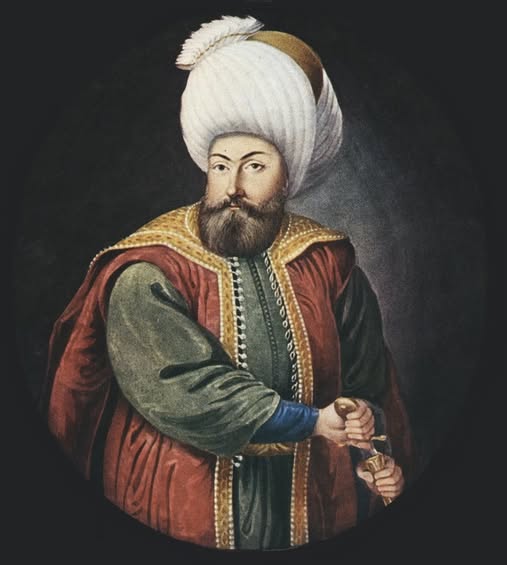
You will even notice that they tried to fix this when they drew him in those days.. so they shortened his arms.. and they came out shorter than necessary.. like the picture with the post.. you will also notice that one of his eyes is higher than the other.. "Ismail Arunsal" himself tries to convince the reader in the course of his words that these are "great hereditary traits". The reason is that "Osman" passed these deformities down to his descendants for several generations after him.
We are not here to mock the creation of God, glory be to Him, or anything of the sort.
It is only an important indication that justifies the reason for his failure to become a knight as "Ertugrul" had wished.. and the reason for the tribes' refusal to let him become their leader, as we shall see later.. and the emergence of "Saru Batu Savci Bey".. who was only three years younger than him.. as a strong candidate.. for rule after "Ertugrul".
After the Mongols' defeat at "Ain Jalut" near the Egyptian border.. their forces scatter.. and their kingdom dissolves.. and "Ertugrul" has to find a new master.. to offer him his services.. so he turns his gaze to "Rukn al-Din Kilij Arslan ibn Kaykhusraw Kilij Arslan" the sultan of the Seljuks of Rum.. and he works under his command with his men as a mercenary.
"Ertugrul" dies in the year 1281 AD, and leaves "Osman" at the age of 23.. some people say that a struggle took place between him and "Dundar Bey", his uncle.. and a civil war occurred.. unfortunately the historical sources about "Dundar Bey" are very few.. and I could not ascertain the date of his birth and death.. so for the sake of honesty I decided to pass over this part, considering that it did not happen.. since it has no sufficient sources.
What is established is that "Osman", while "Ertugrul" was on his deathbed.. noticed that the tribes refused to let him lead them.. because of his congenital defects.. and were thinking of an alternative to him.. so he headed for the Seljuks of Rum.. and declared loyalty to the vizier and assistant of the sultan of the Seljuks of Rum, "Mu'in al-Din Suleiman".. because the sultan at the time was "Kaykhusraw III".. a weak, worthless man.. with no real authority.. and it was his assistant who ran affairs.
With "Mu'in al-Din Suleiman"'s recognition of brother "Osman" as emir of the Kayi tribe.. matters settle for him.. because these barbarian tribes were too weak to confront the Seljuks of Rum.. and accordingly "Osman" begins to practise his late father's charming activities.. raiding villages and slaughtering their inhabitants and stealing the livestock.
And matters develop and the wealth of "Osman" increases.. and his men.. and his power.
He begins to attack the ports and the cities.. with the support of "Mu'in al-Din Suleiman".. and his army grows and his influence expands.. and then with the departure of "Mu'in al-Din Suleiman".. he decides to marry.. so he asks for the hand of the daughter of the new Seljuk vizier, "Mal Hatun", and marries her.. and from her he begets his first son "Orhan".
Whoever tells you that Ertugrul defeated the Mongols and blah blah blah.. is laughing at you.. the Turkish historian and professor of Ottoman history "Halil Inalcik".. in his book "The History of the Ottoman State from Rise to Decline".. translated by Dr. Muhammad al-Arna'ut, published by Dar al-Mad al-Islami, first edition in 2002.. p. 14.. says:
" The Mongols had tightened their grip on Anatolia.. more than anywhere else.. and they had permanent forces there.. true, some tribes revolted against them once or twice.. but all of that would end with the Mongols' victory and their vengeance".
Whoever tells you too that they were Muslims and protectors of the sanctum of Islam and so on.. has in truth laughed at you.. the truth is that they followed a strange unknown religion.. that blended Islam with other religions in an odd mixture, with new rituals and different prayers.. founded by a man named "Baba Ishak".. the Turks pronounce it "Baba Ishaq".. and he was a Shiite Alawite man.. who appeared in the year 1239 AD in Anatolia.. and "Ertugrul" and his tribe followed him along with many other tribes and clans.. they left Islam and believed in this "Baba Ishak".
And the religion of "Baba Ishak" was indeed a strange religion, for his followers believe that he is the Messiah and has been sent anew.. and at the same time believe that he is the Messenger of God "Muhammad ibn Abdullah" incarnated once again.
They believe it is forbidden to build mosques, because there were no mosques in the days of prophethood according to their claim.. and in a saying, because our master "Ali", may God be pleased with him, was killed in a mosque.. and "Ishaq Baba" made his followers believe that he is immortal and does not die.. in any case the son of the Sultan "Ala al-Din Kayqubad" refuted this hypothesis.. and hanged him for them in the year 1241.. because his followers had become too many in Anatolia and he decided to defy the Seljuk sultan with them.
"Osman" and his people entered Islam again at the hands of a man whose origins are from the Arabian Peninsula, from "Banu Tamim", named "Sheikh Edebali".. because "Osman" loved his daughter "Rabia Bala Hatun", who was forty years younger than him.. and asked to marry her.. so the sheikh agreed on one condition.
That "Osman" enter Islam.
And indeed Osman enters Islam and his clan behind him.. and this daughter of the sheikh bears him his second son "Alaeddin Pasha".
Now they come and tell us, "No, Osman was a Muslim and was a disciple of Sheikh "Edebali" from his childhood because the sheikh was a close friend of "Ertugrul".. the truth is that when "Osman" was born in the year 1258.. this sheikh was 12 years old.. born in 1246.. and was not even in Anatolia at that time.
And the truth is that "Osman" was violent, extremely coarse and cruel with the villages and towns on which he imposed his influence.. and burdened them with many taxes and tribute.. so they began to grow weary of him.. and aspired for "Saru Batu Savci Bey", his brother, to take over the rule in his place. "Bey" by the way is a title meaning "emir".. and these titles used to be bestowed on them by the Seljuks of Rum.
"Osman" notices that the popularity of "Saru Batu Savci Bey" is growing among the people.. so he decides to get rid of him.. and finds that the appropriate moment to kill his brother is the nearest battle they will fight together.
The "Battle of Domanic" during the invasion by "Osman" and his tribe of the city of Bursa.. and this event deserves for us to speak about it in a post of its own.
So our talk.. will have a continuation.
----------
Previous posts
----------
1 - http://bit.ly/32Q5W4t
2 - http://bit.ly/2SJESze
3 - http://bit.ly/2YmsINT
4 - http://bit.ly/2KekUZo
5 - http://bit.ly/31c7XWU
6 - http://bit.ly/2Zv9iaL
#The_Ottoman_Caliphate 7