When the Ottoman state first arose, it was about 200 km, and it contained only two cities: Sogut and Domantic. That is smaller than the distance between Cairo and Alexandria via the desert road.
What we know from history is that the Ottomans later defeated the Mamluks and occupied Egypt. But the truth is that Egypt had defeated the Ottomans' forefathers long before that.
At the beginning of the year 1277 AD, Egyptian forces were pursuing the Mongols in Palestine after the victory of "Ain Jalut," under the command of "al-Zahir Baybars," after the death of "Sayf al-Din Qutuz," and then liberating the Levant from them, and then liberating Iraq, and then pushing on after them into Anatolia, where the "Battle of Elbistan" took place between them.
The Battle of Elbistan was not only between the Egyptians and the Mongols, because the "Seljuks of Anatolia" had joined the Mongols at that point.
Guess who was the governor of the Seljuks of Anatolia at that time, in 1277, and was married to the daughter of the Seljuk "Ghiyath al-Din Masud," as we said before?
Bravo to you. The father of "Osman": "Ertugrul Ghazi."
And in the "Elbistan" battle, the Seljuk officials and the men of the Kayi tribe were crushed by the Egyptian forces, and they fled. The Mongols were defeated in a crushing defeat, and the grandson of "Hulagu," "Berke Khan," surrendered and announced his conversion to Islam in exchange for "Baybars" leaving him alive. And the truce was indeed concluded.
With his victory, al-Zahir "Baybars" entered Antioch, and he conquered the Turkish city of "Kayseri," the seat and capital of the Seljuks, and sat on the throne of the sultanate, and the emirs and officials of the Seljuks raced one another to offer allegiance and obedience to the sultan of Egypt.
Guess once more who among them was kneeling, humbled, before "al-Zahir Baybars." Exactly. Also "Ertugrul" Ghazi. The Ottoman Turks have never forgotten this historically.
Unfortunately, "Baybars" returned to Egypt, and he had been determined to go back to Anatolia to consolidate his rule, but fate gave him no respite, and he met his Lord in the month of May of that same year, 1277 AD, and his son "al-Said Nasser al-Din Muhammad" sat on the throne of Egypt.
We are at the first founding moment of the Ottoman state, and "Osman" is invading "Domantic," or "Domanic" as they call it, in order to annex it to Sogut so that it becomes his emirate and his small state.
And at the same time, "Osman" found it a golden opportunity to get rid of his brother "Saru Batu Savci Bey," whom the tribes had begun to agree upon, and were thinking of having him replace "Osman," the harsh and cruel, and who had become a threat to his throne and his rule.
And in the midst of the battle of "Domantic," amid the neighing of horses and the clashing of swords and the dust, a special squad of Osman's men set off to kill "Saru Batu Savci."
And it was a real surprise for "Saru Batu Savci," who was startled by men fighting on his own side coming to kill him. But "Saru Batu Savci's" guards noticed the situation quickly and clashed with Osman's men.
And we were left with a strange scene...
Two men in one army, suddenly, in the middle of a battle against an enemy, stopped and fought each other!
And "Saru Batu Savci Bey" was skilled in the use of the sword, and "Osman" realised that victory would not be an ally of his men, and that if "Saru Batu Savci Bey" survived, he would tear him to pieces. And "Osman" was extremely weak in direct confrontation and a failure at using the sword, but he was a good marksman, very skilled with bow and arrow. So he snatched up his bow, fitted an arrow from his quiver, and loosed it at the heart of "Saru Batu Savci," who met his death on the spot.
And the matter settled for Osman in his rule of the tribe.
But that scene was witnessed by many, and word of it passed from mouth to mouth, and everyone knew that "Osman" had killed his brother, while "Osman" wanted to show that he had died in battle by chance. That is why historians called the battle the "Battle of the Twins." "Osman" and "Saru."
And then "Osman" wanted to erase this tragedy from people's minds, so he had his historians write that it was called the "Battle of the Twins" because it took place in a Turkish village called "Ikizce," and that word in Turkish means "the twin." The truth is that "Ikizce" is a proper name, and it has no meaning, and it does not mean "twin" in Turkish.
Whenever "Osman" won a battle and occupied a village or a town, he imposed a large tribute on its people, and sent most of it to the Seljuk Sultan, so the latter would reward him with new lands and support him in further conquest, and so on.
Osman won the battle of "Domantic," on the personal and the practical level, but he was unable to expand, because there was danger all around.
The Mamluks of Egypt, a force not to be underestimated, and the Mongols of Persia, who had the remnants of the defeated Mongols themselves joined to them, gave them a thousand considerations.
So what was he to do? Any land he took now, its good would be his alone. The Seljuks were in collapse, finished.
Egypt was fighting the Crusaders, and busy with its conflicts with them, but it was still strong, and would come to Anatolia and give him a shoeing if he thought of expanding.
But the opportunity came to "Osman" on a golden platter...
For after the death of "al-Nasir Said," "al-Adil Badr al-Din Salamish" came to the throne of Egypt, and after him came "al-Mansur Sayf al-Din Qalawun," and after them "al-Ashraf Salah al-Din Khalil," and after them "Muhammad ibn Qalawun."
And let us pause for a few moments at "al-Ashraf Salah al-Din," because he committed a fatal mistake that was not intended, and he is the reason for an extreme weakness that struck Egypt at a certain stage and made it lose its control over Anatolia.
There was a Persian Mongol soldier whom "Baybars" had taken captive during his war against the Mongols. "al-Mansur Qalawun" bought this soldier, and that was the first mistake. Then he found him to be a troublemaker, so he threw him into prison.
When "al-Ashraf Salah al-Din Khalil" came, he released this soldier and returned him to political life, on the grounds that he had experience in dealing with the Mongols, his own people. And he began to grow and rise and become influential and became an emir. And that was a fatal mistake.
This man's name was "Kitbugha," and he is not the same as "Kitbugha," the famous Mongol commander and deputy of "Hulagu."
And in the year 1293 AD, Sultan "al-Ashraf Khalil" died, so they installed in his place his young brother "Muhammad ibn Qalawun," who was nine years old. And because of his young age, "Kitbugha" seized the opportunity and had him sign a decree appointing him deputy to the sultanate and administrator of the state.
And with "Muhammad ibn Qalawun" being so young, "Kitbugha" became the de facto ruler.
And a new sultan sat on the throne of Egypt.
A Mongol sultan...
"al-Adil Zayn al-Din Kitbugha"...!!
What the Mongols had failed to do with the sword and armies was achieved by a single mistake by a single man who brought an enemy close to the sultan of Egypt and the centre of decision-making.
But this matter did not please the vizier "Sanjar al-Shujai," so he began negotiating with "Kitbugha" on the basis that it was not permissible for him to rule Egypt, and "Kitbugha" refused, so "Sanjar" thought of removing him by force.
And here "Kitbugha" rallied to his side the Shahrzur Kurds and his companions among the Mongols residing in Cairo.
And "Sanjar" rallied to his side the Burji Mamluks.
And Egypt turned towards a terrifying turning point, one that weakened it greatly, and became a golden opportunity for the Anatolian scoundrel to expand, in light of this new turning point.
The turning point of civil war.
You feel that history really does repeat itself.
An enemy of the state in prison, who comes out of prison for some reason, and enters the game of politics, and after a while sits on its throne while his loyalty was never to it in the first place, and sets about driving it towards civil war!!
Does this remind you of something?
Notice also that our history with Anatolia is a series that repeats itself all the time: one of them rises up, throws his weight around and exploits our periods of weakness or a traitor sitting on the throne of Egypt, and bullies us as much as God allows him to, then Egypt rises and wakes up and decides to give him a shoeing, and the Egyptian army reaches the heart of Anatolia and besieges the capital, and then we go and bring him back from there and say to him, never mind, he is just a kid, it was a mistake, and you were in the right and we owe you...!
The important thing is that Egypt entered, at the hands of "Kitbugha," into the turning point of civil war, and that is enough to weaken any state.
And there is much to be said about this matter, so we will continue talking about it later, and we will see what "Osman," the killer of his brother, did after that.
And the conversation still has more to come.
----------
Previous posts
----------
1 - http://bit.ly/32Q5W4t
2 - http://bit.ly/2SJESze
3 - http://bit.ly/2YmsINT
4 - http://bit.ly/2KekUZo
5 - http://bit.ly/31c7XWU
6 - http://bit.ly/2Zv9iaL
7 - http://bit.ly/2GNIyee
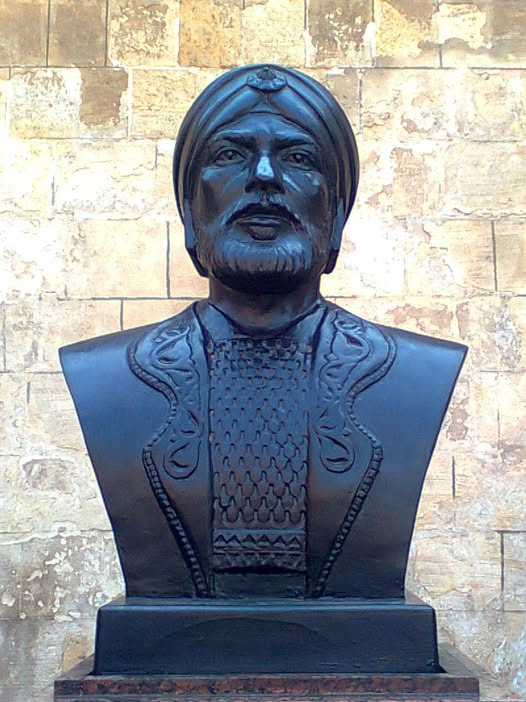
The image is of the statue of "Sayf al-Din Qutuz."
#الخلافة_العثمانية 8