As the friends chose by majority.. we begin with the "Ottoman Caliphate".
As we saw in the caliphate episodes.. after the Rashidun Caliphate.. which brought us to the Mamluk era.. anyone who loved expansion decided to call himself caliph.. or to enlist an honorary caliph.. to bestow spiritual authority on his works and deeds, so that he would appear.. thereby supported by the Lord.
Europe itself learned this game from the Umayyad state in Andalusia.. and raised the banner of the cross.. and decided that it was "the hand of God on earth".. and began to invade and slaughter with full support from its peoples.. following the very same approach.
And in order for us to know what the foundation of the Ottoman state is, where it came from and when it began, we must go back a little before it.
A patch of land between Europe and Asia.. 3000 years before Christ.
This patch was called "Anatolia".. or what we know today as "Turkey".
It had no real people we could call "sons of the land".. or "of pure blood".. just a patch of land to which some Persian tribes migrated.. along with tribes of Mongols.. over nomadic Bedouin tribes.. that is why you find their language today containing a mixture of all these languages.. and even Urdu.. the language of the people of India.. linguists have confirmed that the Turkish language originally sprang from the Mongolian language.. which includes Tatar and Mongol.. despite its strong similarity to the Persian language, which has no masculine or feminine and no dual.. because of the mixing of the Mongols who were there with the Persians before Christ.
And there is no one you can look in the face and say "this one looks Turkish" for example.. like the Arab and the Russian and the Persian and the European. Although there is near consensus among scholars that the majority of this race are originally Mongols.
These tribes remain in constant struggle and strife.. and a tiresome civil war.. whose weapons are stone and tree trunks.. because we are in the year 3000 before Christ approximately.
Even the Persians and Mongols, who were at that time a power to some extent.. the tribes that migrated from them to this patch were exiled criminals or nomadic Bedouins.. not at a degree of development that suited that era.. and they could not integrate with its vocabulary or develop themselves and their weapons.
This region continues more like a barnyard.. based on the struggle of fang and claw and tribalism and backwardness.. until the year 336 before Christ.
In that year a Greek Macedonian king sits on the throne of "Macedon".. succeeding his father "Philip II of Macedon".. who made an alliance between "Athens" and "Thebes".. which enabled him to invade all of Greece.. and he became its absolute ruler.. until he was assassinated by his wife "Olympias" through a professional killer, called "Pausanias of Orestis".. because "Philip" had married another woman over her.
And this heir of "Philip" sets off from where his father ended.. and begins to establish one of the greatest and largest empires in the history of the world.. and his influence extends from the "Ionian Sea Mare Ionio" north of the Mediterranean.. to the Himalayas...
This commander is known never to have been defeated once in any battle he fought in his life throughout history.. and he has a mark with us in Egypt.. because he came to us and founded a famous great city in the north that bore his name, up to the moment of writing these lines.
This king's name is "Alexander the Great Alexander III of Macedon".
At the same time this Anatolia was still wallowing in its barbarism until the year 334 before Christ - note that dates before Christ count downwards.. until the beginning of the Christian calendar.. meaning they decrease not increase.. they go in reverse - in which "Alexander the Great" comes with his enormous forces and his formidable army.. and sweeps Anatolia completely in about two hours of time.. or as some historians said literally "from around dawn to just before sunrise".. and annexes it to his mighty empire that sat on the throne of the ancient world in one era of history's eras.
"Alexander" afterwards decides to invade Egypt.. and it was at that time in one of its last eras of decline, which was divided into the first and second eras of decline and so on.. and we will talk about it, God willing, when we talk about ancient Egypt in a separate series.. the point is that Egypt in this era was occupied by the Persians.. and its people looked upon Alexander as a friend and a saviour hero.. and this feeling was deepened by the fact that we were originally allies of Greece most of the time and there was wide commercial and cultural exchange between us.. so when he reaches Pelusium, the eastern gate of Egypt, in the autumn of 332 BC, the Egyptians open the gates for him and welcome him.. and they hand over the Persian garrison to him the way locals hand things over.. to the point that it was taken without any resistance out of sheer surprise.
He moves north on the same approach until he reaches a small island called "Pharos".. so he decides to fill in the sea and turn it into a large city.. and he assigns one of his ministers, "Deinocrates", to this task.. and indeed the city is built and named after him as we said.. "Alexandria".. and it becomes the capital of the state.. in the era of the Ptolemies after him.
With "Alexander's" occupation of this patch.. he begins to bring in these Anatolians.. who were in fact without craft or real use.. and turns them into cheap labour in menial works.. like heating the baths.. and "attending to the concubines".. and barbering, and tending to the cleanliness of the pens of livestock and sheep.. and feeding the horses and.. etc.
And in the year 326 before Christ.. "Alexander" marches on India.. and there he meets one of the most skilled military commanders in the history of the ancient world.. the Indian king "King Porus".. and a terrible epic battle takes place between them, considered the harshest and fiercest of the battles "Alexander" fought in his life.. in which he lost about a third of his army.. but his military experience, despite his young age - 32 years - made him victorious in the end.. and he enters India.. and made history pause for moments.. and pick up its quill and inkwell to record for us this fierce battle under the name "Battle of the Hydaspes".
And this "Battle of the Hydaspes" was the last of "Alexander's" battles.. because his soldiers realised at the hands of "King Porus" a truth they noticed for the first time.. that they could die far from their families at any moment.. and they began to grow bored and ask.. when will they return to their country.
And here "Alexander" announces to them the glad tidings.. "we still have a few more years to go, everyone.. no one is going home".. and he took a decision to attack the Bengalis.. and they had a great strong state with massive armies.. whose fighters were extremely fierce.. and here the soldiers began to mutiny.. and more than 20,000 soldiers came out against "Alexander".. in direct, explicit disobedience.. with one heart and one decision.. no fighting until we see our wives and children.
And with "Alexander's" famous stubbornness.. he decides to confront these renegade soldiers.. and assigns his commander "Coenus" to this operation.. but he is surprised by the latter telling him: "The men have longed to see their fathers and mothers, their wives and children, and their land and homelands".
And because Alexander was wise.. at that very moment.. he reverses his decision to confront and punish the rebels.. and announces to the soldiers his new decision.. to withdraw and return home.. to see their homeland which they had not seen for years.. and their children and wives whose appearance they had forgotten.
And these were the last conquests of "Alexander" the Great.. after which he moves to "Susa" in the land of Persia.. and it was under his control.. and he discovers that the commanders he appointed had wronged the people and devoured their rights and violated the sanctities of women.. so he arrests them and executes them all without hesitation.
And after this incident.. and during his stay in the palace of "Nebuchadnezzar" in Babylon.. which was also under his control.. a small mosquito stings him.. whose sting leads to swelling at the site of the sting along with a violent fever.. and this made historians lean towards it being a mosquito carrying a parasite like malaria.. and "Alexander" felt the illness.. so he sent to summon his deputy "Antipater".. whom he had entrusted with Macedon during his campaigns and conquests.
But this brother "Antipater" was messing things up in Macedon exactly as "Alexander's" commanders had done in "Susa".. and he believed that the emperor was summoning him to execute him.. so he sent to his son "Iollas", who was "Alexander's" personal cupbearer, a carrier pigeon.. with a private message.. in which he asks him to slip poison into Alexander's drink.. and indeed "Alexander" drinks wine in honour of "Hercules" at a private evening gathering, on a hot night in mid-June.. in the year 323 before Christ.. and because of the poison along with the illness.. his condition worsens severely.. and he dies.
With his death each of his commanders begins to make himself independent with the part he was ruling.. and they divide Anatolia - present-day Turkey - among themselves.. and every little while they began to fight each other and make the Anatolians strike one another.. so a horrifying series of civil wars erupted in this region.. returning it to what it was before "Alexander" opened it.. uncivilised beastly tribes killing one another the whole time.
With the death of "Alexander" and the division of his state among his generals it weakens severely.. so the tribes of the "Celts" come from Europe.. and occupy Anatolia.. and build in it a city to be the centre of their rule.. this city we all know today as "Ankara".
History does not stay as it is.. so the Romans come to expel the Celts.. and occupy Anatolia.. and this time they build in it a new city to be their capital and to run matters from it.. and they call it Constantinople.
Which we know today as "Istanbul".
Reading history is wondrous.. and you feel it repeats itself all the time.. perhaps because of human foolishness.. because the Roman Empire collapses with the death of "Theodosius I".. and exactly as happened with "Alexander's" empire.. it begins to disintegrate.. and each one makes himself independent with a piece.. so there arises in Anatolia on the ruins of the Roman Empire, a new empire.. called the Byzantine Empire. The remnants of the Romans and with the same customs and norms.. but in a new form and a different name.
What you notice in the history of Turkey.. is that this patch of land has never ruled itself by itself except very few times, countable on the fingers of one hand.. and it has never won a war against anyone who came to occupy it.. even at the height of the power of the Ottoman state.. which possessed an army the like of which no state in the East possessed.. Ibrahim Pasha at the head of the Egyptian army.. besieged the palace of the Ottoman Sultan and confined his residence in Istanbul as we shall see later.
The Byzantine Empire enters an era of decline.. whose most important causes are scientific neglect.. so it falls behind and becomes at the tail of nations.. and its weapons fall behind and become antiquated.. and with the spread of corruption and the sidelining of people of competence in favour of palace men and those they are pleased with.. it begins to actually collapse and split and fade away.. and this patch returns to warring tribes in civil war as it was.. without a controller or a binder.
And there were mercenary tribes from states like the Seljuks who went and rode the Abbasid state for a while.. and killed each other for a while.. and tried in any way to establish a state.. but they fail and remain mercenaries.. until we arrive in Egypt at the era of the Mamluks.. and the commander "Al-Zahir Baybars".. whom a new commander of one of the tribes meets in Anatolia.. of unknown lineage.. about seven years younger than him.. whose star began to rise for special reasons.
And this commander's name was "Ertuğrul" and the story of this man and the reasons for his star's rise, talking about it would take long.. so we will continue our talk later.
And there remains for the talk.. more to come.
#Ottoman_State 1
---------
References with the final episode.
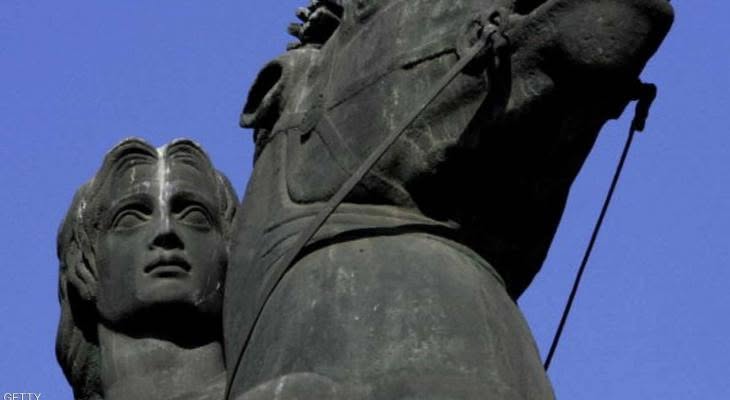
The image is of the statue of Alexander the Great
--------