The real legend of the Ottoman State began with "Muhammad II" - the one they call "Muhammad the Conqueror" - who sat on the throne on 19 February 1451.
And the legend began with a hadith in Musnad Ahmad, on the authority of Abdullah ibn Bishr, from his father, that the Prophet, peace and blessings be upon him, said to him:
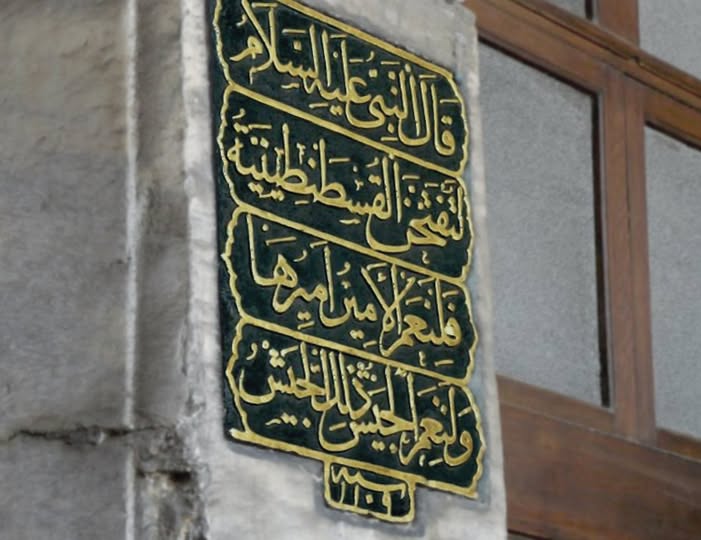
"You shall conquer Constantinople at the hands of a commander at the head of an army. What an excellent commander is its commander, and what an excellent army is that army."
This hadith is inscribed in Turkey today on one of the gates of Hagia Sophia, seen in this image, as referring to Muhammad II, known as Muhammad the Conqueror, who inherited the throne from his father Murad II in 1451 AD.
The first thing Sultan Muhammad the Conqueror - supposedly "the excellent commander" - did after sitting on the throne was order his soldiers to slaughter all his brothers. Then he decided that when their sons grew up they might seek vengeance or claim the throne. "So he poured molten lead into the eyes of those who were older, threw them as helpless, blind prisoners into the terrible prison of the Princes' Islands, and killed those who were young."
Of Muhammad the Conqueror's brothers, one remained, named Ahmed - an infant not yet six months old. He sent one of his commanders, Efranos Zade Ali Bey, to kill him. Efranos Ali found him in the women's quarters, where his nurse was protecting him in a basin of warm water. He took him from her, drove her off, threw him into the basin, held his small, helpless head under the water with his hand for several minutes, and left him to drown in silence.
Turkish historians tried to defend Muhammad the Conqueror against this crime with two answers. The first answer: "Efranos Ali Bey acted on his own initiative, and the sultan punished him later." Historically, this never happened, because Efranos Zade Ali was never punished at all. He died burned in an underground tunnel of boiling oil while leading a group of soldiers, in the war for Constantinople...
The second answer was a justification: that killing this infant may have been done "to preserve the order of the world, at a time when the possibility of the little one's corruption when he grew up existed."
Meaning: "Maybe this baby, when he grows up, will corrupt and rebel against the state, so we just kill him, as long as the possibility of corruption exists."
This filthy justification is mentioned in the book "The Unknown Ottoman State" by the Turkish historians Ahmed Ag Kunduz and Said Ozturk, at the end of page 141.
The important thing is that at last Muhammad the Conqueror sat on his throne at ease, and calmly announced the issuance of a new law called the "Law of Transgression" - that is, "transgression and rebellion against the state".
And the text of the law included: "If the sultanate becomes available to any of my sons, then for the sake of the public interest it is permissible for him to kill his brothers. This is the law of my fathers and forefathers, and it is likewise my law, and most of the scholars have permitted it. So let him act accordingly at once."
I don't know exactly what "transgression" means in an infant not yet six months old, but that was Muhammad the Conqueror. The truth is that the law brought nothing new to the House of Osman, but the Conqueror was the first of them to codify the matter - and to kill a baby still nursing.
At that time the Janissaries had become addicted to alcohol in a frightening way, to the point that wine no longer made them drunk, but had become necessary just to keep them balanced and calm. So the Conqueror decided to continue what Bayezid had been doing and gave them a fixed, regular ration - at the same time as he began expanding the size of the army and striving for something new.
He made his own weapon.
And the weapon of that age was artillery.
In Egypt at that time was Sultan al-Ashraf Abu al-Nasr Qaitbay, who began building his famous fortress in Alexandria - the Qaitbay Citadel - which still stands against time to this day, after laying its foundations on the site of the ancient Lighthouse of Alexandria, which had been destroyed by a massive earthquake in the era of al-Malik al-Nasir Muhammad ibn Qalawun.
Qaitbay knew that strength would provoke the Ottomans and make them think of attacking Egypt, so he began strengthening his army, building the fortress and preparing to defend Egypt.
But Muhammad the Conqueror's gaze was directed at another target: Constantinople, which we know today by its distinctive name.
"Istanbul".
The Conqueror began looking for an expert to help him strengthen his army, and found a Hungarian expert named Urban. Finding no recognition or embrace in Hungary, he left it in anger. Muhammad the Conqueror received him, rewarded him generously, and placed at his disposal whatever material and human resources he wished.
Urban was an artillery expert, so he made cannons for the Ottoman State like the European ones, and made for him the famous giant "sultanic cannon", whose shells later smashed the walls of Constantinople.
Egypt did not carry out this development at the time, because before Muhammad the Conqueror, and in the era of Orhan, something strange happened there.
The Mamluks were the first to introduce the office of "mufti", as we said after the visit of Ibn Taymiyyah. Many grew bold in issuing fatwas and there was chaos of fatwas. So when Sultan al-Zahir Jaqmaq was in Egypt and decided to take an interest in artillery in 1439, the jurists came out with a new issue.
That killing by artillery is a form of killing by fire, and killing by fire is forbidden - none kills by fire but its Creator.
Al-Zahir Jaqmaq was a religious man, so when they told him this, he halted his project for artillery units, referred the whole matter to the religious scholars, and asked them to settle on an opinion.
Their fierce debate went on for a long time.
It went on for more than three quarters of a century - more than 75 years.
But these fatwas did not hold back Muhammad the Conqueror, who pressed ahead with his plan to develop artillery. He began settling his disputes with his enemies and concluding treaties with them, so that no one would attack him while he was pursuing his goal.
The siege of Constantinople could not work without a naval blockade, so he began building new ships capable of carrying the terrible heavy cannons built by the Hungarian engineer. Then he decided to build another fortress, directly opposite the fortress Bayezid had built on the Asian shore of the Bosphorus. Rumeli Fortress was duly built, and he reinforced the two facing fortresses - separated by only 600 metres of Bosphorus water - with his modern cannons, thus ensuring that he controlled the passage of ships at that spot, and that Constantinople would receive no supplies from Trebizond or the nearby cities.
Then he began looking for a pretext for war. He sent his Janissary forces into some Greek villages belonging to Emperor Constantine XI and told them to seize whatever women and money they wished, and whoever seized something could keep it as his own. The Janissaries duly set off ferociously, laying waste to those villages, and of course their inhabitants tried to defend themselves - and killed 500 of his soldiers.
At this he said: "No - how dare you kill my soldiers? You are wicked aggressors!" He mobilised his army and set off towards Constantinople, and stood contemplating its giant, impregnable walls on 6 April 1453 AD.
At first he tried to slip suddenly into the heart of the city and terrify its people, ordering his men to dig tunnels under the walls and infiltrate through them. But the people of Constantinople, while the soldiers were midway through the tunnels, flooded some of them with boiling oil and others with seawater, and the Conqueror's soldiers died burned or drowned. So he sent his envoys to the Byzantine emperor demanding surrender. The emperor put the matter to his advisers: some said surrender, some said fight. In the end Constantine chose the latter view and replied to Muhammad the Conqueror that he would defend his homeland to the death - either he would protect his land and the land of his forefathers, or he would be buried beneath its walls.
The Byzantine emperor tried to enlist Europe's help, and had he succeeded, the Ottoman State would have ended at the walls of Constantinople. But Constantinople followed the Orthodox Church of Alexandria, and the Pope of Europe regarded them as heretical infidels, as we said, so he refused to help him. Only Greece and the Italian cities of Venice and Genoa responded to him.
When Muhammad the Conqueror saw these forces joining Constantinople, he feared that Europe had thrown its weight behind them, so he sent another probing message to the emperor: that he thanked God that the emperor had inclined to peace and handed him the city, and that he would keep him as its governor, subject to him and accepting the tribute. The emperor replied with the same message: he would protect his land, or they would bury him in it.
Here Muhammad the Conqueror replied with a special pledge: that he would not attack the city until the month of May had passed, out of respect for the "May festival" of Constantinople - the feast marking the Constantine family's accession to the throne, which lasted a full month, with prayers held, people celebrating and church bells ringing. He also pledged not to fight any woman, old person, child or civilian, and to make peace with anyone who laid down his arms and inclined to peace.
One day after this message, at one o'clock after midnight on 29 May 1453, "the excellent commander", brother Muhammad the Conqueror, broke his pledge and violated his promise, bombarding Constantinople with artillery by sea and land. Then he sent more than 150,000 soldiers through the gates and up the walls. Emperor Constantine attacked them with his forces and fought them, but he was defeated. He kept his promise and died defending his land, beneath the walls of Constantinople.
And history pauses at this moment to record a turning point in the history of the world: the fall of the city of Constantinople. It also records for us how Muhammad the Conqueror broke his pledge a second time, ordering his soldiers to do whatever they wished in the city and to seize whatever women, money and treasures they fancied, for three whole days. The historian Asad Rustum said in his book "The Byzantines in Their Politics, Civilisation and Relations with the Arabs":
"The city was laid open to plunder and the honour of its women was violated for three nights. Then Sultan Muhammad entered it and went straight to the Church of Hagia Sophia; its monks opened the doors for him and asked for safety, and he killed them. He prayed at its altar and declared it a mosque, then settled in the palace of the Byzantine emperor. The Ottomans slaughtered 40,000 and drove 60,000 to the slave markets."
Once matters had settled for him, the Conqueror ordered his soldiers to round up concubines and collect the tribute. They set off through the city again, turning it upside down, destroying and looting. Then Grand Vizier Khalil Jandarli Pasha intervened, asking to be left to handle this matter. He began calming the people of the city, reassuring them and treating them kindly, and he paid the tribute from his own money on behalf of several families who had none.
Here Muhammad the Conqueror noticed that Khalil Jandarli Pasha's popularity was beginning to grow, and that he had begun to enjoy good relations with the city's people and notables. So he suddenly declared that Khalil Pasha was a traitor, and that he had taken a bribe from the dead emperor Constantine XI during the siege to reveal Ottoman movements. Accordingly, Muhammad the Conqueror arrested Khalil, they poured molten lead into his eyes, and he was then imprisoned for forty days before being executed. After that he executed Khalil Pasha's entire family, so that no one would think of taking revenge or turning against him.
Imagine them knocking on your door and taking you away to be executed on the charge of being "Khalil's cousin"...! A comic nightmare - but that is what happened.
Afterwards the Conqueror rebuilt the walls that had been destroyed, declared Constantinople the capital of the Ottoman State, and named it "Islambol" - meaning "cradle of Islam" or "house of Islam". The name was later corrupted into "Istanbul". And as you walk on the soil of Istanbul, you are in fact walking on the soil and the skulls of thousands of innocent people of the city who were violated by Muhammad the Conqueror merely so that he could satisfy and secure the loyalty of his troops.
Excuse me, but how can this man, a killer of children and a violator of women, be "the excellent commander" of a prophetic tidings? And how can an army addicted to alcohol and violating all sanctities be "the excellent army"?
But the scholars of hadith have two opinions that may interest you greatly.
The first opinion is that the hadith is weak, as stated by many scholars, among them Shuaib ibn Muharram al-Arnauti and Sheikh al-Albani.
The second opinion holds that the hadith is entirely authentic, but that Muhammad the Conqueror is not the one meant at all. They based this on several other authentic hadiths.
This is because the noble Prophet, peace and blessings be upon him, stated that Constantinople would not be conquered by the Turks in the first place.
It would be conquered by the Arabs - specifically the Arabs of the Peninsula.
This hadith is authentic - the hadith of Amr ibn Awf, may God be pleased with him:
"Then the elite of the Muslims, the people of the Hijaz, whom no blame in the cause of God deters, will march out against them, until God grants them the conquest of Constantinople and Rome by glorification and takbir."
And Muhammad the Conqueror was not an Arab of the Hijaz; he was a non-Arab Turkmen.
And in Sahih Muslim: "An army will march out against them from Medina, from the best of the people of the earth on that day."
Meaning the army is Arab, from Medina - not Ottoman Turkish.
And in the hadith of Abdullah ibn Amr, may God be pleased with them both: "The soldiers will reinforce one another until the people of Aden reinforce them."
And worse than that for the brothers who love the Ottomans: the commander in question will be a Hashemite Qurayshi, not an ordinary commander, according to the hadith of Abu Hurayrah narrated by al-Khatib in "Al-Muttafiq wa al-Muftariq", saying:
"The commander of the army at that time will be from the family of the Prophet, peace and blessings be upon him."
And the noble Companions have an opinion that may interest you even more.
The conquest of Constantinople in question will take place before the great battle at the end of time.
According to the hadith of Dhu Mukhammar, may God be pleased with him: "The Byzantines will say to their leader: 'We have spared you the edge of the Arabs,' then they will betray and gather for the great battle" - meaning the great battle between the Arabs and the Byzantines at the end of time, at the emergence of the Antichrist.
Then will come the true "conquest of Constantinople", and it is the commander of that army of the end of time - he and his army - who is meant.
A shock, of course, for the lovers of the Ottoman State, who spent decades circulating the lie that "the excellent commander" is the killer of infants and breaker of pledges, the violator of women's honour, "Muhammad II" - whom they called "Muhammad the Conqueror".
In any case, the conquest of Constantinople was not the end of the road, because after it a new, terrifying nightmare appeared to Muhammad the Conqueror, one that would turn his days into a continuous, horrifying tragedy.
And that nightmare we know by the name "Dracula".
Count "Dracula", ruler of Wallachia, who was no "vampire" at all and was a Romanian hero, but the cinema insisted on portraying him as a blood-sucking monster.
This man's story is extraordinarily fascinating, but today time has run away with us and the talk has grown long, so we will continue our story later.
And the talk will have a remainder.
--------
Previous posts in the first comment
--------
#Ottoman_Caliphate 16