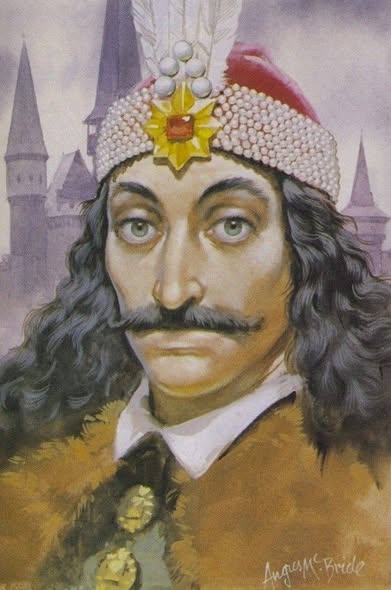
The nightmare of Muhammad the Conqueror and the Ottoman State in Europe was a man named "Vlad III Dracul" - son of "Vlad II Dracul" and grandson of "Mircea the Elder", founder of the Romanian state and ruler of "Wallachia".
Some people call it "Wallashia", and that is an incorrect name; it is called "Wallikia" or "Wallakia".
This family is very large, with branches in Romania, Bulgaria and Hungary.
With the death of Mircea in 1418, Vlad II could not claim the throne because he was an illegitimate son of Mircea. So it was Vlad's brother who leapt to rule Wallachia, "Alexander I Aldea", and he submitted to the Ottoman Empire, paid it tribute and became its vassal.
With the death of Alexander, Vlad II sat on the throne and continued his submission to the Ottoman State, sending his young son as a hostage with the Ottoman emperor to prove his loyalty and guarantee he would not betray him.
And that son is the hero of our story: "Vlad of Wallachia".
If you want to picture Vlad, he looked like Amir Karara when he played "Selim al-Ansari", with that same moustache. If you haven't seen "Selim al-Ansari", do a search for it on Google.
Vlad was raised as a hostage with the Ottoman emperor in Edirne; in fact he was raised alongside Muhammad the Conqueror. They were children together, and the Conqueror in his childhood was an annoying, arrogant bully, so Vlad grew up hating him as a result.
Deprived of his family the whole time, deprived of his father's kingdom and of a normal childhood, Vlad lived alone in a country where he knew no one. But he had a great passion for learning, so from an early age he threw himself in among the Ottoman soldiers and learned from them. He learned their language and their military systems, learned horsemanship and combat, and memorised the Quran despite being a Christian belonging to the Orthodox Church of Alexandria. He developed himself at an astonishing speed, which did not please the Ottoman emperor, so he threw him in among a group of hunters to work in a lowly trade and learn submission. From those hunters he learned hunting, marksmanship and trap-making.
After his father's death, after troubles and struggles over the throne of Wallachia, and three years after the conquest of Constantinople, Vlad sat on the throne of Wallachia on 22 August 1456. He found it torn apart and collapsed because of conflicts and wars, so he began to rebuild it and raise it up again, and he stopped paying tribute to the Ottoman sultan. His only goal was for Wallachia to become free and independent again, as it had been before the Ottomans.
In 1460, Muhammad the Conqueror sent him soldiers demanding the tribute that had been outstanding for four years, along with the application of the "law of the fifth" - a proportion of the male children born each year, to join the Janissaries. Vlad asked them to tell the sultan to give him until the following year, and that he would surprise him with something that would impress him.
A year later, in November 1461, the Ottoman soldiers came back demanding the tribute from Vlad. But he had by then grown strong, formed a reasonable army and made an alliance with Hungary. So he ordered the Ottoman soldiers' fezzes nailed to their heads with iron nails, and sent word to Muhammad the Conqueror that "there is no more pandering, my dear - there is no tribute". The sons of Wallachia would not be raised as slaves of the Ottoman sultan.
When the bodies of the Ottoman soldiers reached Muhammad the Conqueror, he asked Vlad to negotiate at Giurgiu with his envoy "Hamza Pasha". This was a trick, because Muhammad the Conqueror had ordered Hamza to fall upon Vlad, capture him and bring him to Constantinople in a cage.
Hamza Pasha set off with five thousand horsemen to Giurgiu to meet Vlad. But Vlad, who had been raised alongside Muhammad the Conqueror, knew him very well, so he waited for Hamza Pasha in a mountain pass area north of Giurgiu, before the meeting place, fell upon him with a force of the army, captured them all and ordered them executed in a unique way.
The impalement stakes.
Vlad seated the Ottomans on sharpened wooden stakes, which began to pierce slowly through their rears under their weight and tear their intestines, until the tip of the sharpened stake finally emerged from the shoulder, the neck or the mouth.
At the nearby fortress of Giurgiu, where the Ottoman forces had camped awaiting Hamza Pasha, the Ottoman soldiers were surprised by a commander on horseback before the fortress ordering them to open the gates, and they recognised in him the distinctive uniform of Ottoman commanders.
That commander was Vlad of Wallachia, disguised in the uniform of one of the commanders captured with Hamza Pasha, exploiting his fluency in Ottoman Turkish to deceive the fortress soldiers. They did open the fortress gates, and the commander entered, and behind him five thousand Wallachian soldiers suddenly fell upon them.
Vlad destroyed the Ottoman fortress completely, killing every soldier in it down to the last man. Then he fell upon the surrounding villages, which were occupied by the Janissaries, killed more than 25,000 of their soldiers and razed them to the ground. Then he declared general mobilisation in the country, and most people joined him - even women, the sick and the elderly asked to join the army.
Muhammad the Conqueror was at that time besieging Corinth in Greece, and he was driven mad with rage. He sent Grand Vizier "Mahmud Pasha" at the head of 30,000 soldiers to destroy "Braila", Wallachia's coastal port.
Mahmud Pasha set off to carry out the mission - and did not return.
Of those 30,000 soldiers, only 6,000 came back alive, to inform the Ottoman sultan that Vlad had won again. Worse still, Vlad afterwards attacked the Turkish camps in all the surrounding areas, which held about 18,000 soldiers. Only nine soldiers returned from them to Muhammad the Conqueror.
Here Muhammad the Conqueror lifted the siege of Corinth and sent word throughout the Ottoman Sultanate, calling for holy war against the Romanian devil, "Vlad Dracul".
On 26 April 1462 AD, 250,000 Ottoman soldiers moved, with the terrible artillery, towards Wallachia, whose entire army numbered 30,000 soldiers.
The Conqueror's artillery was extremely heavy, drawn by oxen and needing paved roads to travel on. He sent his spies to watch the route, and they found no trace of Vlad and his soldiers, but they found that Vlad had filled the roads with grass and tree fibres that would wrap around the artillery wheels and hinder their advance. So he sent after them 10,000 soldiers to clear the way for the cavalry and artillery before Wallachia, until they could catch up with them.
But those soldiers never came back...
The truth is that beneath the grass filling the road, Vlad had made thousands of traps: sharp metal clamps like bear traps that snapped shut on the soldiers' feet and severed them; deep pits filled with sharp pointed stakes; and ropes that closed a noose around the legs and hung the soldiers upside down from tree trunks.
Muhammad the Conqueror arrived and found his soldiers dead or maimed, or hanging from the tree trunks.
Muhammad the Conqueror was forced to go around this road, and had two other routes before him. He tried to cross by the first, but Vlad had diverted the course of a small river and turned that land into dense, sticky mud swamps, with mud reaching up to a soldier's knee, so that he moved through it with extreme difficulty. This meant the artillery would not pass this way until the dry season came next year, God willing, and the ground dried out.
Here the Conqueror decided to turn back and take the other route by the city of Vidin. But he was surprised by Wallachian arrows raining down on him and his men like rain, and he was forced to withdraw, almost bursting with rage.
A few days later, the Janissary forces stormed south-western Romania, specifically the city of "Turnu Severin". They were surprised to find a very weak Wallachian garrison there, which shot a few arrows at them, killed 500 of their soldiers and fled. The Janissaries stormed the city, and Muhammad the Conqueror entered it victorious. He was amazed that the city was empty and desolate - not even a stray cat in it - but with the feeling of pride filling him, he paid this no attention, and ordered his soldiers to camp and rest.
The soldiers camped and rested, and brought drinking water from the lake. It was not long before the first Ottoman soldier doubled over, vomited violently and met his death on the spot.
Then other soldiers followed, and others: thousands of soldiers clutching their stomachs, doubling over, vomiting and dying.
The Conqueror was stunned to find his camp drowning in vomit and corpses, and he suddenly realised the terrifying truth.
"Vlad of Wallachia" had prepared a tight ambush for him: he had evacuated the city's people, its animals and its herds, and lured him into it after poisoning its drinking water.
Muhammad the Conqueror shouted at his soldiers that no one should drink, and began to think of retreating. But it was too late: a small dam of wood and clay collapsed behind them, and with its collapse the waters of another small river - whose course Vlad had diverted - poured through, flooding the land completely and sweeping away much of the supplies and many soldiers in their path.
Another trap, a black night, and no escape but to advance. They could not camp here.
Muhammad the Conqueror advanced through southern Romania, advancing for seven days without food or water along with his soldiers, until at last they reached the outskirts of the city. And there they found a cluster of houses containing nothing but Romanian and Gypsy women tending some poultry and herds. He seized them and ordered them to drink from the small river there. When they drank and none of them vomited or died, he and his soldiers fell upon the water and drank, slaughtered the herds, ate and finally rested.
After the rest came the turn of pleasure. They brought the women they had seized, and intimate parties began among the soldiers. The Romanian and Gypsy women welcomed the matter greatly, moving from tent to tent with great energy for some unexplained reason. This merrymaking went on for several days, and they tried to get close to the Conqueror, but his mood was unbearably foul - because he had discovered that he had lost about 50,000 soldiers without a fight, without even meeting Vlad's forces! So he decided to use these days to regroup, and to let the soldiers enjoy themselves so they would not mutiny against him.
A few days later he decided to continue the advance, but he was surprised by another calamity...
Fever, shivering, vomiting and severe diarrhoea among his soldiers, general weakness, bleeding and blood that would not clot.
For a moment Muhammad the Conqueror did not understand what was happening, and thought the soldiers had been poisoned again.
Then the truth suddenly dawned on him when he found that the women they had found were suffering the same symptoms.
The plague.
Those infected with the plague bacterium were among the women who had joined the army when Vlad declared general mobilisation. These were the very women: they had gone to Vlad and volunteered for this task, and Vlad knew well that the Ottoman soldiers would not be able to restrain themselves before them. So they passed the plague infection on to the Conqueror's soldiers.
The plague spread through the Ottoman camp like fire in straw. In his fury, the Conqueror ordered the fleet moved and the two coastal cities of Braila and Chilia destroyed. But black news reached him: Vlad had taken advantage of his entanglement in mud, traps, poisoned water, plague, vomit and eternal exhaustion, and had destroyed every nearby Ottoman port and razed them to the ground.
The Conqueror moved quickly, leaving most of the sick soldiers behind him, and at last reached the south of the Wallachian capital after losing 100,000 soldiers. He camped there that very day, 16 June 1462.
During the night camp, a group of Ottoman soldiers sat outside their tent, lit a fire and began chatting. But they were surprised by an Ottoman commander shouting at them sternly that, according to Ottoman military regulations, it was absolutely forbidden for any soldier to be outside his tent at night. This was true, and he ordered them to accompany him so he could tour the camp and make sure order was kept. They did go with him, he toured the camp, made sure the sultan's tent was secured, then ordered them back to the tent and turned back.
That commander was once again "Vlad of Wallachia" himself, disguised a second time in an Ottoman commander's uniform and exploiting his complete knowledge of the Ottoman language and military regulations. During this adventure he managed to pinpoint Muhammad the Conqueror's tent, studied its guard, and returned to his soldiers.
Hours later, shortly before dawn on 17 June, Vlad fell upon the camp at the head of 7,000 soldiers in the darkness. They released the Ottoman horses and camels and drove them fleeing far away, set fire to the tents and killed the soldiers. Vlad set off towards Muhammad the Conqueror's tent, intending to turn him into dough. But amid the chaos, Muhammad the Conqueror had already fled the tent, and Vlad found nothing in it but Grand Vizier "Ishaq Pasha".
The soldiers woke to fire, sword blows and gunfire. The Janissaries led a counterattack, and Vlad withdrew with his forces after killing 15,000 Ottomans and losing 4,000 soldiers.
In the morning Muhammad the Conqueror appeared and ordered his soldiers to advance on the city of "Targoviste" and besiege it. He did reach there, but found the city's gates wide open, so he entered with his soldiers cautiously and advanced through it for about an hour, until strange, incomprehensible shapes appeared to him on the horizon. He approached them after another half-hour's march.
An empty, silent city, where you could almost hear silence itself, and the rustle of the wind pushing a few dry leaves between his feet and the feet of his soldiers as they passed among the shapes they had seen from afar.
The impalement stakes.
Thousands of long wooden spears driven into the ground, with more than 30,000 Ottoman soldiers and officers impaled on them, insects crawling over their corpses, the sharpened wooden tips protruding from their mouths. Muhammad the Conqueror saw the body of "Hamza Pasha" on the longest wooden stake, as he was the highest in rank. The corpse was putrid and completely decomposed; the Conqueror recognised it only by its military uniform.
A forest of stakes, preserved for us by history under the name "forest of the impaled". And Vlad entered history with a new title.
The title "Vlad the Impaler".
Muhammad the Conqueror trembled and his soldiers' limbs shook at the horrifying scene, each of them imagining himself meeting the same terrible fate. The Conqueror realised that he might end up on a wooden stake longer than Hamza Pasha's. So he ordered his soldiers to retreat slowly, to spend the night outside this city, and he set up camp outside the city and dug a large trench around it, so that Vlad would not attack him again, capture him and impale him. The night passed over him, black as the conscience of a neighbourhood official. In the early morning of 22 June he ordered his soldiers to strike camp and withdraw completely to Constantinople...
With the Conqueror's withdrawal and return, he brought Vlad's brother from Bulgaria - his name was "Radu" - promising him rule over Wallachia if he defeated his brother. Radu led Ottoman forces against Vlad very many times, winning and losing very many times. In the end he besieged Vlad's castle and stormed it, and Vlad's own wife threw herself from the castle walls, preferring death to becoming a concubine of Muhammad the Conqueror. Despite what happened, Vlad managed to escape being killed and disappeared.
Vlad continued his war with the Ottomans under Radu's command, but in the end, with all these wars, Vlad went broke and could no longer fund his soldiers, so he went to the King of Hungary to ask him for financial support.
The Pope in Europe took great interest in what Vlad was doing, even though he was Orthodox, especially since Vlad's moves had made the Conqueror lift the siege of Corinth, and he was now terrified and withdrawn into himself. So he contacted the King of Hungary and asked him to provide support to Vlad.
But the King of Hungary received a fixed income from the Pope which he spent on his pleasures. He had no intention of fighting at all, and no intention of splitting that money with Vlad - he wanted it all for himself. So he arrested Vlad and imprisoned him.
The Pope noticed that Vlad had disappeared, and that Radu had occupied Wallachia and become a vassal of Muhammad the Conqueror. So he investigated the matter, discovered what had happened and grew furious. He ordered the King of Hungary to release Vlad so he could return to his throne and hold the Ottomans back. Three months later, Hungary released Vlad, and the Hungarian monarch apologised to him in fury.
After many skirmishes and battles, Radu died and Vlad returned to the throne of Wallachia on 26 November 1476.
The Ottoman forces were at that time advancing on Hungary, so Vlad headed for them and engaged them in fierce battles near Bucharest. Because of a Hungarian betrayal, Vlad was defeated, his forces withdrew, and he disappeared.
Days later, Muhammad the Conqueror paraded through Constantinople a wooden stake bearing a disfigured, unrecognisable human head, saying it was the head of "Vlad of Wallachia".
The Ottomans sighed in relief and believed their nightmare was over. But a month after this incident, an Ottoman garrison near Bucharest was captured and all of it died, executed on the stakes.
The legend of Vlad began to circulate again: where is he? Is he alive or dead? People began to doubt Sultan the Conqueror, so he ordered the arrest of anyone who even mentioned Vlad, and issued a proclamation that his men had killed Vlad, cut off his head and brought it to Constantinople, and buried his body in the monastery of the island of Snagov...
But in 1855, the Romanian archaeologist "Alexandru Odobescu" went and dug up Vlad's supposed grave, and found nothing but horse bones - and no human remains at all.
Some whispered that Vlad remained alive, secretly resisting the Ottomans and impaling them, until he died a natural death at an unknown time.
Vlad became a legend and a popular national hero in Romania, Bulgaria and Hungary, still alive to this day. And in October 2011, the English Prince "Charles" claimed descent from "Vlad Dracul" of Wallachia...
In 1477 a delegation from the Umayyad caliphate in Andalusia went to Muhammad the Conqueror asking for his support so that Andalusia would not fall. But he drove them away and paid the matter no attention. In his last days he had been struck by advanced paranoia, imagining that everyone around him would hand him over to Vlad to be impaled - even though he had said he killed him - and he began waking up screaming from nightmares.
Here his son "Bayezid II" decided to relieve his father of this whole Vlad business entirely. He bribed his private physician "Yaqub Pasha", who slipped poison to Muhammad the Conqueror so that he met his end on 3 May 1481 AD, and Bayezid II ascended the throne in his place.
The story of Bayezid II and his struggles, and those of his successors, would take long, so we will continue talking about it later.
And the talk will have a remainder.
---------
Previous posts in the first comment.
The image shows "Vlad III", Prince of Wallachia.
---------
#Ottoman_Caliphate 17