Before the death of Bayezid, grandson of Osman, founder of the Ottoman State, at the hands of Tamerlane, Egypt was struck by a great calamity. Yet the Ottomans still feared it. That calamity was the plague.
The terrible epidemic swept through the protected city, creeping through its alleys and streets, sparing neither old man, elder nor child. Al-Maqrizi says that in a single day 700 funerals left Alexandria alone, and in Cairo a thousand funerals left in a single day. Then the number of victims increased. Ibn Iyas said that "more than 20,000 funerals left Cairo every day, and the number of those who died between the months of Sha'ban and Ramadan reached about 900,000."
Corpses lay scattered in the roads. Food grew scarce because there were no longer enough people to farm. And: "Because of the multitude of the dead, coffins disappeared, so the dead were carried on baskets and wooden planks, the cemeteries filled up, and there was not a sufficient number of peasants for the harvest season. So the state set about providing some soldiers to carry out the harvest, and the state announced that whoever took part in the harvest would have half of what he reaped."
The number of the Bahri Mamluks dropped from 200,000 to only 10,000 soldiers. The number of craftsmen fell, and weapons and equipment grew scarce.
Yet that state was still strong enough for the Ottomans to fear it.
With the death of Bayezid, he left behind his sons Muhammad, Suleiman, Isa and Musa. Each of them went to a city, declared himself sultan, and had a group of soldiers swear allegiance to him. Suleiman was the first to go to Edirne and declare himself ruler and sultan of the Ottoman State. So Tamerlane sent word for him to come and offer submission and allegiance. Suleiman did indeed go to his father's killer laden with gifts, knelt before him and offered him loyalty and obedience. Timur confirmed him as ruler of Edirne and of the Ottoman principalities on the European side.
Suleiman also sent a caravan of gifts to the Serbian tsar, and the tsar recognised his sovereignty. Thus Suleiman felt that matters had settled in his favour, and he became the Ottoman sultan after his father Bayezid.
Isa had gone to Bursa and declared himself sultan, so his brother Muhammad attacked him and nearly killed him, but he fled to Izmir. Suleiman was waiting for them to cut each other down so he could step in and kill them both. But when Muhammad won, Suleiman gathered his army and marched from the European side across Anatolia. So Muhammad allied with their brother Musa, and they agreed to kill Suleiman.
At this point Tamerlane sent a harsh letter to Muhammad ibn Bayezid, blaming him for fighting Suleiman, who was his vassal. Muhammad apologised to him, sent him caravans of gifts, and went to offer him loyalty and obedience. So Timur was pleased with him, did not attack him, and did not interfere in these little family disputes - until Tamerlane himself died in 1405.
Suleiman's war with his brothers dragged on for nearly seven years, and he began to doubt victory. So in order to defeat his brothers, he married a Byzantine princess, drew close to the Byzantine emperor, and offered him his daughter and his sister as concubines!
With those two gifts, the emperor promised to support him in the coming battle with equipment and men. But at the time of the battle he betrayed him and sent nothing. So Suleiman's forces clashed with the army of Musa and Muhammad at Edirne in 1413 AD, and Musa captured his brother Suleiman and killed him.
I don't know, folks - is there some family trouble or what? After killing Suleiman, Musa went and besieged Constantinople, to conquer it and make use of its wealth and soldiers. So the emperor of Constantinople enlisted Musa's brother Muhammad against him. He did attack him and defeated him, and Musa fled to Sofia in Bulgaria. Muhammad pursued him there and killed him.
Amid these charming family adventures, Sultan Faraj ibn Barquq had died in Egypt. With his death the state of al-Zahir Barquq came to an end, and after him the Abbasid caliph al-Musta'in Billah al-Abbas took over. This was an honorary post, introduced by al-Zahir Baybars - the post of the Abbasid caliph in Cairo. But at that point they found no one else, so he ruled as sultan for about six months, and he too died, just like Faraj ibn Barquq, of the plague.
As soon as matters settled for Muhammad, on the throne of Egypt sat a Circassian Mamluk sultan named al-Mu'ayyad Abu al-Nasr Sheikh al-Mahmudi. He sent Muhammad a letter recognising him as ruler of the Ottoman State, and at that point Muhammad became the sole, official ruler of the Ottoman State.
Muhammad's reign was not pleasant, because he spent a long time putting down unrest and revolts against him. In truth, the people of Anatolia could not stand the House of Osman. On top of that, his alcoholic father Bayezid used to hand out fixed liquor rations to the Janissaries until they became addicts, robbing people and bullying them to get the price of drink. So Muhammad and his men set out to crush these revolts. The historian Yilmaz Oztuna said in The Political, Military and Civilisational History of the Ottoman Empire, Volume One, p. 118:
"They attacked people and property, and killed thousands."
Then a strange problem suddenly appeared for Muhammad.
We remember that at the Battle of Ankara, where Tamerlane captured Bayezid I, there was a brother of theirs named Mustafa who disappeared, and no one knew where he went. This Mustafa suddenly appeared before Muhammad in 1419, after an absence of more than 15 years.
And he demanded the throne!
He had fled at the time of the battle and hidden in Greece. Now he was back and wanted the throne, being the eldest and the most entitled to it after Bayezid's death. So Muhammad pulled a very neat trick: he denied that this was his brother at all, and said he was an evil sorcerer disguised in his form!
He drove him off and called him "Mustafa the Impostor". So brother Mustafa turned to a number of princes, who recognised him and acknowledged him, and he raised an army to fight his brother Muhammad and kill him.
The two brothers' armies met at Thessaloniki, and Muhammad won. So Mustafa went to take refuge with the Byzantine emperor, and when Muhammad demanded his handover, the emperor refused. But Muhammad paid well, and they reached an agreement that Mustafa would remain a prisoner of the Byzantine emperor and would not be released as long as Muhammad was alive.
After that Muhammad grew afraid of Orhan, son of Mustafa - in case he thought of freeing his father or claiming the throne or something. So Muhammad arrested him and ordered molten lead poured into his eyes, then sent him as a helpless, blind prisoner to Bursa.
And so the problem of the brothers came to an end - a matter that Murad II, Muhammad's son, had been watching in silence and eagerness. Afterwards he quietly slipped poison to his father and agreed with the Grand Vizier Amasyali Pasha to conceal news of his death and claim he was ill, until matters settled in his favour.
And so it happened. Murad II sat on the throne in May 1421 AD, and he kept his father's death hidden for 45 days.
After that, Murad's young brother "Mustafa the Younger" tried to depose him and take his place, and they fought as well, until Murad won, captured Mustafa the Younger and executed him in late February 1423.
When news of Muhammad's death became known, the Byzantine emperor - in accordance with the agreement - released Mustafa the Elder, Murad's uncle, from captivity. Mustafa the Elder went to fight his nephew, but Murad II killed his uncle and crucified him on the fortress tower in 1426, after wars that lasted five years.
This Ottoman caliphate is so very affectionate and gentle!
Murad fought a great deal, bought weapons from Europe in enormous quantities, attacked Hungary and Bulgaria and expanded more and more. In the early days of 1451 AD he was struck by a mysterious illness and a severe fever, and he died.
But before his death, Murad had paved the way for his successor, handing him a largely cohesive state, a strong army and advanced European weapons.
And the one who came after him is the favourite figure of the Ottomans and Turks to this very day - the one they call "the man of the prophecy", saying that the Prophet of Islam, peace and blessings be upon him, foretold him.
Muhammad ibn Murad II.
Or "Muhammad the Conqueror"...
And as for this fellow Muhammad the Conqueror, the talk of his story and the prophecy they try to tailor to his measure would take long.
So the talk will have a remainder.
-----------
- Previous posts in the first comment.
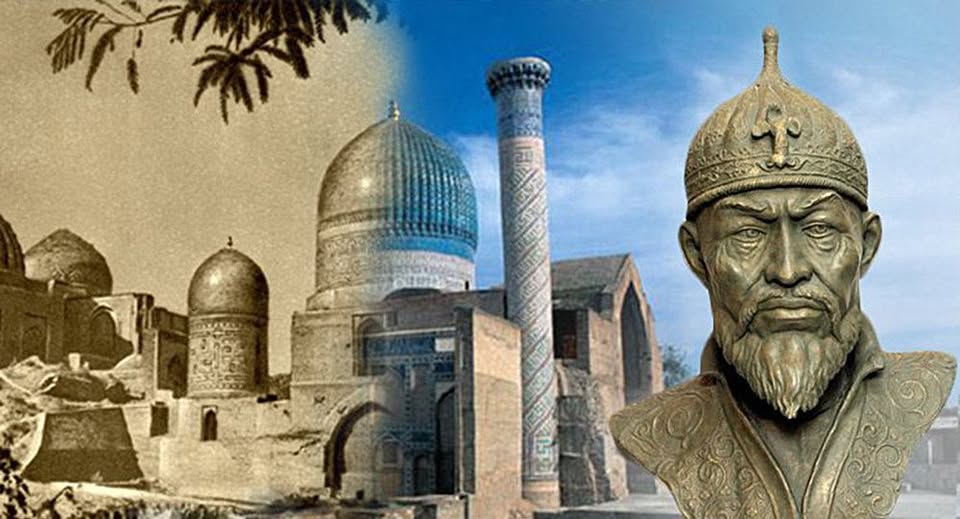
- The image shows the statue of Tamerlane and his tomb.
----------
#Ottoman_Caliphate 15