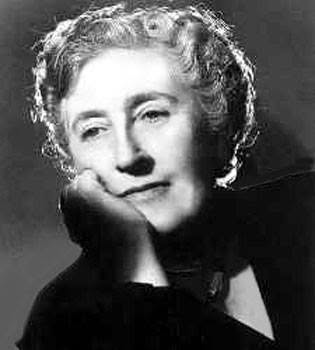
A very reserved lady, calm in temperament, who loved to sit at home in her favourite chair and read with a cup of tea, and she was fascinated by the “Sherlock Holmes” stories of Sir “Arthur Conan Doyle”.. when she was young she was from the middle class, and her father was in poor health, and he suffered a series of heart attacks that ended with his death..
The father's death left the family's financial situation shaky.. and this meant “Agatha Christie” had no means of entertainment or luxury like the rest of the boys and girls of her class, so she spent her time reading a great deal.. “Agatha” later notes in one of her interviews that her childhood ended with her father's death, when she was 11 years old...
She grows up and works and life carries her along.. until the age of 26..
And on one summer day in 1916; in the middle of World War I.. she sits down at her typewriter and decides to write a story of her own whose hero is a detective like “Sherlock Holmes”.. but at the same time different from him.. so she writes a story called “The Mysterious Affair at Styles”...
And at that moment the Belgian detective “Hercule Poirot” comes into being...
“Poirot” is very different from Holmes.. in everything.. while Holmes is trim and athletic and a hero as heroes of stories ought to be.. “Poirot” was short in stature.. with no physical fitness.. a little plump.. “Holmes” could throw the Scottish plaid shawl over his shoulder on top of any clothes and move when necessary.. while “Poirot” might leave the crime scene and go into the bathroom and stand in front of the mirror combing his moustache.. admiring himself to a strange degree.. to the point that he once described his moustache as having “no equal in beauty in the world”...!!
“Holmes” was somewhat chaotic.. and this gave him a human touch.. while “Poirot” was madly fond of order and system to a pathological degree.. and while “Holmes”, if you provoked him, might get agitated and invite you to a duel.. “Poirot” was cool-nerved and always smiling a cloying smile.. no one could easily provoke him.. while he could provoke anyone...
“Holmes” relies on extraordinary intelligence and an unusual power of observation along with his logical method that we spoke about, and “Poirot” relies on his experience as a former policeman, and his knowledge of “toxicology”.. and of the shapes of wounds, their types and their causes. The reason “Poirot” possesses this ability is that “Agatha Christie” worked for a period as a nurse and a pharmacist's assistant in a hospital during the war...
While Sir “Doyle” admitted that “Holmes”, in most of his character, imitates Dr “Joseph Bell” in the real world, Madame “Agatha” was extremely reserved about her personal life, and therefore the character of “Poirot” contains nothing of her or of anyone she knew..
“Agatha” did not deny being influenced by the world of “Holmes”, and she admitted that “Doyle” was her master, while “Doyle” used to read her and enjoy what she wrote.. to the point that in a particular incident in her life, which was the beginning of the door through which people entered her personal life.. the incident of her disappearance.. “Doyle” left all his work and began searching for “Agatha Christie”, who had disappeared mysteriously without leaving a trace...
So on a cold night in December 1926, and at the peak of her success after her stories began to spread.. the businessman “Archie Christie” told his wife “Agatha” straight out that he no longer loved her and that he had become attached to another woman.. a row broke out between the couple and he left the house and went to his mistress.. “Agatha” also left the house and left a letter saying she was going to Yorkshire.. but she never reached Yorkshire that night.. they found her car stuck in a limestone quarry at “Newlands Corner”.. with an expired driving licence in it.. with no trace of her...
The state took the incident very seriously.. and the Home Secretary “William Joynson-Hicks” mobilised police forces to search for her and put up a reward from his own pocket of 100 pounds sterling for whoever led to her.. and this is a sum equivalent to 20,000 pounds sterling today..
Search teams made up of 15,000 policemen, informers and volunteers moved.. until they found her after 11 days in a beauty salon.. no one knows why she disappeared and what happened.. but the doctors who examined her announced that she had suffered partial memory loss as a result of the shock of her mother's death and then her husband's betrayal in the same year...
“Doyle” at that time was recruiting people with his own money and searching for her through them and himself.. to the point that he took one of her gloves and went with it to a spiritual medium, so that he could guide him to her location...
“Agatha Christie's” disappearance inspired “Dorothy L. Sayers” in her story “Unnatural Death” and inspired the writer “Philip Prowse” in his famous story “The Woman who Disappeared”...
“Agatha” chose Poirot to be “Belgian” by nationality, to support Belgium morally in its war against the Germans.. the English in general were extremely sympathetic to the Belgians in this period, and let us not forget that the fall of Belgium was the “main reason - casus belli” for England to enter the war...
Like “Holmes”.. “Poirot” has a companion named “Arthur Hastings”.. and he is the equivalent of “Watson” with “Holmes”.. and he performs the same role.. and he shows “Poirot” that the criminal wants “ordinary people” to think in any direction, and therefore he rules him out...
“Poirot”, in his days as a policeman, was very brilliant.. to the point that he once foiled an operation to kidnap the British Prime Minister himself by the Germans in the story “The Kidnapped Prime Minister”..
Unlike “Holmes” too.. “Poirot” was somewhat “international” in his stories.. he travelled most parts of the world and solved crimes everywhere.. and in “Murder on the Orient Express”.. he goes from Istanbul to London to Yugoslavia to solve the mystery of a crime whose first threads began in the United States..
He solved the mystery of crimes in Iraq in “Murder in Mesopotamia” and came to us in Egypt in “Death on The Nile”.. and he solved the mystery of a crime in a pharaonic tomb in a story commercially translated as “The Adventure of the Egyptian Tomb” ..
He travelled almost most countries of the world.. and among “Poirot's” traits is that he was not a hater of women like “Holmes”.. on the contrary.. he was an ogler.. and once he fell in love with the Russian countess “Vera Rossakoff”.. whom the Bolshevik revolution had hurled from her wealthy aristocratic class to the depths of poverty.. so she turned into a charming jewel thief...
“Vera” had a great deal of “Poirot's” personality in her.. she had the ability to fabricate stories and events with astonishing speed and without gaps, in order to deceive her enemies.. and the two of them, you cannot tell where they stand on the social ladder.. they deal and behave like the rich.. while they are neither rich nor poor, nor can you call them “middle class”.. “Poirot” loves “Vera” madly.. and in the story “The Big Four” he helps her to escape and flee from justice....
“Poirot” very often executed justice with his own hand as he saw it.. and in the short story collection “The Golden-Haired Woman” he stands on the side of a defendant in a blackmail case and covers up her crime against his client and helps her to escape.. and gives her money she can start with somewhere else..
Likewise in the story “The Murder of Roger Ackroyd”.. “Poirot” helps the killer escape justice by having him commit suicide and the secret of his crime be buried with him.. because the killer was the respected family doctor whom time had wronged and driven to crime.. and he did not want his sister to know that her brother was a criminal and see him behind bars...
The story “The Murder of Roger Ackroyd” is one of the few stories not narrated by “Hastings”.. the one who told it is the killer himself.. and he confessed to “Poirot”, who helped him to commit suicide...
As for the story “The Augean Stables”.. Poirot covers up major corruption in the British government and almost sacrifices his credibility for the sake of that.. so as not to shake the country's economic condition...
Strangely, just as happened to “Doyle” with “Holmes”.. “Agatha” too came to hate “Poirot” madly..!
It seems this is a particular trait of this kind of literature.. because “Agatha Christie”, at the peak of her success, described “Poirot” once in a press interview as “an insufferable, cloying person”.. and another time as “a selfish, detestable, pretentious, boring person”...
But Agatha refused to kill “Poirot” for a long time.. because the audience loved him very much.. especially since his cloyingness and his arrogance have a comic flavour.. that makes you smile and you can never manage to hate him.. the truth is that “Poirot” actually died several times.. but they were all tricks to trap enemies or opponents of his.. and he decided to retire a hundred times.. and every time he would come back to work as usual...
As we said.. unlike “Holmes”, who handed the criminal over to the law.. “Poirot” very often executed justice with his own hand.. and this is the reason for his end in the story “Curtain: Poirot's Last Case”...
In this story “Poirot” had grown old.. and began suffering from illnesses like heart disease and arthritis (like Agatha Christie's own father).. and living on sleeping pills and medicines.. and moving most of the time in a wheelchair.. because his legs no longer allowed him to walk much due to arteriosclerosis.. but he is forced to return to Styles Court to track a very dangerous killer.. currently settled in the house.. the place where “Poirot” began his first adventure.. and where he is destined to have his last adventure too...
In this story Poirot meets a criminal of superhuman intelligence whom he called “X”.. because he could not easily determine his identity...
Mister “X” was a guest among a group of guests at the Styles Court hotel .... and this Mister “X” kills without having any partners and without holding a weapon or poisoning anyone or moving from his place.. to the point that once he was 200 miles away from the scene of his crime.. he kills from a distance..
How does he do that? By planting ideas in people's minds and manipulating them psychologically and letting them turn into killers...
“Poirot” tracked the criminal who was responsible for several murders committed by people.. not killers by nature.. to the point that they committed suicide or handed themselves over to justice after the crimes...
“X” makes people kill through pressure and psychological manipulation of them.. for example Mrs “Luttrell”, the domineering wife of Mr “Luttrell”, the owner of the house, blames him all the time and humiliates him and shouts at him in front of those present.. so “X” takes him on.. and says to one of those present in a whisper that “it is a pity he is such a coward, submissive, so afraid of his wife”.. and then tells a gripping story about “a soldier who made a mistake during the war and shot his brother”..
“X” was certain that Mr “Luttrell” had heard him.. but he pretended otherwise.. this makes the idea crystallise in “Luttrell's” mind and take root in his head. He grabs the hunting rifle and fires with it at what he announced was “a rabbit eating the plants behind the bushes in the garden”.. and the truth is that it was not a rabbit.. it was his wife tending the garden, and he knew it..
Luckily the wife does not die and the bullet hits her shoulder.. and “Luttrell” comes to his senses and realises the enormity of what he was about to do.. especially since he truly loved his wife...
“Poirot” points out to Hastings here that this would have been another crime whose hero was “X”...
In the end “Poirot” decides that no court in existence would be convinced that “X” was killing by “influencing people emotionally”.. so he decided to execute justice with his own hand..
“Poirot” summons to his room one of the residents of Styles.. the quiet young man “Norton”.. he brings two cups of warm cocoa.. and invites Norton to drink.. and confronts him with the truth.. that he is Mister “X” and committed all these crimes by psychologically influencing his victims..
They chat and drink the cocoa.. “Poirot” tells Norton that he has learned everything about him and about his life and his childhood and the bad treatment he met with at home and at school.. and that they turned him into a criminal obsessed with revenge against human beings.. and that he is “X” himself...
“Norton” confesses.. but he tells “Poirot” that no court will accept this nonsense he is saying.. so Poirot tells him that he knows that.. and that he does not need a trial.. he has issued his death sentence.. and he put a dose of his sleeping drug in the cocoa.. a dose sufficient to kill him...
But “Norton” laughs heartily.. and tells Poirot that he swapped the two cups.. therefore “Poirot” is the one who drank the poisoned cup.. so Poirot smiles sarcastically and tells him that he knew he would swap the cups.. and therefore he poisoned both cups together...!
“Norton” slips into a coma he will never wake from.. while “Poirot”, although he too drank poisoned cocoa.. had a little time because he takes this sleeping drug daily and therefore his body is used to it.. he puts Norton in his wheelchair and takes him back to his room.. and shoots him in the head and puts the pistol in his hand.. and returns again to his bed in calm..
Poirot's heart, with the dose of the sleeping drug and the exertion, is severely exhausted.. he needs his medicine, which could save his life at this moment.. but “Poirot”.. perhaps because of his conscience weighed down over his eventful life.. had got rid of his medicine.. and decided to die in calm...
In the morning they find “Poirot” dead of a natural death from a heart attack.. and they also find Norton dead with the murder weapon in his hand.. and they announce that he committed suicide for a hidden reason...
But “Hastings” learns the truth when a letter reaches him from “Poirot” which he wrote and in which he explained what happened before his death.. and he concludes it: “May God forgive me.. the first adventure we undertook was here, my friend.. and the last adventure too.. they were beautiful days...”
Thus ends the life of “Poirot”, with his pathological love of order and his laughable arrogance and his strange moustache.. and his eventful record, and his methods of solving crime.. which certainly differ from “Miss Marple”.. who can solve for you any mystery of any crime while sitting in her place.. without examining evidence or seeing a crime scene.. in a very unique way..
“Miss Marple” is also a creation of “Agatha Christie”..
But since the story of “Miss Marple” is a little long.. this makes us postpone our talk about her, and there is more to come...
-----------
(References in the first comment)
----------