To take a tour with the most famous fictional detectives in history.. we have to go back to the year 1841..
We grew up on these stories and they taught us a great deal about the paths of logical, rational thinking.. but today, unfortunately, they have receded into the shadows, and nobody knows anything about them anymore..
The year 1841.. and the strange crime in the "Rue Morgue".. whose victims are "Madame L'Espanaye" and her daughter, inside their home..
A gruesome crime whose secret nobody can unravel..
Then enters Mr. "Auguste Dupin".. he is not a professional detective.. but he is extremely intelligent, and he has a term that appeared for the first time and entered the language at his hands, which we can translate as "ratiocination", along with a touch of creative imagination..
"The Murders in the Rue Morgue"..
The very first novel in the modern era in which the character of the "detective" appears, the one who solves the mystery of the crime when everyone else has failed.. and "Auguste Dupin" appears as the first fictional detective character in modern literature.. at the hands of the great American writer "Edgar Allan Poe"..
After that, "Auguste Dupin" appears twice more in "Poe's" stories.. once in "The Mystery of Marie Rogêt" and one last time in "The Purloined Letter".. and then he withdraws and disappears, with the death of "Poe" himself, although he still holds the title of "the first detective in the world of literature" to this very day.. and he became a source of inspiration for many who came after him..
The problem with "Auguste Dupin" as a detective.. is that there is something inhuman about him.. you feel he is a machine for logic and nothing more.. unlike the character of the British detective "Sherlock Holmes", who appeared after him in 1887..
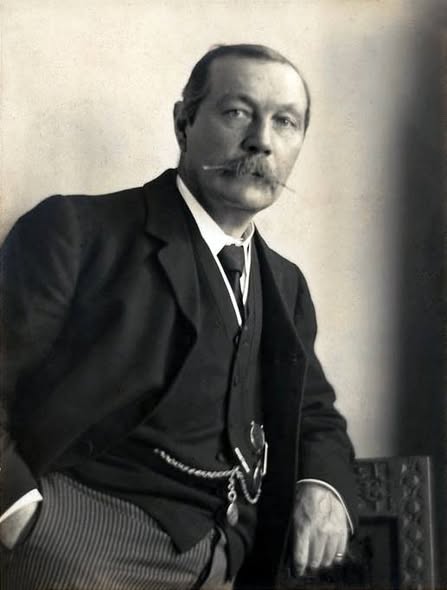
And "Holmes", by the way, was inspired by his author "Sir Arthur Conan Doyle", the man in this picture.. from a real character..
A character who exists in the real world.. who genuinely possessed that intelligence and those extraordinary powers of observation..
That character was the Scottish professor "Joseph Bell", professor of surgery at the University of Edinburgh, who possessed a power of observation beyond imagination, enabling him to reach major conclusions based on simple observations, which he pieced together in a logical way..
Dr. "Joseph Bell" could tell your health problems from looking at your face.. he could tell your origin and your ancestry from your features and your bone structure.. he could tell the accidents you had been through from the scratches on your skin, and know that you have a problem keeping you awake from the dark circles around your eyes caused by sleeplessness.. and he would look at your fingers and see the mark of a ring that had been removed.. and know it was a romantic problem!
In addition to Professor "Bell".. "Holmes" carries a great deal of the traits of "Sir Henry Duncan Littlejohn", professor of forensic medicine, who by virtue of his work taught "Doyle" many things in the field of crime, and made him stand on the dividing line between medicine and the justice system..
"Holmes" relies on his supernatural power of observation, and the method of "abductive reasoning".. he eliminates all the impossibilities and studies what remains with logic.. and he gathers the small details and arrives at the truth.. and he always has a line he says: "When you have eliminated the impossible, whatever remains, however improbable, must be the truth"..
Holmes is a skilled boxer, as we discover in "The Sign of the Four".. and an expert in the martial arts, as he declares in "The Adventure of the Empty House".. and skilled at marksmanship and the use of firearms.. and in general, "Holmes's" physical strength is unnatural.. and surpasses the ordinary man by stages..
Holmes always has with him his friend Dr. "Watson", who represents for him "ordinary human stupidity" in solving the mystery of the crime.. and therefore, when Watson thinks in a certain direction.. Holmes eliminates that direction.. because that is the way the killer wants "ordinary people" like "Watson" to think..
"Holmes" started out poor, to the point that he met Watson when he was looking for someone to live with him and split the rent with him.. and then he began to earn a great deal from his work.. but Watson points out in "The Adventure of Black Peter" that "Holmes" sometimes refused to offer his services even to the wealthy and the influential, no matter how much they tempted him with money, if the case did not interest or appeal to him..
Unlike "Watson", who was married and then widowed.. "Holmes" is an enemy of women.. and it seems he has no patience for the talk of "if you were interested you would have figured it out yourself".. and "you don't love me like you used to and work has taken you from me".. because he says at one point: "How could I tie myself to a mysterious, incomprehensible creature like woman?.. How can you build a solid structure on shifting sand"..?
And "Doyle" speaks about Holmes in a letter to Dr. "Joseph Bell", telling him: "Holmes could fall in love if the computer fell in love".. referring to the first primitive device we could call a "computer".. invented by "Charles Babbage" in 1837..
But what happens over time.. is that people deal with "Sir Conan Doyle" only because of "Holmes".. and when he is invited to a party it is because of "Holmes", and any conversation with him is about "Holmes".. and when someone sends him a gift it is for the sake of "Holmes".. and when a lady admires him it is an admiration for the character of "Holmes"..
His whole life became built on "Holmes".. and this began to cause him distress.. and a very particular kind of jealousy.. toward the character he had created himself..
And on a cold night in December 1893, "Doyle" sits at his desk and writes the story "The Final Problem".. in which he decides to end the life of his hero "Sherlock Holmes" forever..
In this story, "Doyle" presents a professional criminal, a "criminal mastermind" worthy of "Holmes".. "Professor James Moriarty", the genius professor of mathematics, who deviated and took to the world of crime, and was involved in dozens of crimes of theft, forgery and murder, without leaving behind a single piece of evidence.. that would let the police arrest him..
"Holmes" tries to track "Moriarty".. so "Moriarty" goes to his house and asks him to stop pursuing him or else he will be forced to kill him.. "Holmes" refuses.. and he is subjected to three deadly accidents, all arranged by the genius criminal.. and he escapes them by a miracle..
After that, "Holmes" travels to Switzerland and leaves a letter for Watson.. "Holmes" was going to meet the genius criminal Professor "Moriarty" at the Reichenbach Falls "to debate and enter into a duel of minds.. and for each of them to tell the other how he had been tracking his movements and tracing his steps..
A struggle between one mind.. and another mind..
When "Watson" goes to the meeting place.. he finds no one.. but when he reads the letter he discovers that "Holmes" had decided to rid society of the evils of "Moriarty", but only "at a heavy price that will grieve all those close to him"..
Watson learns that a struggle took place between the two men, whose lines ended with the death of the detective and the criminal together, and their drowning in the waterfall.. and nobody was able to recover their bodies..
"Holmes" dies.. and readers receive this story with shock and outrage..
And angry letters of objection poured in on "Doyle".. but "Doyle" was relieved and felt he had regained his own personality, which "Holmes" had overshadowed..
Unfortunately, "Doyle" is surprised to find that people gradually began to drift away from him and nobody even spoke to him anymore.. no one visited him or asked about him as before.. and he found himself completely alone.. so he was forced to bring "Holmes" back to life again in the story "The Hound of the Baskervilles".. and "Holmes" explains to Watson in the story that his death was merely a performance to get rid of his enemies..
There are many who do not know "Sir Arthur Conan Doyle", but there is no one in the world, from one end of it to the other, who has not heard of "Sherlock Holmes".. to the point that he has crept into jokes and popular proverbs all over the world as a symbol of intelligence and logical thinking..
"Holmes" has a statue to this day in "Doyle's" birthplace in Edinburgh.. the statue in this picture..
"Holmes's" method of deduction and reaching the killer is like real magic.. and many experts see that it influenced the development of the science of forensic medicine itself and how it deals with the crime scene, and in the science of "criminology"..
To this day.. "Holmes's" method of deduction is taught to students in police academies in most countries of the world..
Holmes differs from "Hercule Poirot", the extremely brilliant Belgian detective.. created by "Dame Agatha Christie".. who of course needs a post of his own, and that leaves our conversation with more to come..
----------
References
----------
1 - Accardo, Pasquale J. (1987). Diagnosis and Detection: Medical Iconography of Sherlock Holmes. Madison, NJ: Fairleigh Dickinson University Press.
2 - Knowles, Christopher (2007). Our Gods Wear Spandex: The Secret History of Comic Book Heroes. San Francisco: Weiser Books. p. 67.
3 - Riggs, Ransom (2009). The Sherlock Holmes Handbook. The methods and mysteries of the world's greatest detective. Philadelphia: Quirk Books.
4 - Conan Doyle, Arthur (1986). The Complete Sherlock Holmes, Volume 2. Bantam Books. p. 480. Retrieved 17 October 2014.