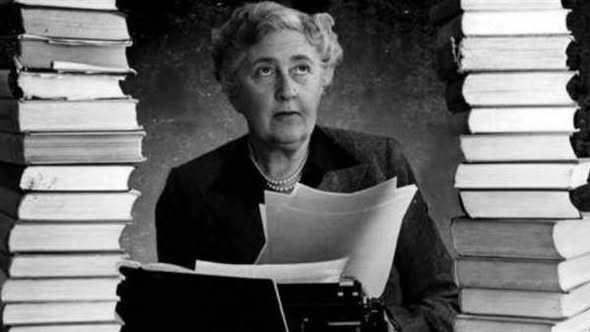
One of Agatha Christie's distinguishing traits was that she kept renewing herself and diversifying in her writing. Meaning, it wasn't limited to "Poirot".. as a single character.. the way it was with "Doyle" and "Holmes".. It wasn't even limited to crime fiction.. No.. she wrote six romance novels under a pen name.. that is "Mary Westmacott".
Because she worked in a London hospital during the war, she wrote real science about injuries and especially about poisons.. and she used to consult experts.. so much so that the clever pharmacist at the hospital.. Mr. "Harold Davis" was the one who suggested she use poisoning with "Thallium" in the story "The Pale Horse".. and her description of the symptoms of poisoning was extremely precise.. hair loss and so on..
It seems that everything Agatha touched or came near turned to gold.. because "Harold" later became the chief pharmacist at the Ministry of Health in the United Kingdom.. Her new husband, the archaeologist - because of her fame - the government took an interest in his work and the Kingdom granted him the rank of "Knight".. Her friend "Dorothy L. Sayers" turned into a famous writer.. and a junior editor at The Telegraph turned into a famous, distinguished journalist because he did an interview with her..
There were some harassments along her career but they were minor.. Once, for example, "the British intelligence agency" summoned her and interrogated her at length.. after a new character appeared in her story "N or M?"..
A character called "Major Bletchley".. and Britain had a secret intelligence facility for intercepting and breaking codes called "Bletchley Park".. What "Agatha" wrote about the Major made British intelligence believe she had a spy in "Bletchley Park".. but she turned out to be innocent.. and the events and characters of the story were mere coincidence..
Among the characters "Agatha" created.. was "Miss Marple"..
"Miss Marple," the kindly spinster wearing a cap in the picture next to "Agatha Christie".. By the way, "spinster" is not an insult the way it is spread on social media, and it isn't said only about women..
The word "Spinster" is said of both men and women alike.. meaning a person who has passed the usual age of marriage recognized in their environment.. but somehow we insisted on attaching it to women only..
The point is that "Miss Marple" was not this gentle her whole life.. she was a very nosy, curious woman.. a suspicious, annoying old woman who talked a lot and was fond of rumours and gossip.. she hated people and always expected the worst of them.. but story after story.. the character changed and became calm and kind, loved by all her neighbours in her village "St. Mary Mead"
"Miss Marple" came into being because of the story "The Murder of Roger Ackroyd".. when "Michael Norton" made an "adaptation" of the story for the stage.. and in it there was a character of an old spinster named "Caroline Sheppard".. but "Norton" cut her out on the grounds that "old people are finished and no longer interest anyone".. and put a young girl in her place..
This situation enraged "Agatha Christie" greatly.. and she decided to create a character through whom she would give older people their chance and prove they are capable of giving.. so she began drawing the threads of the character of "Miss Marple".. and "Agatha" took her revenge on "Norton" by making him the insane killer in her story "Curtain".. and killing him..!
"Miss Marple" is a mixture of several characters.. but in truth.. she is very close to Agatha Christie's real aunt.. Miss "Margaret West"..
"Miss Marple".. her intelligence is extremely sharp.. and she has an iron memory the likes of which no human has had in history.. she is a little malicious and always pretends to be foolish, and that makes people underestimate her.. and trust her..
"Miss Marple" also has a big, kind heart but a steel one.. meaning she can look at a slaughtered corpse without batting an eyelid.. "Marple" sometimes visits the crime scene.. rarely, not often.. and Scotland Yard calls on her unofficially for her extraordinary intelligence..
The one thing she is not allowed to do, such as entering a certain place connected to a crime.. or anything that stumps her.. she used to call on her friend, the retired policeman "Sir Henry Clithering" for that..
"Miss Marple" solves crimes in a highly innovative way.. she listens and observes.. and listens to the investigators while sitting in her comfortable chair knitting or drinking tea.. until she hears a word or sees a certain movement or remembers a certain situation.. that is the key to the puzzle.. and then she tells them calmly:
- "A crime like this once happened in St. Mary Mead"..
In general, "Marple's" stories assume that any crime in the universe.. has happened the same way in "St. Mary Mead".. the fictional village that "Agatha" created and where "Miss Marple" lives..
"Miss Marple" says this sentence of hers and begins to narrate the story.. without names.. but with descriptions like "the cousin".. "the sister".. "the servant".. and she links the two crimes and then arrives at the real criminal..
Here "Agatha" made "Marple" rely on her memory to recall similar crimes.. and on what she has seen during her life in "St. Mary Mead" of the dark side of the human soul..
Any crime in existence has a parallel crime that happened in "St. Mary Mead".. meaning if you told Marple that someone in "El-Senbellawein" was found drowned in the canal.. she would tell you, "A crime like this once happened in St. Mary Mead"..
That could have turned the stories featuring "Miss Marple" into very boring stories.. were it not that her linking of events, her tracing of situations and her grasping of the common element between the two crimes.. was always in a highly suspenseful mould.. so you never get bored of "Miss Marple"..
"Miss Marple" has another famous sentence she repeats more than once.. and it seems it is also directed from "Agatha Christie" to "Norton":
- "Young people think old people are fools, but old people know for certain that young people are fools"..
"Miss Marple" was 74 years old.. as we understand from the context of the stories, for in the story "Bertram's Hotel" she says she hasn't been to this place in 60 years.. when she was a girl of 14.. The age of the heroes of Agatha Christie's stories always caused her a problem.. because she sometimes wished they were five or six years younger.. so they could move more easily.. and she once declared that she regretted not having "Poirot" start appearing when he was younger than that..
"Miss Marple's" luck was not good with cinema and television.. the works made were simple and few.. while Poirot took the lion's share of it..
The last story of "Miss Marple" was written by Agatha Christie and kept with a will in a bank vault in London, to be published after her death.. and its name is "Sleeping Murder"..
This time we will not tell "Sleeping Murder".. so that we get motivated and go looking for it and read it.. but the story concerns "Gwenda".. who moves into an old house that overlooks the sea the first time she goes there.. and she begins preparing it to live in.. and she started working on the house with the workers, and in her imagination there was the painting and the repairs and a pattern of a certain "wallpaper" she wished to have put up..
And while working.. the workers open a closed, forgotten door for the first time.. and stunned.. "Gwenda" sees in it the exact same wallpaper she had imagined..
Things get worse when "Gwenda" is assailed by incomprehensible visions and terrifying memories.. and she begins to see glimpses of a strange past.. mixed with a mysterious horror, every time she tries to go down to the ground floor of the house..
"Gwenda's" life turns into a hell of terror, panic and insomnia.. and she calls on "Miss Marple".. and asks for her help.. and tells her all her fears.. including visions of the puzzle of a terrible murder that happened in the distant past..
The journey of Miss Marple ends with "Sleeping Murder".. and "Agatha Christie's" stories themselves end.. after she gave us dozens of adventures for "Poirot" and "Miss Marple" and other characters such as "Mr. Harley Quin".. the most hazy and mysterious of her detectives, about whom no one knows much except that he solves crimes by instinct and "intuition".. and he appeared in the collection "The Mysterious Mr Quin".. and "Ariadne Oliver" and "Parker Pyne" and others.. although they did not achieve the fame of "Poirot" or the kind, gentle "Miss Marple"..
And on January 12 of the year 1976.. "Agatha Christie" dies quietly in her home in "Winterbrook".. and her house is sealed with blue wax by order of the British government.. as it is part of English heritage, it may not be demolished or disfigured.. and to this very day she still carries the title given to her by her admirers around the world..
The title "Queen of Crime".. or "The queen of crime"..
Of course, after we have learned all this about "Auguste Dupin" and "Holmes" and "Poirot" and "Marple".. we cannot skip the most famous detective.. the funny, slovenly, unkempt, dishevelled-haired one.. whom if you saw him you would think him a homeless beggar.. with his famous coat missing a button that has never seen an iron in its life, his lit cigar, and his stinking car..
"Columbo".. talking about whom would take long.. and there will be more of our talk, God willing..
----------
(References in the first comment)
----------