If we make a comparison between "Omar ibn al-Khattab" and "Uthman ibn Affan", may God be pleased with them.. two types of politics appear to us.. for "Omar" was a directly confrontational man, harsh with his officials and his governors, and he dealt with them with excessive strictness at all times.. to the point that he once opened his letter sent to "Amr ibn al-As", the governor of Egypt, with the words:
"From the servant of God Omar, Commander of the Faithful, to al-As son of al-As".. and the letter made "Amr" tremble with awe. The secret was that "Amr" had carried out the hadd punishment of flogging on the son of "Omar ibn al-Khattab" himself, secretly in his house.. not publicly before the multitudes of the Muslims, in violation of the conditions of the hadd.
So in short, the politics of "Omar" was strictness and "people of competence".. as for the politics of "Uthman", it was gentleness at times and severity at times and "people of trust".
The story says that "Uthman" had several mistakes.. shortly before the departure of "Omar ibn al-Khattab", he had stipulated that the governors should not be changed for a period of one year, so that there would be no turmoil in the state.. and "Uthman" did indeed commit to that time period.. and after it he dismissed the governors whom "Omar" had appointed and appointed in their place those who were people of trust in his view.
Among these governors there were two in particular with whom the Muslim community dealt somewhat cautiously. The first of them was "Abd Allah ibn Sa'd ibn Abi Sarh".. and he was a Companion from among the scribes of the revelation.. he used to write down the revelation that the Messenger, peace and blessings be upon him, dictated to him.. and he has an amazing story, which is that one night; the Messenger was dictating to him Surah al-Mu'minun, in the description of the creation of man, and "Abd Allah" interrupted him in amazement: "So blessed be God, the best of creators".. and the Prophet replied to him smiling: "Thus was it revealed to me."
This situation was repeated once again.. so "Abd Allah ibn Abi Sarh" said to himself: "No, at this rate I would be a prophet too, here, and it is being revealed to me.. if Muhammad is truly a prophet and truthful, then revelation is being sent down to me too.. and if he is a liar.. then I can say what he says".. so he apostatized.. and fell into confusion.. and fled to Mecca.. and the verses were revealed concerning him: "And who is more unjust than one who fabricates a lie against God or says, 'It has been revealed to me,' while nothing has been revealed to him."
And when the Prophet conquered Mecca, "Abd Allah" was among the group of "al-Tulaqa'".. those whom the Prophet pardoned.. so "Uthman ibn Affan" interceded so that the Prophet would forgive him.. and he returned to Islam anew. The secret of "Abd Allah" being chosen by "Uthman" was that he was close to him and trusted him.. and he was his foster brother.
That is the first one.. and this is "Uthman ibn Affan" whom he appointed governor over Egypt.. and the people of Egypt were not pleased with him.
As for the second, he was "al-Walid ibn Uqba ibn Abi Mu'ayt".. and God described him as wicked.. and the verse was revealed concerning him: "O you who have believed, if a wicked person comes to you with a report, verify it".. the secret is that the Prophet, peace and blessings be upon him, had invited "Banu al-Mustaliq" to Islam, and they accepted it and their chief made a pact with him on that.. and the Prophet informed him that he would send him a delegate to collect the alms from him after some days, which they should have prepared.
And this group of "Banu al-Mustaliq" were wealthy.. so they collected a huge sum by the standards of that time.. and they went out with it to the gates of their city waiting for the delegate.. and because the sum was large they went out with their horsemen to protect this caravan.
And the delegate of the Prophet, peace and blessings be upon him, was "al-Walid ibn Uqba" himself.. who, as soon as he saw them with their horsemen, and there was a previous enmity between them, trembled and was seized by intense fear, and terror took hold of him to the bone.. and he returned fleeing to the Messenger saying; that they had attacked him and driven him off and prevented the zakat from him. So the Prophet was greatly angered.. and was about to march against them with a detachment of the army.. but one of God's protections was.. that when they found the delegate delayed, they themselves became worried.. so they headed to him.. and they met in the end.. and the Prophet asked their chief in a way that meant, "I sent you my delegate and you did such and such with him"?
So the chief of "Banu al-Mustaliq" declared to him in astonishment.. that he had the alms for the public treasury already.. and he had brought them himself.. and he said to him truthfully, "By the One who sent Muhammad with the truth, I did not see him.. and he did not come to me."
And this "al-Walid" is the one whom "Uthman" appointed governor of Kufa.
The adviser of "Uthman" and his private secretary was "Marwan ibn al-Hakam ibn Abi al-As", the founder of the second Umayyad state.. as we will see later.. and he was very nervous and sharp with people, and they did not accept him easily. It was said that the Prophet had previously exiled him to Ta'if; and this account is of doubtful authenticity.. because "Marwan" at the moment "Abu Bakr" assumed the caliphate was 8 years old.
Anyway, with "al-Walid" and "Ibn Abi Sarh" and "Marwan" in the picture.. they said that "Uthman" contradicted the Messenger of God.. and appointed governors who were not among the people of competence and piety...
This was the first objection they took against our master "Uthman".. they said, we do not like these governors.. and we do not want them. Especially since "Abd Allah ibn Abi Sarh" was not an acceptable face to the people of Egypt, and because of their non-acceptance of him, he was consequently violent with them.. and "al-Walid" was the same in Kufa.
The second thing was the financial policies of "Uthman".. and this, unfortunately, was not his mistake.. because any ruler at this time in the world did that.. his only problem is that "Omar ibn al-Khattab" had preceded him.. so people compared between them unconsciously.. "Omar" was aggressive, extremely harsh and fierce when it came to public money.. anyone who stretched out his hand to the public treasury without right, by a single millime in the days of "Omar", could consider himself to have gone behind the sun.. on the contrary.. "Uthman" allowed his governors to borrow from the public treasury.. so they would take money whenever they needed.. and leave in its place a "debt note".. and repay at their leisure.
Sometimes one of these governors might be unable to repay.. so "Uthman" would repay in his place from his own wealth.. this stirred the resentment of many people, as a privilege for the governors that they had no right to.. and "Uthman" was originally a target of criticism from certain Companions with a socialist bent.. such as "Abu Dharr al-Ghifari", who believed that there should be no rich person at all.. we take the money of the rich and distribute it to the poor all the time, one after another.. and in fact he used to walk in the markets criticizing the financial policy of "Uthman" publicly.. so the caliph exiled him to the Levant, to "Muawiya ibn Abi Sufyan".
As soon as he went to the Levant, he was surprised by the palaces that "Muawiya" had built and the pomp and the wealth that they were living in.. so he began to attack him as well:
"If you built them from the money of the Muslims then it is treason, and if you built them from your own money then this is extravagance."
And the people in the Levant began to gather around "Abu Dharr" and listen to him.. so "Muawiya" feared a revolt of the people of the Levant against him.. so he sent him a second time to "Uthman".. and when he returned to "Uthman", he continued to impugn his integrity and his financial probity, so "Uthman" exiled him to a town called "al-Rabatha" east of Medina.. and there he lived on the bare minimum and died destitute.. to the point that his wife did not know how to shroud him or bury him.. had it not been for some Iraqi pilgrims passing by chance.. who took care of the matter.
This angered "Ammar ibn Yasir" and he came to "Uthman" and quarrelled with him.. and he nearly exiled him as well, and he left his presence defeated.. and this angered the tribe of "Banu Makhzum", the people of "Ammar".. and they joined "Ghifar", the tribe of "Abu Dharr", against the caliph "Uthman".
And "Uthman" used to give a lot of money and goods to his relatives and his loved ones.. so they accused him of embezzling this money from the public treasury of the Muslims.. while he was giving it from his own wealth.. because he was in fact a wealthy man.
And among the objections taken against him as well, was his ruling in the case of "Ubaydullah ibn Omar" and "Abu Lu'lu'a" and "Hormuzan".. and his refusal to execute "Ubaydullah ibn Omar".. so they said, "Uthman is contradicting the Book of God".
All these things came together and movements of opposition and groups and secret organizations began to form, and began to gather and meet.. and the snowball went on growing.. into a frightening discord, that lasted for four continuous years.
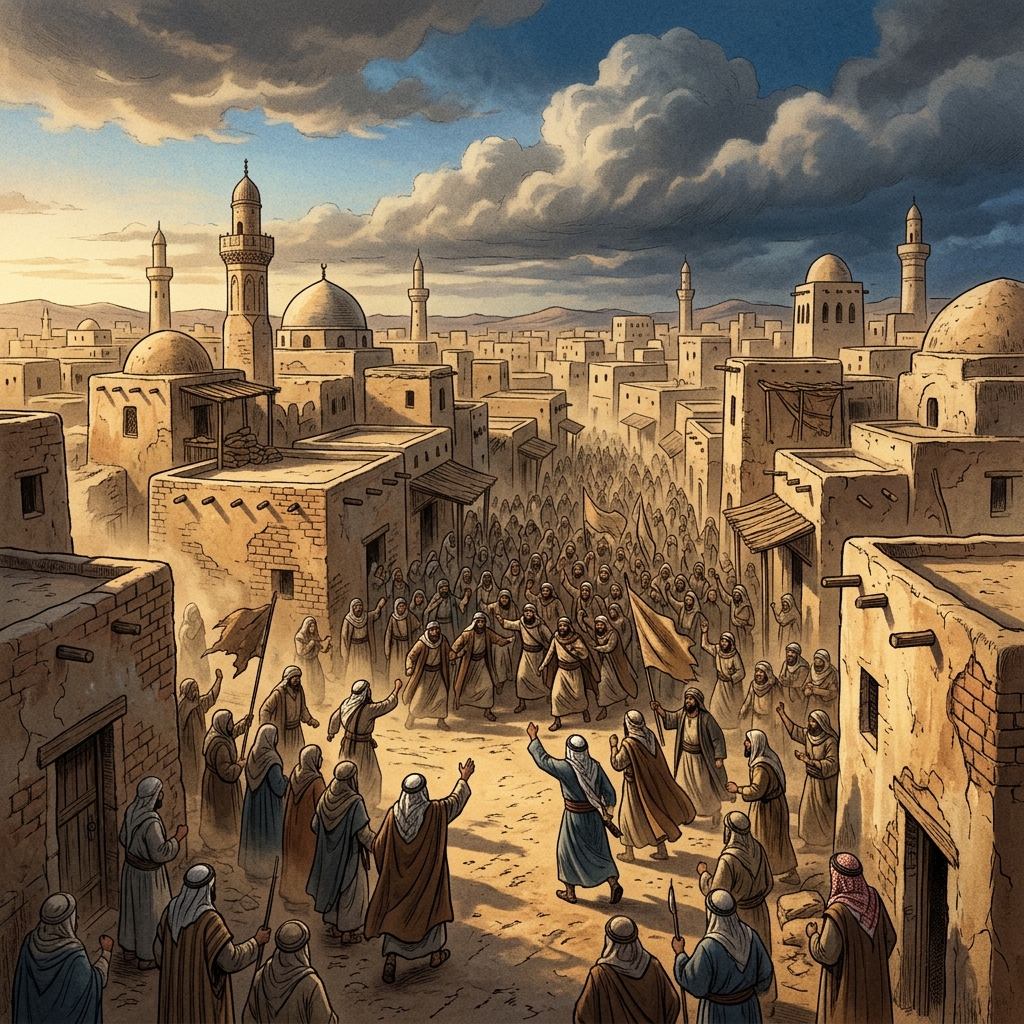
And the angry multitudes from "Egypt" and "Kufa" and "Basra" and "the Levant" and "Sanaa" met.. and headed for Medina in the year 656 AD, in furious crowds.. threatening a violent revolution, if their demands were not met.
And there, they meet the Imam "Ali" and his two sons, and he had learned of their arrival.. and although he used to differ with "Uthman ibn Affan" over many policies.. he was silent and not among the people of discord.. and in a move that deserves appreciation, he places himself and his two sons as a guard for "Uthman".
These people were not Kharijites, nor had the Kharijites yet joined them.. they were ordinary people who had been subjected to injustice, or had demands, or understood certain matters wrongly.. the Kharijites were still gathering slowly and watching what the events would reveal.. and which horse would be the winner, so they could ride it and bet on it.
So these people, since they are ordinary people.. when they reach the caliph's encampment, and meet "Ali ibn Abi Talib", they are awed by the cousin of the Messenger of God, and they feel shame.. and they ask him to intercede for them and to speak with the Imam "Uthman" to respond to their demands, in order to ward off injustice.. and indeed the Imam "Ali" enters to "Uthman", may God be pleased with them both.. and convinces him.
The caliph "Uthman ibn Affan" comes out to the angry crowds.. and he engages in dialogue with them and delivers a sermon to them.. and he threatens them.. and afterwards he leans towards gentleness and kindness.. and begins to listen to them.. and to explain to them what had been hidden from them.. and he promises them reform.
As for the reaction of the people.. it seems that they are truly convinced by the words of the Imam "Uthman ibn Affan".. and it also seems that time has stolen us today and the talk has grown long.. so we will continue our story later..
And the talk.. has a remainder.
-------------
Previous posts:
-------------
1 - http://bit.ly/2Rm5tBs
2 - http://bit.ly/2RACrOV
3 - http://bit.ly/2NeseJs
4 - http://bit.ly/2XoDruI