With the sermon of "Uthman ibn Affan", may Allah be pleased with him, to the people, the delegations are moved, and they depart on their way, and "Uthman" summons the governors whom the people complain about and meets with them.. and tries to find a solution with them that satisfies the people and calms them.
When the solution is slow in coming, we remain in push and pull.. and delegations going to Uthman and a delegation coming, and once, during the return of the Egyptian delegation to Egypt, "Abdullah ibn Abi Sarh" meets them, and kills one of their men.. that, of course.. along with a few scattered similar acts.. does nothing to help smother the sedition.
At this moment the Kharijites begin to appear, inciting the people to depose and kill Uthman, and to bring down his state.. and the strange thing is that the crowds of rebels waited for the dismissal of "Ibn Abi Sarh" first.. and then they began to lean towards the opinion of the Kharijites.. and to return, and to revolt against "Uthman".
We can say that this is the first appearance of the Kharijites in an organised form on the scene, formed into a group called the "Sabai'ah".. after "Abdullah ibn Saba", about whom they have disagreed all along, as to whether he was a Jew.. or a man claiming to have faith, or an imaginary figure who never existed.
And this time the delegations besiege the house of "Uthman", and he comes out to them and addresses them and asks his Lord's forgiveness if he has erred.. and he weeps and the people weep with him, and the matter ends with the dismissal of "Ibn Abi Sarh", and the appointment of "Muhammad ibn Abi Bakr" in his place, governor over Egypt, whom the Egyptian delegations accepted and were satisfied with.. and they departed with him in a caravan returning to Egypt.
And shortly before everyone's return.. the Kharijites had become intensely active, and they wrote to the people of Kufa and Basra and Syria, that Uthman had decided to get rid of every rebel against him, and every objector to him.. and during the return of the Egyptian delegation, led by "Muhammad ibn Abi Bakr", they were surprised by a man said to be "al-A'war al-Sulami", riding a camel, and walking alongside their caravan, and he was determined to attract their attention to the point that he began to fling words at them and harass them.
This point is extremely important, because the group stopped, and fell upon "Abu al-A'war", and they decided to make him live up to his name.. by reshaping his features anew.. but he, terrified, tells them that he is merely a simple man.. and a messenger from "Uthman" to the governor of Egypt "Ibn Abi Sarh", carrying a letter of the utmost importance and danger.
They search him and wrench the letter from him, and it had been sent to "al-Sarh" ordering him to kill everyone when they returned, including "Muhammad ibn Abi Bakr".
And the letter was sealed with the seal of "Uthman ibn Affan" himself.
And it appeared to the inflamed nerves that "Uthman" was a traitor who breaks his promise and violates his covenant. But the truth is that this letter was entirely forged.. what reinforced that was that the caravans of the delegations of Kufa and Basra and Syria returned at that very moment from those places, and met the Egyptian delegation.. and they had known about the matter for days.. through a letter that was supposed to be secret.. and had only just been written.
Add to that that the brother "Abu al-A'war" was determined to draw attention to himself despite carrying a letter of the utmost secrecy, and accordingly, the delegations and the enormous crowds set off, returning to "Uthman ibn Affan".
This time Imam Ali had withdrawn, but he left his two sons "al-Hasan and al-Hussein" to guard Uthman, so the crowds gather and chant angrily, and the Kharijites try to push them to storm "Uthman's" house at any cost.
"Uthman" comes out to them a second time, and they show him the letter, and genuine bewilderment appears on him.. first, he did not know who had come to him first to order al-Sarh to kill him.. and second.. he had been with them from the moment they came until they left.. so when did he write the letter? So they ask him "Is this your servant" - meaning al-A'war - and he tells them in a decisive tone that yes, he is one of his workers.. but he set out without his knowledge.. so they bring him the camel he had been riding.. well, and this?.. so "Uthman" told them that "he took it from the house without my command".. even the letter was written without my knowledge.
With the rational dialogue, "Muhammad ibn Abi Bakr" thinks a little logically.. and he notices indeed that the handwriting in the letter is not the handwriting of "Uthman" at all.. he says this to the crowds, and a shouter shouts that this is the handwriting of "Marwan ibn al-Hakam".. and this begins to spread among the gathering.. indeed "Marwan" has the caliph's seal.. so it is him.
Here the people said to Imam "Uthman".. well.. we have wronged you and the shame is past.. hand us "Marwan" so we may kill him.. and step down from the caliphate, then!
Of course the Kharijites, with this game, did not have as their goal that the conditions of the people of Egypt and Kufa and Basra and Syria and Yemen would improve.. nor did it matter to them at all.. they have one single goal that they pursue all the time.
The chair...
The seat of rule and power and influence. One of the very fine things about the Kharijites, and you will notice it in them in every era.. is that they incite you to rebel against the ruler and bring down the state.. so if the Kharijites reach power.. and you go to their comrades who revolted with you long ago.. and you say to them "No, this new ruler has turned out to be unjust.. come, let us revolt and bring him down".. they reply to you: "No, rebelling against the ruler is forbidden.. are you an unbeliever or what.. where is the prestige of the state and stability, you troublemaker?"
In short, rebelling against the ruler is forbidden in one case only.. if he is one of them.. and if the Kharijites meet the peaceful opponents, as happened at that time.. you find that gradually everything turns into "Kharijites".. and they become comrades.. and they defend one another and take up arms on one another's behalf.
Never mind.. the cries of the Kharijites escalate from among the people.. hand us "Marwan" so we may kill him.. and they knew that this could never happen.. and indeed "Uthman", may Allah be pleased with him, refuses.. so they say to him "Then there is nothing between us and you but the sword". "Uthman" comes down from the balcony to his house, and fortifies himself in it.. and he had imagined that these were ordinary people whose nerves would calm after a little while.. or at least.. that they wanted only him.. but that does not happen.
Of course we have all seen the cocktail of "rebels + Kharijites" in many countries around us.. and even here in Egypt.. where it takes the country.. one group of them keeps besieging his house, and the crowds set off in the city terrorising peaceful civilians with weapons, and Imam "Uthman" finds no solution other than to send to "Muawiya" in Syria asking him to relieve him and save the city with soldiers of his own.. but the distance was long.. and the time had already passed.
A terrible struggle goes on at the threshold of "Uthman's" house between "al-Hasan" and "al-Hussein" and "Muhammad ibn Talha" and "Abdullah ibn al-Zubayr".. but the one who said that "numbers overcome courage" was entirely truthful.
In a prophecy about the Messenger of Allah ﷺ in a noble hadith, that he once spoke to "Abdullah ibn Umar" about a sedition that would occur after his death.. and said to him "this veiled one will be killed unjustly that day".. and he pointed to a man approaching them.. and "Abdullah" says: "So I looked, and there he was, Uthman ibn Affan".
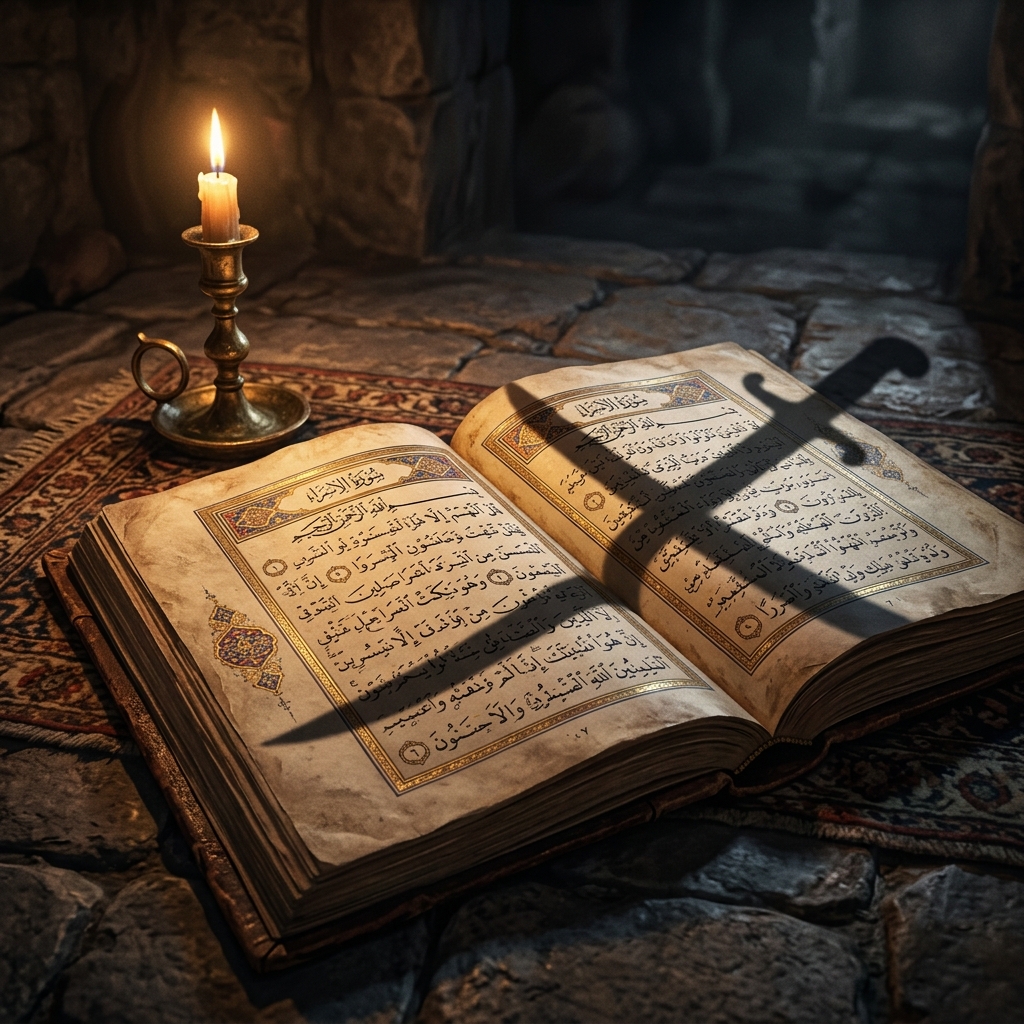
And so.. in the heart of the house of "Uthman ibn Affan" while he is bent over his copy of the Quran, "Muhammad ibn Abi Bakr" advances towards him, after they had stormed the house.. and he strikes the Quran from his hands, and throws it to the ground, and sits with his knee on his chest and points his sword at his throat.. and says to him gloatingly "O Uthman, what has Allah done to you".. and Uthman replies to him saying: O son of my brother, your father would not have been pleased with you for this position.
At the mention of "Abu Bakr al-Siddiq", "Muhammad ibn Abi Bakr" returns to his senses.. and begins to control himself and feels disgrace and shame and awe.. and he recoils from "Uthman" in retreat.. so his comrades fall upon "Uthman" with swords.. and the latter's wife tries to push him away from him, and blocks the sword with her bare hand, and the sword cuts off half her palm, and the blade strikes its target, and the blood of "the possessor of the two lights" is scattered over the Quran and over the face of "Muhammad ibn Abi Bakr" himself.. who comes to.. and stands contemplating the crime in bewilderment mixed with astonishment and terror.. having finally realised the enormity of what he had become entangled in.
And because the small crowd and the delegation of demands turned into a catastrophe.. and with their knowledge that "Muawiya" might at any moment receive the letter of "Uthman" in which he asks for support.. the crowds head towards Imam "Ali ibn Abi Talib".. and at their head an astonishing, malicious idea takes shape.
And this idea we shall continue talking about later.
And there remains more to the conversation.
-------------
Previous posts:
-------------
1 - http://bit.ly/2Rm5tBs
2 - http://bit.ly/2RACrOV
3 - http://bit.ly/2NeseJs
4 - http://bit.ly/2XoDruI
5 - http://bit.ly/2IAYulr