From the very first step, and before we talk about the idea of the "caliphate" itself, we must know that it, like most rulings, is disputed in the interpretation of its meaning and what is meant by it.
Some told us it is "the succession of a Muslim leader over the Islamic state." Others said, "No, the state does not have to be Islamic." And some said, "What matters is that a Muslim rules the country, then he is a caliph, on condition that it is run by Islamic law."
Some expanded its concept greatly, and considered it an extension of prophethood itself. And that is what the common people hold today. If you criticize any act of any caliph today, people answer you on the basis that the caliph is an extension of the Prophet, and that his actions are sacred and not to be discussed. Even though this is not the jurisprudence of the Sunnis. It is the doctrine of some Shia sects, the very people these same people insult all the time.
Branching interpretations, independent reasonings, and many sects. And every sect has its jurisprudence and its hadiths on which it relies.
Today we need to travel through time to the year 632 AD, the eighth day of June, the seventh century AD.
The day of the death of the Messenger, peace and blessings be upon him: Abu al-Qasim Muhammad ibn Abdullah ibn Abd al-Muttalib.
A tremendous turmoil is taking place among the Companions. Turmoil, tension, nervousness and agitation that no one expected. To the point that Umar ibn al-Khattab, may God be pleased with him, drew his sword and said in anger: "By God, the Messenger of God has not died."
Few had expected this tension, among them al-Abbas ibn Abd al-Muttalib al-Hashimi, the uncle of the Prophet himself, who shortly before his death asked Ali ibn Abi Talib, may God be pleased with them both, that they go to the Prophet and ask him, "Will Ali ibn Abi Talib be his successor?" But Ali refuses this completely and answers al-Abbas, "I will not ask it of the Messenger of God."
Meaning, he does not ask to be appointed ruler. And this, by the way, is an extremely important part of the essence of governance in this system: that governance is not taken by the one who requests it. Whoever wants to be a ruler, a president or a minister according to this system, the position is denied him. And the Prophet used to say about seats and positions:
"We do not give this to the one who asks for it, nor to the one who is eager for it."
This point is very important because we will come back to it at the end.
"Stretch out your hand so I may pledge allegiance to you, so it will be said that the uncle of the Messenger of God pledged allegiance to the cousin of the Messenger of God, and no one will dispute you." Al-Abbas repeats this to the young man Ali ibn Abi Talib after the death of the Messenger, peace and blessings be upon him. But Ali refuses. Some references say that Ali refused because he was certain that he would be the ruler after the Prophet. And al-Abbas knew that Ali was a stubborn young man, difficult to deal with, so he did not repeat the offer a second time.
The truth is that division almost broke out among the Muslims at that very moment.
Who takes power after the death of the Prophet, peace and blessings be upon him?
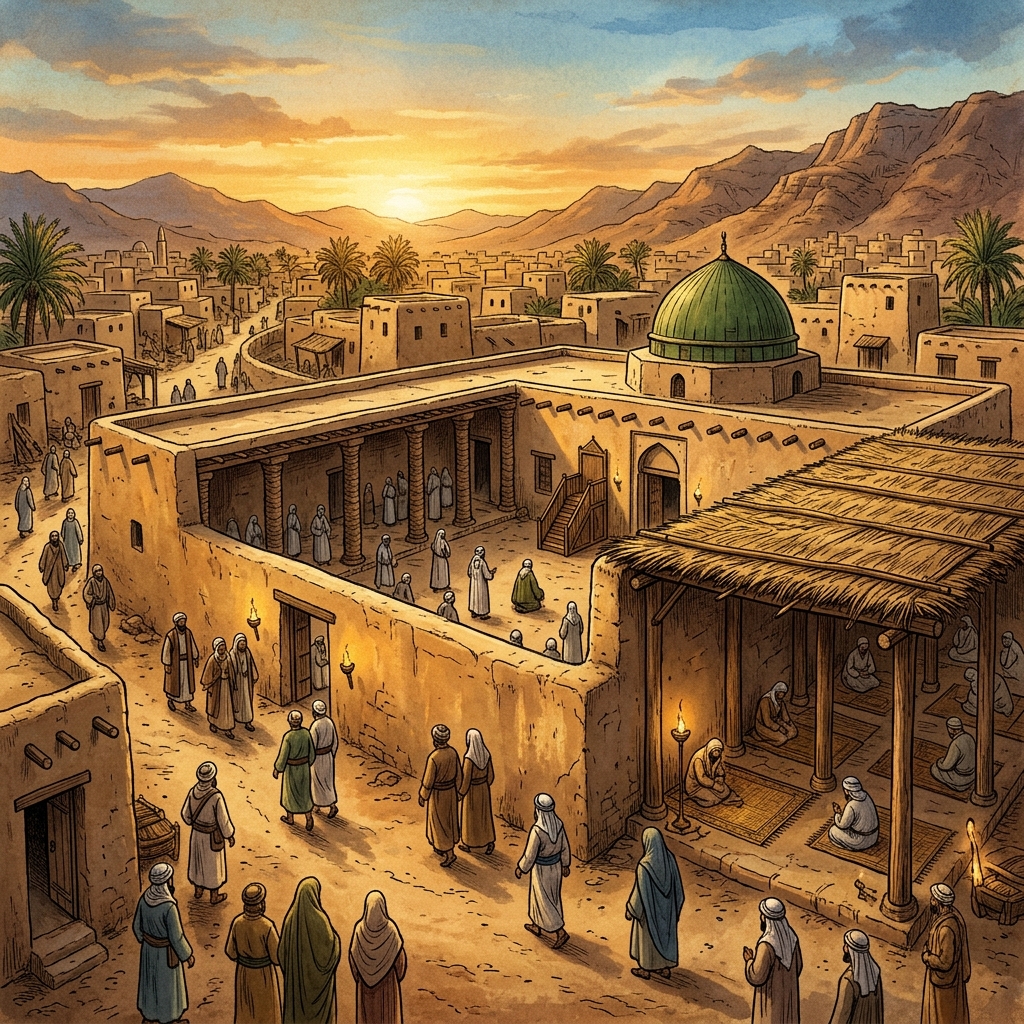
At the time when the family of the Prophet were preparing his body, washing it and shrouding it, a group of the Ansar went and gathered in a place called the Saqifat Bani Sa'ida. This is a spot on the northwestern side of the Prophet's Mosque, where they were accustomed to gather, in order to answer this question and choose one of their own.
The complete list of people who attended this meeting is historically lost. But there are specific names transmitted to us by the accounts, of the leaders of the Ansar, such as Sa'd ibn Ubada, Bashir ibn Sa'd and al-Hubab ibn al-Mundhir.
It seems that these gathered Ansar intended to agree on a ruler, and come out with him to the people so they would pledge allegiance to him and the matter would be settled. The meeting was almost secret, because Umar ibn al-Khattab learned of it by chance. So he decided to attend it, and sent for another man, who was famous for being extremely close to the Prophet and the most believing and most obedient of people to him.
The Companion Abu Bakr Abdullah ibn Abi Quhafa, whom we know as Abu Bakr al-Siddiq, may God be pleased with him.
The truth is that Abu Bakr was a man of great presence, not because of physical strength or any special physical trait. The fact is that he was short of stature, thin, slight of body, but with enormous charisma, which his special standing among the Companions helped him develop.
So when they reach the Saqifa, he finds the group of Ansar gathered around Sa'd ibn Ubada, who was a weak, sick man, deliberating and discussing which of them they should pledge allegiance to as caliph. So when Umar wanted to answer them, Abu Bakr silenced him, and told them that before them was one of two men for them to choose from.
Umar ibn al-Khattab or Abu Ubayda ibn al-Jarrah.
The matter almost developed into a violent quarrel, especially since Umar extended his hand at that time to Abu Ubayda and asked to pledge allegiance to Abu Ubayda as caliph. But Abu Ubayda refused, and said he could not accept that in the presence of Abu Bakr al-Siddiq.
They turn to Abu Bakr al-Siddiq, and the latter asks Umar to extend his hand and pledge allegiance to him, and for Umar to become the caliph. But Umar refuses and asks that they pledge allegiance to Abu Bakr himself.
Al-Tabari tells us: Umar pledges allegiance to Abu Bakr. A violent quarrel breaks out, and other people rise to pledge allegiance to Abu Bakr. There is a crush and some of them almost trample Sa'd ibn Ubada. So some of Sa'd's companions shouted to rescue him. Then Umar showed his contempt for Sa'd. So Sa'd seized Umar by the collar, and Umar almost finished him off, had Abu Bakr himself not intervened and soothed the tense atmosphere that could have turned into a massacre in a single second.
And at the same moment, al-Tabari says: "Aslam came to the Saqifa until the paths were crowded with them." And the tribe of Aslam was a strong tribe with enormous numbers. They found them entering upon them to the point that the paths were narrow from their sheer number. And they were loyal to Abu Bakr al-Siddiq.
Indeed, with their presence the people pledged allegiance to Abu Bakr. Some of them later transmit from Umar his saying, "I did not see Aslam until I was certain of victory." Because the matter could have turned into a massacre, and because the Ansar were afraid of Aslam.
Even though the Ansar already realized that Abu Bakr was the first caliph, in a final attempt they made a strange request.
They said to Abu Bakr, fine, let there be a prince from among you and a prince from among us.
In other words, let us form a presidential council!
So Abu Bakr refuses this completely, and says to them, no. "We are the princes and you are the ministers."
This moment is extremely decisive in the matter, because the issue here is no longer Companions talking about "religion." Because if this is "religion" and law, then the seat or the position, by law, is not obtained by the one who asks for it or seeks it.
At this very moment, we stop at the barrier of religion, and move to another area. The area of "politics."
These are "men talking politics."
Full stop and back to the beginning of the line.
At this decisive moment, and with the phrase of Abu Bakr al-Siddiq, may God be pleased with him, Islam as a religion separated from the "history of the Islamic state" after the death of the Prophet, peace and blessings be upon him. The actions that follow, in "most" of them and not all of them, most of them, are pure politics.
Politics that changes and evolves according to circumstances and any new data.
And because the jurists could not separate Islam as a religion from the history of the Muslims after the death of the Messenger, they fell into much confusion. They defended mistakes, justified killers, and turned a blind eye to horrific evils that occurred in the period following the death of the Prophet, peace and blessings be upon him, because they understood this to be "religion," and that the caliphate is an extension of prophethood.
And when they fell into this dilemma, and could not get out of it, they began to hide matters from the common people and prevent them in the first place from reading words like what is written here, or from asking about certain events, including the events of the "Great Tribulation" that occurred between the years 656 and 661 AD.
And whoever among ordinary people like me and you tried to go deeper, they rebuffed him and told him "this is religion." So either he became an atheist and abandoned the religion altogether, because he imagined that many of the actions he read about, and found in them deceit or something frightening and horrific, were considered "religion." Or he became extreme and fanatical, because he imagined that these actions were religion, obligatory to enforce.
Few understood the truth. This is politics, nothing more.
Men from the seventh century AD, playing politics.
The important thing is that after the Saqifa, Abu Bakr ascends the pulpit, and sends for two particular Companions. Note that they were not present among those gathered, nor did they attend his pledge of allegiance.
These two were very important, because if they refused this pledge of allegiance, war would break out. The cousin of the Messenger and the cousin of his aunt: Ali ibn Abi Talib and al-Zubayr ibn al-Awwam.
He sends to summon them and they do attend. Abu Bakr asks them whether they are with the pledge of allegiance, or whether they want to split the ranks of the Muslims. So Ali and al-Zubayr answer him that they are not opposed, and they address him by the title "Caliph of the Messenger of God," and they pledge allegiance to him.
And with the pledge of allegiance of Ali and al-Zubayr, the matter becomes settled for Abu Bakr, and he becomes officially the caliph of the Muslims.
But even so, a new problem faces him, one that was capable of undermining the state. Some said it was the reason for his assassination later on.
And this problem we will talk about later.
And there remains more to say.
---------------
(The references come with the last part of the series)
(The image is from the AlUla desert, Saudi Arabia)
---------------