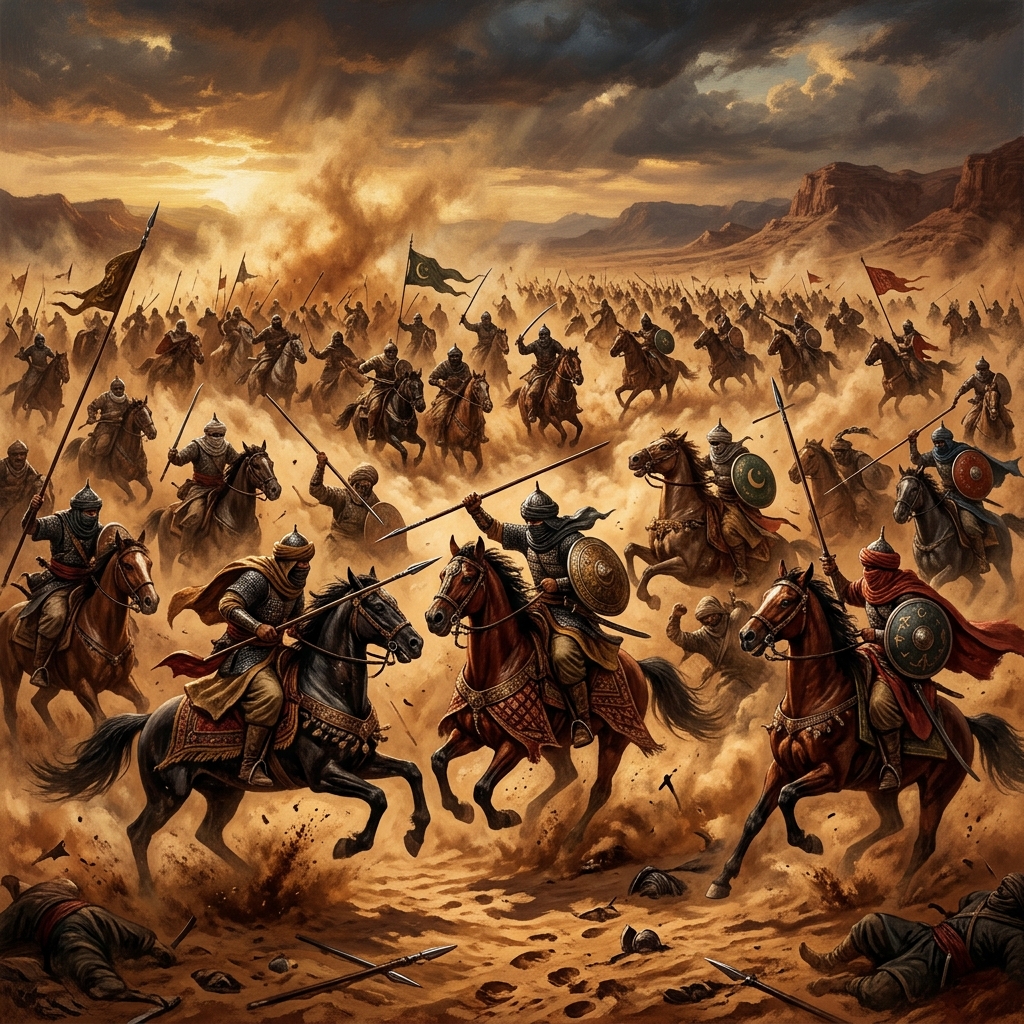
During the caliphate of Abu Bakr al-Siddiq, three groups of Muslims rose up against the authority and dominion of the state at that time. They formed something like "separatist movements" aiming for independence from the central state, undermining its influence, and breaking away from it.
The first group were tribes that had embraced Islam and declared their allegiance to the emerging state reluctantly, and were not happy that prophethood had gone to a poor orphan from the tribe of Banu Hashim, and that this influence had not gone to one of them. They seized the opportunity of the presence of one of the claimants to prophethood, Musaylima ibn Habib al-Hanafi, and followed him as a new prophet.
Along with Musaylima, a group of new false prophets also appeared, such as Tulayha ibn Khuwaylid al-Asadi and Sajah bint al-Harith al-Tamimi. She was a tribal leader who also claimed prophethood, and her people followed her. And Uṭarid ibn Hajib al-Tamimi said of her:
Our prophet has become a female we hover around her **** and the prophets of other people have become males!
And our sister Sajah wanted to fight Musaylima a war of influence, but Musaylima's affair had grown and he had an army of 100,000 soldiers. So she decided to marry him, and merged her army with his.
The reality recorded by history is that most of these people knew that Musaylima was not a prophet, and they had a famous saying: "So-and-so is a greater liar than Sajah." But his presence was an opportunity to achieve their ambitions of secession from the state. Some of them even heard the verses Musaylima used to compose and said to him:
"I bear witness that you are the liar and that Muhammad is truthful, but the liar of Rabi'a (Yemen) is dearer to us than the truthful one of Mudar (the Hejaz)."
As for the second group, they were people who reverted to worshipping idols, and this group joined with the first and supported it. The central authority must be brought down at any cost.
The third category is a category of Muslims, monotheists who pray, fast, perform pilgrimage and everything. But they refused to pay zakat to the Islamic state, on the basis that paying it to the state lapsed with the death of the Messenger, peace and blessings be upon him. This category was the largest in number, equipment and activity. They moved and negotiated with Abu Bakr, and besieged the capital until he responded to their conditions. And when he refused, they tried to invade Medina itself.
And it is precisely this group that very many Companions opposed fighting, among them Umar ibn al-Khattab. They said to Abu Bakr that they are Muslims and their blood is inviolable, and that their reckoning for refusing zakat is with God.
But Abu Bakr refuses even to be lenient with them over a single dirham. Even over a small piece of rope, of the ropes used to tie camels, which he used to count as zakat before his caliphate.
So the idea here is that the war was not because these people apostatized, because many of them were already Muslims. The war was to save the state that had begun to fall apart and split, with each one going off in a direction and setting up a state and founding an emirate. Meaning, a political war of the first order.
This is a very important point that we must remember throughout these episodes. Everything is acceptable. Everything is open to give and take. Even those who worshipped idols and the claimants to prophethood were talked with and debated. But a direct threat to the state has no joking and no talk. This will lead us to talk about another group of Muslims, whose features will become clear later, and which must be fought and combated in every era without discussion.
The Kharijites.
The group whose first characteristic is that they rose up against the state with weapons to strip the allegiance from the ruler, after it had become settled for him.
The important thing is that the campaigns of Abu Bakr al-Siddiq succeed. He fights in very many locations, in Yemen, Bahrain, Iraq, the Levant and most of the Arabian Peninsula against rebellious tribes, to the point that some Companions said, "The whole earth has disbelieved," and it began to fight the caliph of the Muslims.
But despite these pressures, the caliph succeeds and gathers the scattered parts of the state. Yet he leaves behind him very many enemies from these tribes. Everyone is lying in wait for him, and everyone wants to get rid of him and achieve his separatist or authoritarian dreams.
We were told about the death of Abu Bakr al-Siddiq, may God be pleased with him, in accounts, that he bathed one cold day, in August of the year 634 AD. Then a fever came to him, because of which he lay in bed for 15 days, and then his soul departed.
A cold day in August in the desert of the Arabian Peninsula? God alone knows. But history has preserved for us another account, a more logical one.
A full year before the date of his death, in August of the year 633 AD, Abu Bakr al-Siddiq and al-Harith ibn Kalada, and some say with them Attab ibn Asid, may God be pleased with them, were together. And Abu Bakr had invited them to a tray of food that had been presented to him as a gift from an unknown person.
And before they were about to finish the simple banquet, al-Harith suddenly jumps up in alarm. He was a brilliant physician. And he shouts at Abu Bakr to stop eating, and says to him, "We have eaten food poisoned with a year's worth of poison."
Meaning, a slow-acting poison, whose effect works slowly over the course of a year.
And the strange thing is that the three of them show symptoms of illness suddenly on the same day. And stranger still, the three of them likewise, Abu Bakr al-Siddiq, al-Harith ibn Kalada and Attab ibn Asid, die on a single day, exactly a year later.
Who assassinated the first caliph? No one can be certain, nor does anyone know. Some people pointed the fingers of accusation at the Jews. Others pointed to Banu Tamim, or the Asadi tribe, or Rabi'a, the people of Musaylima. Or the governors of the Levant, whom the campaign of Usama had crushed. Unfortunately, no one knows exactly where the truth lies until now.
The important thing is that shortly before his death, while on his deathbed, Abu Bakr decides to avoid the situation that happened with the pledge of allegiance of the first caliph. So he chooses Umar ibn al-Khattab, keeping it to himself, and sends to the Companions to ask them about him.
The first was the Companion Abd al-Rahman ibn Awf. Abu Bakr summoned him and said to him: "Tell me about Umar?" He answered: "He is better than your opinion of him, except that there is harshness in him." Abu Bakr smiles. He saw that Umar was harsh and sharp because he saw that Abu Bakr himself was gentle, so he created a balance in consultation and the running of the state.
After Abd al-Rahman ibn Awf, he called for Uthman ibn Affan, and began to dictate to him a special letter. "This is what Abu Bakr ibn Abi Quhafa has covenanted to the Muslims. To proceed..." But he loses consciousness before he can finish the message. So Uthman improvises it: "To proceed, I have appointed over you Umar ibn al-Khattab, and I have not been stingy with you of the best."
So when Abu Bakr wakes up, he reads the letter, and asks Uthman about the reason for what he wrote, and learns that Uthman feared division and fighting, and he approves of what he did.
The letter goes to Umar and he reads it to the people. Then Abu Bakr comes out to them, bearing his weakness with difficulty, and tells them that he has not appointed a relative of his after him. He appointed over them a just man, after taking counsel. And Abu Bakr dies days after this incident.
And thus Umar ibn al-Khattab becomes the first caliph to be appointed directly by his predecessor. And Umar had enemies of a special kind. One of them confronts him and tells him, politely and courteously, that he will kill him in a way that people will talk about for the rest of time. And despite that, Umar dismisses him lightly in a strange story.
And this story is long, so we will continue talking about it later.
And there remains more to say.
-------------
Previous posts:
-------------
1 - http://bit.ly/2Rm5tBs