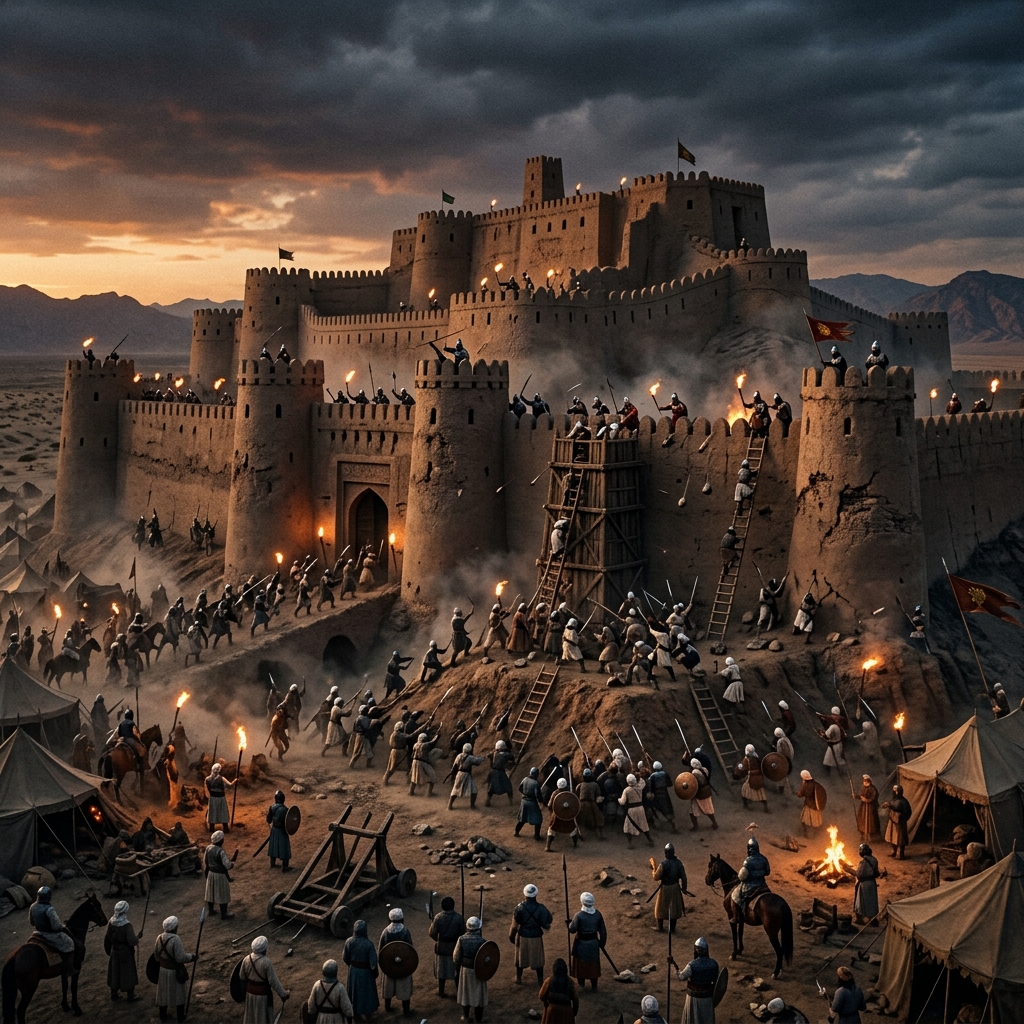
The year 640 AD.. and a new grinding battle between the Persians and the Arabs.. this time on the land of Persia itself.
The two sides were supposed to have a treaty and a peace between them from four years before that date.. but the king of the Persians, "Yazdegerd III".. the last of the kings of the Sassanid state.
Brother "Yazdegerd III" decides to violate the treaty.. and he pushes one of his professional commanders named "Hormuzan".. who begins to harass the Arabs and attack the lands and the forces.. so "Omar ibn al-Khattab", may God be pleased with him, moves against him, to topple the throne of "Yazdegerd" and take complete control of Persia.
And among the army of the Muslims was a man named "al-Bara ibn Malik".. and he was the brother of the famous Companion "Anas ibn Malik", may God be pleased with them both.. and he was brave in a way closer to recklessness.. to the point that "Omar ibn al-Khattab" once declared openly to his commanders that they should never place him in a position of command.. the right commander requires wisdom and a certain emotional steadiness.. "Do not use al-Bara over an army, for he is one of the perils by which they are led to destruction."
The army of the Muslims advances and besieges the Persians and their commander "Hormuzan" in several fortresses.. and they knew that if the commander fell, the army would surrender.. so they focused greatly on the fortress of "Hormuzan".. "al-Bara" had badly antagonized the Persians, because he was known to be someone who "cared nothing for his life".. he advances and fights and does not care.. to the point that it was said of him that on one occasion he killed a hundred men on his own.
In the midst of the battle and the skirmishes below the fortress.. "Hormuzan" himself emerges, carrying a bow and an arrow.. he draws the bowstring and takes careful aim.. and the arrow launches, cutting through the air with a sharp whistle like a rocket.. and lodges directly in the heart of "al-Bara".
And "al-Bara" falls and breathes his last, and not long passes before the fortress itself falls, and "Hormuzan" is taken captive.. and led to "Omar".
And because "Hormuzan" and his king were the ones who began with treachery and violated the treaty.. the Imam "Omar" asks him: "O Hormuzan, how did you find the consequence of treachery?".. so Hormuzan tells him hesitantly that he fears that if he tells the secret Omar will kill him.. so he grants him safety until he speaks.
Before he speaks he asks for a sip of water.. so "Omar" orders water for him.. and of course they were living a harsh life.. not like Hormuzan.. so they brought him a clay cup like this, he looked at it and said to them, "By God, if I were to die of thirst I would not drink from this cup".. so Omar orders "a cup that satisfies him".. as soon as he takes it he begins to tremble, and when "Omar" asks him about the secret of his agitation, "Hormuzan" tells him that he fears they will kill him while he is drinking.
So "Omar" grants him safety for his life until he drinks.. so "Hormuzan" pours the water onto the ground.. and says to them, "Isn't my life safe until I drink? Well, I'm not drinking!"
Of course that is something closer to "child's play".. and "Omar" nearly fell upon him at that moment out of rage.. but "Anas ibn Malik" — the brother of "al-Bara" — says to him, "He is actually in the right.. you, Commander of the Faithful, granted him safety for his life until he drinks.. and he did not drink."
So Omar tells Hormuzan that he has tricked him.. and that he does not accept being tricked.. and he will not let "Hormuzan" go unless he embraces Islam.. so "Hormuzan" declares his Islam.
This incident is very important because there are many accounts that "Hormuzan" embraced Islam only to preserve his life, while in his heart he remained upon his religion and upon his loyalty to the land of Persia.. that is none of our concern because we do not inspect hearts nor judge without evidence.. but the truth is that the Muslims always looked at Hormuzan with anxiety and caution.
Among the captives was a man named "Firuz al-Nahawandi".. the kunya by which he became known was "Abu Lu'lu'a the Persian".. and he remained a Magian as he was.. and he became a slave, and the spoils were distributed after the victory and he fell to the share of "al-Mughira ibn Shu'ba".. the governor of Kufa.
And "Abu Lu'lu'a" was a carpenter, a sculptor and a blacksmith.. and he and those like him among the captives were forbidden from entering Medina, but "al-Mughira" asks permission from "Omar" for them to let "Abu Lu'lu'a" enter because he is a skilled craftsman, and the Muslims could learn many things from him.. so "Omar" agrees.
As soon as he enters Medina he goes to complain to "Omar" about "al-Mughira".. and he tells him that "al-Mughira" demands from him a tax of 3 dirhams a day and that this is too much.. so "Omar" tells him that it is not too much given his crafts and his experience.. the blood rises to the head of "Abu Lu'lu'a" and he grows angry.. but "Omar" does not notice that.. and he asks him to make him a "raha".. a mill, that is.
So Abu Lu'lu'a replies to him: "I will surely make you a mill such as people will talk about."
This phrase carries several meanings.. and it has two readings.. among them "you are going to see a grinding you have never seen before".. meaning the threat.
Of course "Omar" was neither naive nor a schoolboy.. so he understood the threat.. he dismisses "Abu Lu'lu'a" and he becomes lost in thought, so the Companions ask him what is wrong? So he says to them, "The foreigner has threatened me with killing".. and "al-'ilj" is the foreign unbelieving man.. and its plural is "'uluj".
And on the night of 6 November of the year 644.. the Companion "Abd al-Rahman ibn Abi Bakr" was walking in a quiet area.. and he was surprised by Hormuzan and Abu Lu'lu'a and a man named "Jufayna", gathered together whispering and looking at something.. so when he appeared to them suddenly in the darkness.. they were thrown into confusion and a strange dagger dropped from their hands, the like of which he had never seen before.
A dagger with two points, made by Abu Lu'lu'a himself.. they take it and leave in confusion and tension.. and "Abd al-Rahman ibn Abi Bakr" does not pay the matter any attention, and goes on his way.
The muezzin gives the call to the dawn prayer, announcing the birth of 7 November of the same year, and the people line up behind "Omar ibn al-Khattab" and he begins to lead them in prayer.. and during their prayer "Abu Lu'lu'a" slips through the rows and rains down on "Omar ibn al-Khattab" with six fatal stabs.
Confusion breaks out and the people leave the prayer, and they corner "Abu Lu'lu'a" in a corner of the mosque, but he raises his weapon against them, and stabs 13 of them, 6 of whom die later, and he begins to flee, so "Abd al-Rahman ibn Awf" takes off his heavy cloak and throws it over him.. and he stumbles and they fall upon him trying to capture him, but "Abu Lu'lu'a" raises his dagger, and stabs himself in the heart with a penetrating stab, and dies by suicide.
When he dies they swarm over him to pull the dagger from his chest, and when they begin to investigate the matter afterwards.. "Abd al-Rahman ibn Abi Bakr" cries out in denunciation and astonishment, that it is the very same dagger he saw with Abu Lu'lu'a and "Jufayna" and "Hormuzan" on the night in which "Omar" was killed.
And because the Companions are human beings in the end, not gods.. people who err and are right, and with the collapse over the death of his father, anger blinds him, and Satan gains power over him.. so "Ubaydullah ibn Omar" draws his sword, and heads for Hormuzan and Jufayna and kills them.. and then he goes to the house of Abu Lu'lu'a, and finds his daughter, and she was a small child, so he kills her as well without guilt, in a horrifying crime.. that causes a terrible problem.. we will talk about it a little later.
The Imam "Omar" lies on his deathbed.. and he had decided on a system for choosing the caliph after him, so he formed a consultative council of six of the Companions, whose consensus would be binding.. and the six were "Ali ibn Abi Talib, and Uthman ibn Affan, and Abd al-Rahman ibn Awf, and Sa'd ibn Abi Waqqas, and al-Zubayr ibn al-Awwam, and Talha ibn Ubaydullah", may God be pleased with them.. so if the council split in opinion 3 to 3, "Abd al-Rahman ibn Awf" would arbitrate between them. And "Omar" asks them to begin the selection before his death.
The consultative council meets, and "Abd al-Rahman ibn Awf" asks them to choose only three of them.. so "al-Zubayr" begins: "I have given my affair to Ali".. and "Sa'd" chooses "Uthman".. and "Talha" chooses his companion "Abd al-Rahman ibn Awf".
"Abd al-Rahman" begins with "Ali": if I do not pledge allegiance to you, then advise me, whom do you nominate for the caliphate? So "Ali" says calmly: "Uthman ibn Affan".. and in the end the choice is narrowed to two.
"Ali ibn Abi Talib" and "Uthman ibn Affan".
And here.. "Abd al-Rahman ibn Awf" is forced to go beyond the council.. and he begins to survey the opinions of the Muslims at large.. and in the end the scale tips in favor of "Uthman ibn Affan".. the one we all know by a unique title.. it was said that he was given it because he was the only one who combined in marriage the two daughters of a prophet, and it was said because he used to recite much of the Quran and pray at night.
The title "Dhul-Nurayn" — the Possessor of the Two Lights.
And with the martyrdom of our master "Omar".. "Uthman ibn Affan" begins his rule by investigating a very difficult murder case.. because "Ubaydullah ibn Omar" killed two men without trial and on the testimony of one man that is valid only as circumstantial evidence.. and the greatest calamity and the tragedy.. is that a small child without guilt fell victim to his angry crime.
He consults the Companions about this dilemma, so one group says, among them our master "Ali", that "Ubaydullah" should be killed in retaliation.. because a life is for a life.. and another group says, "Omar is killed yesterday and his son today?"
So "Uthman" decided to lean with the other opinion, and since he had become the caliph and the child had no one after her father's suicide.. then the "blood-avenger" here is "Uthman" himself.. so he rules for the blood money, and pays it from his own wealth on behalf of "Ubaydullah".
This incident was one of the important points, which would cause the event that they hid from us for years and prevented us from speaking about it and left us prey to the ignorant at times, and to the ignorant extremists at other times.
The event that history has preserved for us under the name of "the Great Discord".. which took place between the years 656 and 661 AD.
And talking about it would take long, so we will continue our words later.
And the talk.. has a remainder.
-------------
Previous posts:
-------------
1 - http://bit.ly/2Rm5tBs
2 - http://bit.ly/2RACrOV