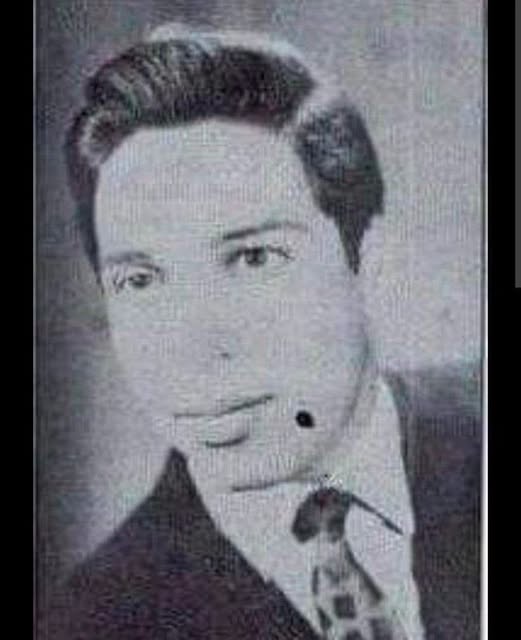
From the buried stories of October.
A story whose details not many know.. although it was turned into a film.. on television screens.
The story of the strange man, the man of a thousand faces, begins with the first ceasefire decision, when the Security Council met on the evening of 21 October, of the year 1973, and issued resolution number 338 for a ceasefire, on the following morning, 22 October.. with the decision to be implemented within a maximum of 12 hours.
Egypt and Israel officially accepted the decision, but Israel did not abide by it.
That is because Israel had not achieved any victory on the ground, and could not bombard the west of the canal, nor advance with tanks and occupy Ismailia or Suez as it had wished, nor cut the communication lines of the Second and Third Armies, nor force Egypt to retreat westwards.
And between 22 and 23 October, a civilian transport vehicle, of the Ford model, 1958 model, belonging to the Al-Ahram establishment, carrying several tons of papers, consisting of newspapers and journals and magazines and books, for distribution in the canal cities, moves out, driven by a young man from the sons of Cairo.
A young man whose real name is "Abdel Aziz Mahmoud".
And the dilapidated car moves with its heavy load, and passes the checkpoints and military columns, and indeed enters the city of Suez, before dawn on 23 October.
And the war ends, with Israel's loss, and its acceptance of the second ceasefire, and the United Nations decides to grant Egypt the right to choose the location of the talks.
And the late President Anwar Sadat insists that they come to him, as he is the victorious party, and indeed they attend at Kilometre 101 on the Cairo-Suez road to negotiate, and exchange prisoners, and on our side Major General Abdel Ghani El-Gamasy attends, as head of the Egyptian delegation in the negotiations.. while the Israeli delegation was represented by General "Aharon Yariv", deputy chief of staff.
The story goes as we all know, and after five months, the situation settles, and this time a special delegation enters Suez, to search for the press car, and its driver "Hassan Abdel Aziz".
The man who entered the exhausted city, and disappeared without prior warning.
And the journey of searching begins, made up of a special committee.
And "Abdel Aziz's" file at the establishment contained nothing but his photograph, and a certificate of good conduct and behaviour from two employees, and a third-degree driving licence, allowing him to drive all types of vehicles, from private cars to huge trucks.
With all that, there was a vaccination booklet, saying that he was one of the sons of Cairo, and an exemption certificate from military service.. because he was an orphan and the sole support of his mother, and her only breadwinner.
The search journey begins from Suez General Hospital, and there, everyone discovers that the hospital records, with the enormous pressure and numbers of wounded, did not have enough time to write down, and register everyone, and therefore they do not know whether "Abdel Aziz" had come.. and was actually wounded or not.
And with disappointment, and as the committee begins to leave, a nurse runs after them, and tells them.. that the man they are asking about came to the hospital and was indeed alone.
And approximately between the days of 23 and 24 October.
And that they extracted two bullets from his leg and his arm, and bandaged his wounds, and he left quietly despite the doctors' advice to stay, and that his name was not "Abdel Aziz", and she does not remember his name exactly, but she remembers his features well, and she named him "Mahmoud", after the name of her father, who was martyred in the year 1967.
And she writes down on a paper the name of Sergeant "Hassan", and tells them that he is the only one who asked about the strange man afterwards, and they might be friends, or he might have met him when he left.
And the journey of searching for Sergeant "Hassan" begins, who tells them that he did indeed allow the press car to pass, shortly before dawn on 23 October, and met its driver several times, and they used to chat and exchange conversation, with cups of hot tea in the cold of October, and amid cigarette smoke.
And he told them with the utmost confidence.. that his name was not "Abdel Aziz".
His name is "Kamal".
And with the committee members' confusion and bewilderment, Sergeant "Hassan" describes to them the location of the scrapyard, and directs them to its manager, and in it is every piece of any wrecked vehicle, or an intact one without an owner, that was on any inch of the land of Suez.
And in the scrapyard, the committee members discover that the notebooks and records are organised and very complete, and contain an inventory list of every piece they found, so they comb the yard, and review the records, in order to find something strange, and a coincidence that provokes bewilderment.
There is no piece that can be attributed to a truck of the Ford model, 58 model.
So the truth is that this model of trucks had its import stopped, and was replaced by Egyptian or Russian trucks, after the clash of the late leader Gamal Abdel Nasser with the United States, around the year 56.
And this type was confined to press vehicles and the transport of goods, in the heart of Cairo only, and the car that gets wrecked of it is scrapped, given the non-import of American spare parts.
Despite that, the owner of the scrapyard remembers that he saw the car in one of the streets of Suez, and it drew his attention because of the rarity of the model in its good condition, and that he exchanged conversation with the driver, and learned that his name was "Mustafa Ezzat".
And the committee is bewildered, and combs Suez inch by inch, and the matter in their hands begins to turn into a strange riddle that made them feel awe, after it had been merely a routine government assignment.
And with the search.. they reach an old woman, over seventy years of age, whose house was the headquarters of the fedayeen in the city, and there, they find hundreds of photographs on the wall.
And she tells them, with cups of tea, that every man of the resistance who used to visit her, she would ask him for a photograph and make him swear to her that he would visit a second time, and many of them did indeed return.
And everyone who did not fulfil the oath, she knew that he had been martyred, and would never return.
And on the full wall, bearing hundreds of photographs, the committee members find his picture.
"Abdel Aziz Mahmoud Ali Ahmed".
The same photograph as in the Al-Ahram file.
And the head of the committee snatches the photograph eagerly, and puts it in front of the woman, who smiles and tells them that this one's name is not "Abdel Aziz".
This is "Khalaf El-Sayed El-Menyaoui".. and that she wrote on the back of each photograph the name of its owner. And that he visited her one week ago, and left her money as was his habit whenever he visited her.
And on the back of the photograph was indeed the written name.
"Khalaf".
But this woman gives them a thread.
An important one.
The name of a real man from the famous resistance men.. who knew the strange man well.
"Mahmoud Awad".
And in "Awad's" house with his comrades from the resistance men, "Ashraf Abdel Dayem" and "Alaa El-Din Beshtly" and "Mahmoud Suleiman".. everyone listens with attention, and with the sight of "Abdel Aziz's" photograph.. "Alaa" remembers that the strange man was with him, during the attempt to prevent the Israeli tanks from advancing and occupying Suez.
And that he blew up two tanks with an RPG on the very night in which he was killed.
But "Suleiman" insisted in disapproval, that the strange man did not die, and that he prayed the Eid prayer with them.
And "Ashraf" said that all of this is wrong, and that the two of them had confused the matter.
That is because the strange man is "Zakhary Abdel Masih".. and that he was indeed martyred in the battle of the Arba'een district.
And for the first time, two testimonies agreed about the man.
"Awad" said that the man had indeed been martyred in the Arba'een battle.
And accordingly, the committee began to feel at ease, and headed to the Arba'een police station.
And with the station chief, and cups of coffee, they were suddenly surprised.. that he began telling them a new story...!
A story that jumped with them through time to the recent past.
23 October, of the year 1973.
And despite the ceasefire, and in an attempt to achieve any gain, even by deception, the Israelis send a private message, to the Suez governorate, requesting surrender, and the attendance of its governor and the security director and the chief of the Arba'een station, in an open jeep, stripped of weapons, raising white flags. On condition that they hand over all the fedayeen and army men and weapons, otherwise Suez will be bombarded by warplanes, and turned to dust.
And the message is picked up at the emergency police, by Major "Rifaat Shata", who rejects the Israeli order, and calls the security director.
But with the heat of events.. the security director was on the ground, not in his office.. in his office, and he was on a mission that might take long.
And for minutes, Major "Rifaat" sits thinking, then he did not delay in lifting the receiver of his telephone, and called directly the Minister of Interior.
And Major General "Mamdouh Salem", the Minister of Interior, listens to him with attention.. then endorses his position, and on defending the city of Suez, to the last soldier.
And immediately "Rifaat" puts on the military cap, and takes hold of his weapon, and begins to move, and on his way he meets the security director, and informs him of the minister's orders, and here, the security director opens the ammunition and weapons depots, and supplies with them all the police and resistance men, to defend the city at any price.
And a new epic begins, carried out by the police men, side by side with the resistance men, most of whom testified that the strange man was in the very same battle.
But some of them said that he was martyred by an artillery shell.
And others said by enemy bullets.
And some of them swore that he was alive.
Even the photograph with the poster, no one is sure of its accuracy.
And a policeman advised them to review the records of the martyrs.. and to go to Mr. "Hafez Salama", one of the leaders of the resistance.
And given that the name of the strange man was not in the records of the martyrs, they did indeed visit Mr. "Hafez", who decided that the stranger had indeed gone to fight alongside the security men, in the Arba'een battle,
But he never saw him after that.
And he swore to them that he had buried all the martyrs himself.
But he did not find the body of the strange man.. and he did not bury him.
And the bewildering question remained.
Where did the stranger go.. the man of a thousand faces?
And where and how did the huge truck with all its load disappear.. without the slightest trace?
And the committee returned to Cairo, with disappointing search results, but its members felt pride.
All pride.
Where did "Abdel Aziz Mahmoud" go.. "Kamal".. "Khalaf".. "Mustafa Ezzat".. or "Zakhary Abdel Masih" if he did not die in Suez between the days of 22 and 28 October?
Perhaps he is indeed alive.
Perhaps he is the worn-out old man whom you helped a few minutes ago to cross the street and you smiled at him, or the old sheikh sitting next to you on public transport, right now.
Perhaps he is sitting in front of you, contemplating you with attention at this very moment.. while you read his story in a public place... and you know nothing about him.
#The_Sixth_of_October #awareness_against_terrorism