The penultimate episode with artificial intelligence and Sophia.. and Elon Musk.. and Atlas and Google..
We stopped at a vital question in the previous posts.. the posts are in the first reference for anyone who wants to go back to them....
How do we stop robots from turning on us?
How do we stop them from killing us? When will machines with artificial intelligence turn on us?
Some enthusiastic AI scientists said "soon".. no, they even set a date.. the year 2029.. not 2028 and not 2030.. 2029 specifically..
This statement is based on "Moore's law".. and Moore's law, in short, is a law that says the number of transistors on any integrated circuit, or "electronic chip", doubles roughly every 18 months..
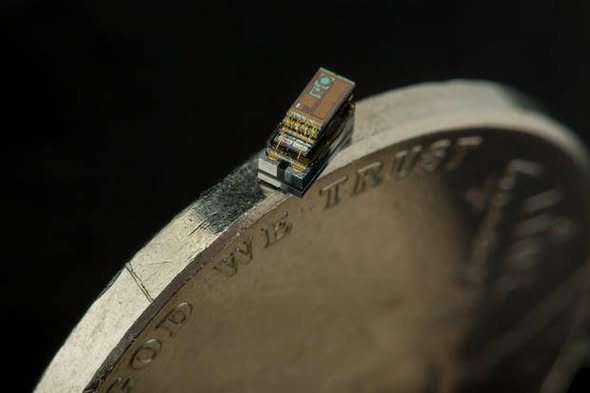
That is why, from the computer the size of a gas cylinder — Moore's base — and this rapid development.. we now have a computer you wear as a wristwatch.. and a computer the size of a pinhead.. the one in this picture, placed on a coin..
It is called the "Michigan Micro Mote".. this device takes pictures.. and measures temperature and pressure.. it has no mouse and no keyboard.. you deal with it through another computer that sends it data and receives data back from it by radiation..
Moore's law, then, has been valid for about 100 years in the past up to now.. from the days of primitive calculators until today..
The Japanese-American physicist "Michio Kaku" answers this question..
When, I wonder, will the day come when a robot "wakes up" in the lab and says "What is this? I am intelligent.. I am conscious".. that is more than that "I could become more intelligent if I put a few extra electronic chips in my brain.."
"Michio" is a "Futurist" as well.. meaning he studies the data and makes predictions about what will happen in the future, among the possibilities..
Some scientists said it is impossible.. it will never happen.. because "Moore's law" is about to break..
"Michio Kaku" explains this view.. and says Moore's law is in fact unable to continue forever.. because in the end.. physics takes over.. and what physics tells us is that "silicon" is an unstable material at the atomic level..
Devices get very small.. and become very powerful.. but every time this development happens.. they generate very high heat..
So what will happen is that at some stage the silicon will melt.. and electrons will leak out of it.. and here it becomes subject to Heisenberg's "Uncertainty principle".. you no longer know exactly where the electron is..
Scientists are now trying to study the "post-silicon" era.. and that needs about 15 - 20 years for them to reach it..
So in short, after a few years.. you will have a computer with no upgrade.. no stronger device coming out.. they will all be exactly the same..
Right now they are studying ideas like computers based on DNA.. quantum devices.. or the quantum computer.. etc..
But not one of these devices is ready to launch in the near future.. the most powerful quantum computer in the world today performs a calculation of at most 5×3 = 15.
So is that stupidity with all this expense and research? No, of course it is a great victory.. it is an easy calculation if you do it in your head.. and easier if you do it on a calculator..
But try doing it on five subatomic particles.. hold them and make them compute this calculation.. and on top of that, keep these particles safe from "quantum decoherence".. because any vibrations.. oscillation.. heat.. or anything else.. will scatter these atoms and you will not be able to do anything with them..
That is why it is hard to understand.. hard to program.. and hard to deal with.. and it still has a long way to go..
Therefore "Michio" says: by the beginning of the new century.. if we solve these problems.. we could build machines with intelligence like human intelligence.. because machines equipped with artificial intelligence today have the intelligence of insects..
We need to raise this intelligence and bring it to the intelligence of mice.. and after a long time it becomes as smart as cats and dogs.. by the end of this century it might reach the intelligence of monkeys.. and here it could indeed be a source of danger..
Here "Michio" simply tells us.. at this level.. a chip will be placed in their electronic brains.. separating them and turning them into useless pieces of iron.. if any harmful or lethal ideas come to them.. whether they developed them on their own, or were fed them, or thought about them.. and this chip detected them..
Even their attempts to destroy or disconnect the chip, if they somehow happen.. lead to the chip activating.. and cutting them off from work..
A chip programmed according to the Three Laws that "Isaac Asimov" set out in his story and that we talked about before..
Therefore the idea of artificial intelligence that might rebel against us is still very far away.. and it has many safety valves.. being developed side by side.. with the development of artificial intelligence itself..
So there is no real danger according to this account at the present time..
In the next post we will build a robot together.. a simple robot that performs a simple function, which is "metal detection".. and it will have the same shape as the "Mars Rover" in this picture.. but the size of a palm..
A model of a landmine detector the size of a palm..
This robot is easy for you to build and to teach your children to build.. instead of sitting there sighing over the planet Japan.. teach your children to think like their children over there..
The small size of this Mars rover was made as a graduation project at the "Massachusetts Institute of Technology MIT".. and this particular robot is studied in the institute's courses, "Introduction to robotics"..
We will see how simple the idea is and how its applications never end, and from it thousands of new inventions and innovations can launch, based on the real principle for which machines were made: "making human life easier"..
A 22-year-old Indian accountant picked up the idea and made a model like it that moves with hand signals.. so what is the benefit? What is the invention in a small model that moves with hand signals??
Meaning this model could move and hand the remote control and the medicine box to those who are bedridden and the elderly..
Meaning an idea, despite its simplicity.. is truly great and comforting for human beings..
The video is in the last link in the references..
You can have your children make a robot from an empty bottle.. a tin can.. the point here is not its value in itself.. as much as it is that they worked with their own hands and learn.. and start to take an interest in this science.. they start to think.. and when they think, for sure.. they will develop..
I hope to see professors at universities launching joint graduation projects between students in different faculties.. engineering students with dentistry students making a new device that is useful in dentistry.. and so on..
Every week school students take a project or a problem to solve in the science class.. every 10 students work on solving a problem.. and bring the solution the following week..
That will make a big difference..
Next time we will also learn some simple things that make the matter easier for us if anyone is into the subject.. like the difference between an "AC motor" and a "DC motor"..
We will learn where a robot like the Mars rover and the rest of the machines on Mars get their energy from and how..
That keeps us to a near meeting.. and the talk will have an end..
--------------
References:
--------------
1 - Previous posts:
- https://goo.gl/LqU7kG
- https://goo.gl/xBDsQw
- https://goo.gl/gphjpT
- https://goo.gl/KT1J1K
- https://goo.gl/WCSeDh
2 - Robots Learn to Say "No" to Humans: https://goo.gl/Ly1wgH
3 - Facebook abandoned an experiment after two artificially intelligent programs appeared to be chatting to each other in a strange language only they understood: https://goo.gl/ubbYud
4 - Problem solving, puzzle solving, game playing and deduction: - Russell & Norvig 2003, chpt. 3–9, - Poole, Mackworth & Goebel 1998, chpt. 2,3,7,9, - Luger & Stubblefield 2004, chpt. 3,4,6,8, - Nilsson 1998, chpt. 7–12..
5 - Russell, Stuart J.; Norvig, Peter (2003), Artificial Intelligence: A Modern Approach..
6 - https://goo.gl/PWHH77
7 - https://www.youtube.com/watch?v=rejZmqRrKMc