The robot Sophia, "Sophia the humanoid robot", caused panic among a lot of people.. some got worried.. and some imagined that the end is near.. and that robots will occupy the world and enslave us.. and some friends asked for information about this very topic..
We'll talk about robots.. and at the end of this series we'll make a video, in which we assemble a simple robot, from pre-made parts.. you can build it yourself.. or even your son who is 8 years old can build it..
First.. what exactly is a robot?
It is just a machine.. programmable by computer.. that carries out a set of complex tasks, whether by commands it has memorized in advance as part of its program, or by direct instructions from whoever controls it via remote control..
In the second reference there is a washing machine.. it performs a complex task pre-programmed into it.. its name is "Foldimate" — as soon as you wash the clothes and give them to it dry, it starts folding them and hands them back to you folded and ready..
Of course it's a complex process.. and folding different pieces of clothing differs, but in "its program" it deals with any piece, according to its nature.. therefore this washing machine is a "robot"..
And in Singapore and London and Dubai.. there is a metro with no driver.. it stops at the stations on its own.. and adjusts its speed by itself.. and gives a signal to the station before entering it, and closes and opens the doors on a set timing, and tells you in a recorded voice that the next station is "such and such".. and if it is forced to stop because of a fault, it notifies the metro behind it and halts the whole line so that no other train crashes into it..
That is a type of "Autonomous things", of which robots are an inseparable part..
The beginning was with the papyri of the Pharaohs, and the mechanisms with which the waterwheels and the shadoof were made, and the cranes that raised the buildings of the temples.. the methods of construction that "Thoth", the god of science and wisdom and medicine and engineering, taught to humans..
Unfortunately the Pharaohs mentioned these things in passing as "something self-evident".. not a miracle or anything.. therefore.. very little about them has reached us..
Then came, in the year 250 BC, a man named "Archimedes".. one of the most famous geniuses and inventors in history.. famous for the phrase "I found it"..
"Archimedes", by the way, studied with us here in Egypt.. in Alexandria..
He set down the law of buoyancy.. which to this day is called "Archimedes' principle".. and by virtue of it we now build enormous ships out of steel, not wood.. and they float on the surface of the water just fine..
Anyway, this "Archimedes".. the Roman fleet had come and besieged "Sicily".. the homeland of "Archimedes" himself.. and tried to push it to surrender..
But Archimedes made for the army mechanical metal arms ending in giant clamps and claws.. operated by chains and ropes, with a small effort that generates enormous force.. with which he tore apart the enemy's ships on the coasts of "Sicily"..
He made giant mirrors that concentrate the rays of the sun on the timbers of the ships from afar and burn them..
The Romans were of course enraged by him because they were the masters of the sea.. and for their fleet to turn into wreckage on the coast of a fragile country like "Sicily" is a disaster..
But despite that they were dazzled by his knowledge and his talent.. and they asked that he be captured alive if they entered Sicily.. and instructions were issued that no one was to harm him.. but unfortunately when the Roman forces landed on the coasts of "Sicily".. a Roman soldier killed him while not knowing who he was..
But after the birth of Christ.. the beginning was with two men...
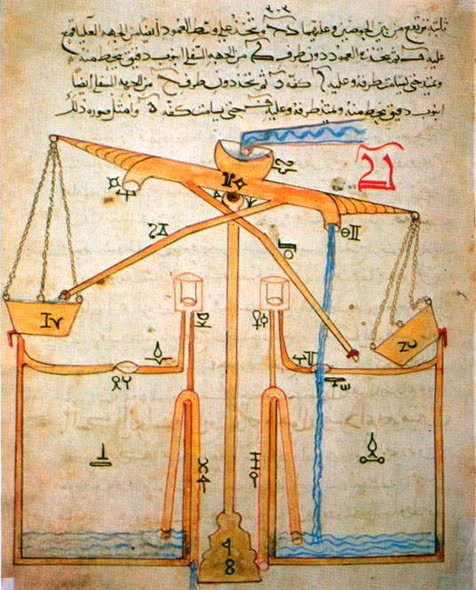
One, most likely a Syrian; his name is "Badi al-Zaman Abu al-Izz ibn Ismail al-Jazari, Ismail al-Jazari"...
This man, in the year 1206 AD, laid down for us the first rules of self-moving machines in this era.. and he wrote them and drew them in a book he called "Al-Jami' bayn al-'Ilm wa al-'Amal al-Nafi' fi Sina'at al-Hiyal".. and through this book we came to know him as yet another of the greatest engineers and inventors in history..
The picture with this post.. is one of the pages of the book..
He made machines for raising water, and clocks and alarms that work with water, and cranes and much else..
"Al-Jazari" is known abroad to this day among scientists as "Master of Robotics" because of his contributions in this field..
The second man came about two centuries after him.. in the year 1452 in Italy.. and his name was "Leonardo di ser Piero da Vinci".. the man who painted the Mona Lisa.. the one in the picture..
While "al-Jazari" and "Archimedes" carried out their inventions with their own hands and made successful models.. "da Vinci" only made drawings and studies.. most of which were not carried out on the ground until his death..
But while the work of "Archimedes" and "al-Jazari" was logical and understandable to some extent for their era.. "da Vinci", unlike them.. did something wondrous.. which brought him into history through its widest gates..
And that we will talk about later, and there remains more to say..
----------------
References
----------------
1 - Carroll, Bradley W. "Archimedes' Principle".
2 - https://goo.gl/ZA8nmU
3 - Hayes, John Richard, 1983. The Genius of Arab Civilization:Source of Renaissance. 2nd edition. p. 205. MIT Press.
4 - Donald Hill (1996), A History of Engineering in Classical and Medieval Times..
5 - Ancient Engineers' Inventions: Precursors of the Present, ed.Cesare Rossi, Flavio Russo, (Springer International Publishing, 2017), 364..