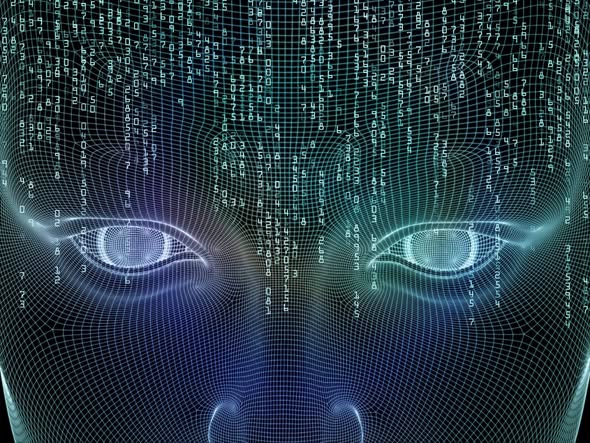
We are still with the robot "Sophia" and we begin to learn what the three laws of robotics are.. and are they fact or fiction?
1 — A robot may not injure a human being or cause harm to a human being through negligence or inaction.
2 — A robot must carry out the orders of a human being unless this conflicts with the First Law.
3 — A robot must protect its own existence so long as this existence does not conflict with the First and Second Laws.
These are the three laws set down by "Isaac Asimov" while he was writing his wonderful collection "I, Robot".. about machines equipped with artificial intelligence, serving humans in their homes and carrying out cleaning and guarding work.. and many tasks in various fields of life..
And because the robot is equipped with artificial "intelligence".. it was inevitable that there be a safety valve that prevents it from harming humans if this intelligence develops.. so here came the setting down of these three laws..
The story is taken and made into a film.. and adapted for the cinema under the same name.. and in the film we discover that there is a robot that "begins to become self-aware".. and rebels against the three laws set down by its makers.. and it becomes the beginning of a thread that guides the police detective "Will Smith" to the mother computer, which drives and controls all the robots in the world..
The mother computer here developed its own artificial intelligence.. and took the principle of "Mohamed Morsi" and with it decided to control humanity: "there is no objection to sacrificing a few so that the rest may live".. and it decided to dominate humans, and control them and prevent them from love and thinking and hatred and wars and pollution and the annihilation of the Earth..
The story reflects man's fear of equipping machines with artificial intelligence.. that makes them in the future the possessor of an independent decision..
What is "artificial intelligence"?
The idea is very old.. from before the birth of Christ.. the most famous figure distinguished by it was the mythical "Talos"..
And this "Talos" is a giant bronze statue that protects Crete from the raids of pirates.. whoever wants to recall "Talos" should recall the old film "Jason and the Argonauts".. in which a giant statue rises from its place to kill Jason and his men when they trespass against Crete.. this shot is in the third link in the references..
And then "Heron of Alexandria" tells us about metal men similar to Talos but of human size.. playing the role of soldiers and guards..
An intelligence that makes devices able to confront new problems and develop solutions for them by means of logical reasoning, which increases their chance of success in their mission..
That is artificial intelligence in its simplest definition..
"Ramon Llull" in 1250 designed a wondrous machine.. but he could not make it.. its name is the "Calculus ratiocinator".. its drawings have reached us.. and it is a machine that is supposed to have been able to solve various quandaries by means of logical reasoning.. and in reality this machine, with the technology of his era, was impossible to make..
But the real beginning was in the fifties..
And specifically in the year 1956, when a man came who gathered all these threads.. and linked human intelligence with the machine.. and spoke about logical reasoning for machines..
And the strange thing is that he was drawing on the story that Asimov wrote in 1940..
This man's name is "John McCarthy", an American computer science professor.. and the first one to coin the term "artificial intelligence".. and today he is called the "Father of AI"...
Men of industry did not care much, especially as they saw the idea as philosophical: "a machine with the ability for logical reasoning?" But in the year 1957.. there is a company called "Newell" that decides to implement it.. and indeed after two years it comes out with a program called the "General Problem Solver"..
The program succeeded in solving simple problems.. arithmetic or otherwise.. but it could not solve real problems that were put before it..
That was a great victory at the time because we are talking about the early sixties..
But with "McCarthy's" announcement of the term in the fifties.. there was a group of university students.. aged 17 and 18.. they held a workshop.. and began working in silence..
And suddenly, in 1958, they came out with a machine that can play chess with a human..
Meaning an intelligent machine.. that develops its positions according to new quandaries.. and tries to win and succeed in its goal..
And here the American army intervened forcefully.. and funded this research with open financing..
And businessmen entered the race..
But failure pursued everyone time after time..
And in the mid-seventies many companies trying to advance in this field collapsed after they had spent nearly a billion dollars on research that did not succeed.. and the government began to care about more important research such as developing weapons of mass destruction and others, and the world entered a phase called "AI winter"..
The world began to talk about the failure of artificial intelligence.. had it not been that there appeared a researcher named "Rodney Brooks" who presented to them many examples of its success in life.. and interest in it returned strongly..
Among these things is a chat robot called the "chatterbot ELIZA" that was made in 1966.. and this robot can sit and chat with you for an hour on the computer.. without you discovering that it is a robot.. you might just feel that it is a "somewhat stupid" person..
You can download ELIZA from the fourth reference and try chatting with it and see machine artificial intelligence in the flesh..
What is the use of artificial intelligence? And what are its applications in robotics.. and in what does it benefit and in what does it harm.. and what are its tasks and functions and limits?
Are there devices that have actually rebelled against humans?
That would take long to talk about, and there remains more to say..
-----------
References:
-----------
1 - https://goo.gl/LqU7kG
2 - https://goo.gl/xBDsQw
3 - https://goo.gl/yyri3q
4 - https://goo.gl/N7swVh
5 - Crevier 1993.
6 - Tao, Jianhua; Tan, Tieniu (2005). Affective Computing and Intelligent Interaction.
7 - Skillings, Jonathan (3 July 2006).
8- Nilsson, Nils (1998). Artificial Intelligence: A New Synthesis. Morgan Kaufmann...