We decided to talk together about the robot Sophia.. a "Humanoid".. and from this topic we began to learn what robots are and their history, and we arrived at "Leonardo da Vinci"..
"Da Vinci" was a painter.. an engineer.. a botanist, a cartographer, a geologist, an expert in anatomy.. a musician.. a sculptor.. an architect.. and an inventor..
Unlike many inventors before him.. "da Vinci" did not build his inventions, and almost no one understood them in his era.. but later on scientists noticed something wondrous..
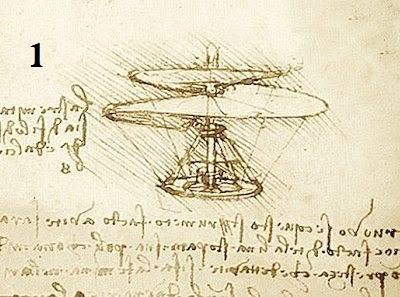
Drawings of a helicopter, which is in drawing No. 1.. it works by ropes, through its rider pulling a rope inside it continuously as if he were ringing a church bell, so the blades turn, and it rises with him..
Here the scientists studied this idea and said that it is impossible.. and unworkable, because muscular force can never be sustained to the degree that it keeps this design stable in the air..
But the credit for the emergence of the idea of vertical flight here goes back to "da Vinci".. the idea was later borrowed by the writer "Jules Gabriel Verne" in his story called "Clipper of the Clouds".. and this story in turn was an inspiration to a young Russian named "Igor Ivanovich Sikorsky" with the idea of "the helicopter that flies".. and in 1909 he made for the Soviet Union the first helicopter in history...
A strange idea, that a man from the fourteenth century invents a helicopter, but da Vinci did not stop here, he designed a complete "tank".. the one in drawing 2.. armored and plated against shells, and it turns around its axis in place by a mechanism of gears and chains, in order to fire its shells in every direction..
No one in da Vinci's day understood exactly what this was.. and no one thought of building it..
The parachute.. da Vinci designed it and drew it.. and he made it "triangular" in shape.. and scientists actually built it, and tested it, and it turned out to them that it is successful.. very much so..
The mitrailleuse.. the rapid-fire field gun that fires shells one after another.. its idea goes back to da Vinci.. and he drew it as is clear in picture 3..
Da Vinci, while designing his helicopter drawings.. put in them a drawing of a simple invention, so that its parts would not wear away from the fast rotation.. and were it not for this invention of da Vinci there would be no industry at all.. and all factory machines would be constantly wearing away, and that would make the price of the goods produced very expensive..
He designed the "ball bearings".. which is in the fourth picture.. it exists today in almost everything.. from the fan in the ceiling of your room.. to the laptop you are using.. passing through cars and the machines and machinery of factories.. to rockets and spaceships..
He made movable bridges.. and he designed the bridge in picture 7...
He designed the pedal bicycle.. the bike we ride, centuries before the Scottish blacksmith "Kirkpatrick Macmillan" made it..
He made a diving suit.. equipped with two hoses.. connected to the surface of a boat.. and they pump air to the diver.. this suit was actually made.. but also centuries after da Vinci's death..
He designed the mechanical player, and he designed a musical instrument that combines the qanun and the piano.. and he designed a real self-moving robot out of the metal suit of one of the knights of the Middle Ages.. the one in picture 5..
And likewise the scientists built this last robot.. and it moved and worked successfully..
This robot was a "Humanoid", meaning "human-like".. meaning this is considered the first ancestor of "Sophia" in history.. its name was "the Mechanical Knight".. and the scientists later called it "Leonardo's robot"..
When you look at da Vinci's drawings and his ideas and know that he died in 1519.. you feel that he was seeing the future while he was drawing these innovations of his..
After that, in 1815, there appeared a Japanese young man named "Tanaka Hisashige".. and he used to make complex self-moving mechanical toys.. and the attempts kept going.. until the story forces us to take a wide leap.. to the year 1956..
In that year the American "George Devol" designs the first real robot that can deal with tools and materials.. and he names it "Unimate"..
He leaves the robot's papers in the drawers, until one of his friends presents the idea to several companies, and here.. "General Motors" buys it in 1961, and uses it in welding car parts and spraying paint.. and dealing with hot and blazing metal parts..
General Motors in turn tries to sell the invention and sets up a line to produce the "Unimate" robot.. but no one buys it or cares.. until the year 1975, when "Unimate" is developed and becomes a "Programmable Universal Machine for Assembly".. and then profits pour in because of it.. and it begins to be known globally and becomes indispensable in industry..
"Unimate" is in picture No. 6.. which is the robotic arm that performs certain functions and that we all see in car factories especially..
But during the period of manufacturing and marketing "Unimate", there had appeared to the world the first robot that people read about and saw clashing with humans and breaking the law and defying everyone directly, and that we will continue talking about later..
And there remains more to say..
-----------------
References:
-----------------
1 - Previous posts: https://goo.gl/LqU7kG
2 - Liana Bortolon, The Life and Times of Leonardo, Paul Hamlyn, 1967..
3 - PUMA Robot Becomes Part of American History at the Smithsonian Robotics Online -
4 - https://goo.gl/acS2u1
5 - Rosheim; Mark Elling. Leonardo's Lost Robots. Springer, 2006...