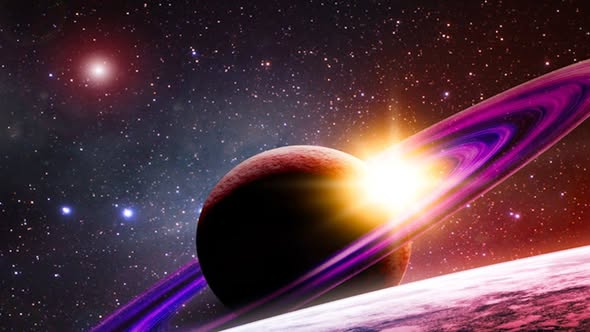
A planet with no surface..!
"Jupiter".. the one named after the chief of the Greek gods.. "Jupiter" or "Zeus".. the lord of thunderbolts, rain, winds and clouds.. a planet with no solid surface to stand on.. or to set your equipment and machines down on..
That is because Jupiter is a mass of gas...
A colossal mass of gas and liquids.. that gathered into this ball shape with a high gravity.. roughly two and a half times our own gravity..
And although the planet is gaseous.. they believe it has a solid rocky core.. around which hydrogen, liquids and other gases collected.. to make the largest planet in the solar system.. which was once twice its size today..
And its temperature was much higher.. so if Jupiter's temperature today reaches 150 degrees below zero.. it was hotter.. and its core gives us a temperature that reaches 24 degrees Celsius..
And despite that, this planet radiates far more heat than it receives from the Sun..
It radiates heat in enormous quantities.. which makes its surface cold.. and its core hot.. and this causes a drop in pressure on its surface.. and this process is called the "Kelvin–Helmholtz mechanism"..
Jupiter also has the largest atmosphere in the entire solar system.. but because the planet has no surface.. they measure the height of the atmosphere from the point where the pressure equals 1 bar.. just like on Earth..
And a day on Jupiter equals ten of our hours.. while a year on Jupiter equals 12 of our years...
So if you left your son at home for a day.. and travelled and stayed on Jupiter for two years.. assuming you would find a way to sit inside this gaseous entity.. you would come back to find your son a young man of 24...
And the planet Jupiter has 67 moons.. yes, "sixty-seven" moons.. orbiting it.. the largest four of them are the ones discovered by the Italian "polymath" "Galileo Galilei" in the year 1610 AD.. and they are "Io" and "Europa" and "Ganymede" and "Callisto"..
And "Ganymede" is the largest of them.. the largest moon in the entire solar system.. larger even than the planet Mercury...
And Jupiter has two poles.. and an aurora was seen at its north pole like the one that occurs here on Earth..
"Saturn" is also a gas giant like Jupiter.. smaller in size than it.. but also a mass of gas...
It takes its name from "Saturn", the Greek god of fertility and agriculture.. and it is the sixth planet in terms of distance from the Sun.. and the second largest planet in the solar system after Jupiter..
And a day on Saturn is close to a day on Jupiter.. 10 hours and 42 minutes of ours.. as for a year on Saturn.. it is much longer.. it equals 29 of our years..
So with the example people like.. if you travelled while you were thirty years old and stayed on Jupiter for two years.. and left your son at home for a day.. you would come back after two years to find your son.. about 60 years old...
And Saturn is a cold planet.. its temperature is 178 below zero.. and Saturn has an atmosphere and there is water.. but in frozen form...
Saturn is very famous for having rings around it.. it is the only planet with visible rings famous for it as in the picture.. Jupiter also has rings around it but invisible.. unlike "the rings of Saturn"..
And these rings are water and ice and metals and particles and fragments and meteorite remnants and rocks.. pulled by Saturn's gravity.. which is very close to our gravity.. differing from it only by a slight increase.. and they orbit the planet constantly..
And Saturn, like Jupiter.. has many moons.. 62 moons.. and there are still 4 whose existence is not confirmed.. if their existence is proven they would make 66 moons.. the largest of them is "Titan"..
And the moon "Titan" is a bit strange.. and closer to a planet than to a moon.. so it possesses an atmosphere mostly of nitrogen like ours.. and its climate has rain and storms like ours.. and it has traces of lakes and rivers like ours..
The daytime scene there is beautiful if you could go there.. as in the picture..
And "Titan" is cold like Saturn.. its temperature is 179 below zero..
Jupiter and Saturn and Titan.. are different from Uranus and Neptune and poor "Pluto" whom they expelled from the list and no longer consider a planet, and put "Eris" in its place.. about which we will talk tomorrow.. and there our talk comes to an end..
------------
References:
------------
1 - Previous posts:
- https://goo.gl/H5ttvo
- https://goo.gl/F8BG9o
- https://goo.gl/H5Hihz
- https://goo.gl/g0Yhwk
- https://goo.gl/tb3esD
2 - https://goo.gl/iaAfQf
3 - Hefler, Michael (2001). "Europa: In Depth". NASA, Solar system Exploration. NASA, Jet Propulsion Laboratory