We talked about the Sun and the Earth and all the planets of the solar system.. that talk is in previous posts found in the first reference for anyone who wants to review it..
Today we conclude with Uranus and Neptune and poor "Pluto" whom they expelled from the list and no longer consider a planet, and put "Eris" in its place..
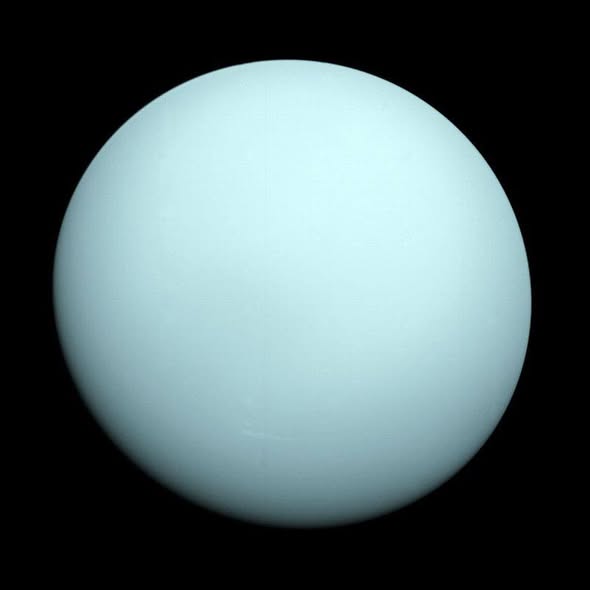
"Uranus" is the seventh planet in terms of distance from the Sun.. and the third largest planet after Jupiter and Saturn..
And "Uranus and Neptune" are different from the two gas giants "Jupiter and Saturn".. and they are classified "as ice giants".. and their atmosphere is ice and ammonia and methane and hydrogen and helium and other elements..
The coldest climate in the solar system with a temperature that reaches 371 degrees Fahrenheit below zero..
As for the core of Uranus, it is made of rocks and ice..
And a day on Uranus is 17 and a quarter of our hours.. and its gravity is almost like our gravity...
And Uranus completes a full orbit around the Sun in 30,912 days..
Meaning a year on Uranus equals 84 Earth years of ours.. so if we apply the usual example.. and you left your son on Earth for one day.. and travelled immediately to Uranus and spent a year there.. you would come back to find your son is 84 years old..
And Uranus has rings like Saturn.. but they do not show easily.. and it is originally invisible to the naked eye.. and it has 27 moons at once.. the largest of them is "Titania" and it is the eighth largest moon in the system and its diameter is the radius of Earth's moon..
As for its friend "Neptune", the fourth largest planet.. it was the first planet they discovered through equations and mathematical prediction.. because the unexpected changes in the orbit of the planet Uranus.. made astronomers suspect the existence of an unknown planet located behind it.. affecting it..
And the distance between Neptune and the Sun is 30 times the distance between the Earth and the Sun.. meaning 30 "astronomical units".. or 4.50 billion kilometres..
And Neptune so far has 14 moons.. the largest of them is "Triton".. and it has rings like Saturn and Uranus..
And a year on Neptune equals 165 of our years.. while a day equals 16 hours and six minutes of ours..
As for "Pluto".. it was the smallest of the nine planets of the solar system.. but scientists redefined the term "planet".. and that took Pluto out of the matter and made it a "dwarf planet"..
And a dwarf planet is neither a planet that influences with its gravity and magnetic field what is around it.. nor is it a moon following something.. it simply has a size and mass and force enough to keep it in its place and preserve its spherical or near-spherical shape..
And Pluto's surface is made of rocks and ice.. and it has five moons, the largest of them is "Charon"..
And a day on Pluto equals almost an Earth week.. and a year on Pluto equals 247.7 of our years..
After Pluto was removed, the planet that came after it entered, and its name was "2003UB313".. and then they discovered that it was a dwarf like Pluto as well.. so they named it "Eris"..
Eris is a "trans-Neptunian dwarf planet".. and "trans-Neptunian" means any body located beyond "Neptune"..
And Eris has one moon like us.. and sometimes in its orbit around the Sun, because of its distance from it.. its atmosphere freezes from the intensity of the cold..
And a day on "Eris" is longer than our day on Earth by just an hour and nine minutes.. but a year on "Eris" equals five and a half centuries.. or 560 of our years..
So if you travelled to "Eris" immediately and stayed there a year.. you would return to Earth to find Morsi still has not come back..
"Eris" like the rest of the planets is still under study.. there is a great deal we still do not know about the solar system..
Uranus is the turquoise one.. and Neptune is the blue one in the pictures with the post..
Among the strange facts that you come across while studying the solar system.. is that what we know about the solar system is more than what we know about the depths of the ocean..
And what we know about the two of them together.. is far more than what we know about the human brain...
-----------
References
----------
1 - Previous posts:
- https://goo.gl/H5ttvo
- https://goo.gl/F8BG9o
- https://goo.gl/H5Hihz
- https://goo.gl/g0Yhwk
- https://goo.gl/tb3esD
- https://goo.gl/o1553k
2 - https://pds.jpl.nasa.gov/planets/special/pluto.htm
3 - https://goo.gl/FmrwXi
4 - Burgess, Eric (1991). Far Encounter: The Neptune System. Columbia University Press.
5 - https://theplanets.org/eris/