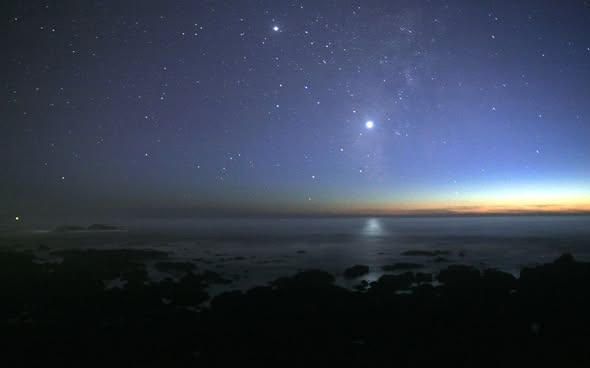
The planet of the riddle...
Named after the goddess of beauty, tenderness and love, "Venus." The second planet after "Mercury," and the second most radiant body in the night sky after the Moon. You can sometimes see it in daylight. It is the one in the picture that is radiant, and the slightly smaller, less radiant one is "the planet Jupiter."
And that is why the Arabs called it "al-Zuhra," meaning beauty, whiteness, loveliness and radiance.
There are scientific theories saying that "the planet Venus" was like our Earth.
Exactly like it, and it still bears many of its features, to the point that because of the resemblance they call it "Earth's sister planet."
An atmosphere containing oxygen, carbon dioxide and nitrogen.
Its gravity is very close to ours.
And it had seas, and oceans, and rivers and forests.
Jungles and thickets, crops and animals.
Rain.
And life.
But suddenly something strange and incomprehensible happened.
Theories are many, but the most wild and thrilling of them is that the planet, from 600 million years ago or more, was subjected to a catastrophe and began to be polluted.
A pollution of unknown source that filled the atmosphere with carbon dioxide, which reached a proportion of 96.5%.
Some say that it was not pollution, but that because of the evaporation of water, the atmosphere's density increased and carbon dioxide began to accumulate in it at this terrifying rate, so the planet began to turn into something like a greenhouse and trap the sun's heat.
The temperature rose to nearly the heat of volcanic lava, and settled at 900 degrees Fahrenheit, meaning higher than the temperature of "Mercury," despite the latter's proximity to the Sun.
With the terrifying heat, every drop of water on the planet evaporated, and all forms of life perished.
The matter does not stop at heat alone. Venus is stormy, and its storms never calm down. But fiery, scorching storms that burn you in seconds and turn you to ash.
And if rain annoys you on Earth, then I would like to tell you that some metals on the surface of Venus — like lead — in certain places, melt from this heat and evaporate.
And come down as rain...!
Rain of molten metal.
And with the terrifying imbalance and the interactions in the climate, the rest of the planet also gets rain, but most of its composition is concentrated sulphuric acid.
In the common expression, "fire water."
But this fire water never reaches the surface of the planet, because it evaporates from the extreme heat before it reaches the surface, and condenses in acidic clouds, and rains again.
Atmospheric pressure is the weight of the atmosphere that we bear on our bodies, and that things around us bear.
Pressure increases when you dive into the sea, for example, and go down into the depths, because your body also carries the weight of the water.
The pressure on the surface of our Earth is roughly 1 "Bar."
As for the surface of Venus, the mass of its atmosphere is more than 90 times the mass of Earth's atmosphere, meaning an atmospheric pressure of 93 bar.
Meaning a force of 930.197162129779 tons on every square metre.
A pressure equivalent to your being at a depth of about a kilometre beneath the surface of the sea. This pressure is enough to crush a human being and squeeze his body in the blink of an eye, as if a truck had run over an empty cigarette pack.
And while the day with us on Earth is 24 hours, the day on Venus equals 5,832 hours, meaning 243 of our days. And the year equals 225 of our days. Meaning the day on Venus is longer than the year there.
So if you left your son on Earth still a newborn and travelled instantly to Venus — regardless of the fact that you would turn into a piece of charcoal or a heap of ash — but if it happened that you stayed a day somehow, you would come back at the end of the day to find the boy is 8 months old...
Venus rotates around itself in reverse, with the direction of the clock's hands, opposite to the direction of rotation of all the planets, which rotate counter-clockwise.
And the Sun rises on it from the west.
A piece of hell rotating in space. Acidic rains. Thunderbolts. Molten metals. Volcanoes. Terrifying atmospheric pressure and lethal heat.
Why is the climate like this? We are definitively not sure. Why does it have no moons? No one knows.
A riddle...
The second picture, the desert that these thunderbolts strike — it is supposed to be one of the true, coloured images of "Venus," but I am not sure of its accuracy and did not find it on NASA's website. But it is present on "Space.com."
Venus differs greatly from Earth, our planet that you might imagine you know a lot about, but the truth is that it holds more surprises than we know. We will talk about them later, and there remains more to say.
-------------
References
-------------
1 - منشورات سابقة:
- https://goo.gl/H5ttvo
- https://goo.gl/F8BG9o
2 - Mallama, A. (2011). "Planetary magnitudes". Sky & Telescope...
3 - "Venus: Facts & Figures". NASA...
4 - Lopes, Rosaly M. C.; Gregg, Tracy K. P. (2004). Volcanic worlds: exploring the Solar System's volcanoes...
5 - Nimmo, F.; McKenzie, D. (1998). "Volcanism and Tectonics on Venus". Annual Review of Earth and Planetary Sciences...