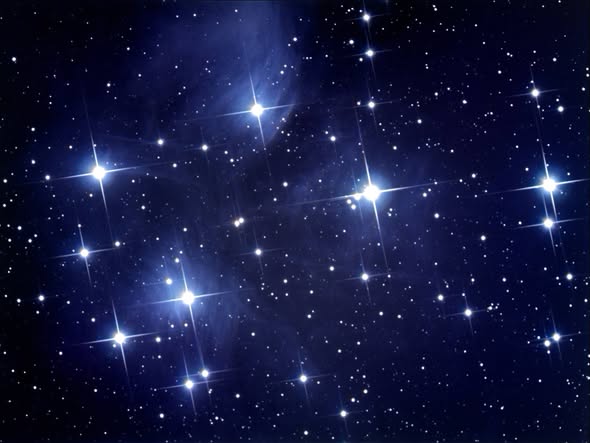
One of the most beautiful sights you could ever see is the sight of the clear sky at night.. and you watching dozens of stars, filling the sky.. some of them shining and glowing and some of them appearing faint, switched off..
If you look closely and search well you will find that these stars are not all blue.. there are white ones like neon lamps.. and there are yellow ones.. and blue.. and even faint red...
That is because in reality they are suns..
Suns exactly like our sun.. the one that rises on us in the morning and disappears at the hour of sunset.. but because they are very far from us we see them as luminous, shining stars at night and that is all..
These "cold" stars are suns.. some of them exactly like our sun.. the temperature of its surface is about 5800 Kelvin.. and the temperature of its core is 15.7 "million" Kelvin...
And the truth is that they are not hundreds..
Our solar system is part of a galaxy called "The Milky Way The Milky Way".. this galaxy contains from 200 to 400 billion suns...
And most of them have planets around them.. and moons.. For a star to carry the name "sun Sun" it must have planets revolving around it.. forming a solar system of its own...
Our sun consists mainly of hydrogen and helium.. it contains 1% oxygen and less than 1% other elements such as carbon and iron..
A gigantic ball of plasma (plasma in the Greek language means jelly or jelly) whose age is approximately 5 billion years.. and it is most likely in the middle of its life.. it has another 5 billion years ahead of it..
Why does this burning mass of gas not burn up in two hours like sulphur and finish and be annihilated..?
Why do suns not burn up and disappear and vanish quickly.. and why do their lifespans reach millions of millions of years..?
That is because the combustion that happens in the Sun is different from ordinary combustion.. unlike the combustion of a piece of paper for example that you set alight with a match...
A piece of paper and a match, for example, ignite in a chemical way, and the energy produced here.. which is heat.. results from the combination of sulphur with oxygen with organic materials...
As for the combustion of the Sun and stars like it, it is nuclear combustion..
Combustion of annihilation...
The atom is smashed and is released as rays across the universe.. and this type of nuclear combustion is extremely slow.. because a very small amount of matter gives us enormous energy.. it makes the Sun the main source of energy on Earth and in the whole [solar system](https://alaafans.com/series/solar-system "solar system")...
What happens if the Sun disappears? Plants die because there is no "photosynthesis Photosynthesis" and the temperature drops to hundreds of degrees below zero and the oceans and seas freeze.. and animals die and children get rickets.. because the sun's rays create vitamin "D D" in our bodies.. and there would be no food so humans would die.. and life would become extinct..
So what if the Sun came closer or grew in size? The seas and oceans would boil and the atmosphere would burn and life would likewise perish and become extinct from the Earth..
The Sun is 149.6 million kilometres away from us.. meaning about 8 light-minutes.. A light-minute is the distance light travels in a minute.. and it is about 18,000,000 km...
The Sun has gravity.. like all the planets of our system.. because in the depths of its core there is a natural, God-given "solar dynamo solar dynamo".. that generates electric currents and a magnetic field and gravity.. What is this dynamo and how does it work? That is still something not entirely known in our present age...
It is true that its gravity is 0.0006 of the Earth's gravity.. but this force is enough for it to pull us to revolve around it in a complete cycle.. once every year...
The closest planet in our system to the Sun is "Mercury Mercury".. and although it is the closest planet to the Sun, and is supposed to be the hottest of them.. that is not correct.. the hottest of the planets is "Venus", for very strange reasons that we will learn about later...
Mercury's temperature during the day reaches 427 degrees Celsius.. and at night it is below 170 degrees below zero..
A year on Mercury is about 88 of our days.. it completes its revolution around the Sun in 88 days.. meaning if you travelled to Mercury and spent a year there.. you would come back and find that you had been away from Earth only two and a half months...
Mercury has a lock on the Sun.. like the one we talked about yesterday.. the one the Moon has on the Earth.. "tidal locking Tidal locking".. or "gravitational locking gravitational locking".. so it has one face that faces the Sun most of the time.. because it rotates on its axis only twice for every 3 revolutions it makes around the Sun...
And because of the strange manner of Mercury's rotation and its extremely slow rotation on itself and the speed of its rotation around the Sun.. a year on it equals 88 of our days.. but a day on Mercury equals approximately 59 of our days...!
The planet Mercury is small in size.. bigger than our Moon by a little bit.. its gravity is weak and its atmosphere is very thin because it is constantly burning and dissipating due to its proximity to the Sun.. but it is not the smallest planet in our solar system...
If we leave the range of the planet Mercury and travel in the direction of Earth, opposite to the direction of the Sun.. we must come across the path of the planet "Venus venus".. which the scientists told us "was once exactly like our planet.."
Meaning it had water..
And seas and oceans..
And an atmosphere and oxygen..
And life..
But unfortunately they also tell us that "Venus" was subjected to a strange catastrophe.. that turned it into a red hell..
And this subject would take long to talk about and the talk will have a continuation...
---------------
References
--------------
1 - Previous posts: https://goo.gl/H5ttvo
2 - Zombeck, Martin V. (1990). Handbook of Space Astronomy and Astrophysics 2nd edition...
3 - Bonanno, A.; Schlattl, H.; Paterno, L. (2008). "The age of the Sun and the relativistic corrections in the EOS". Astronomy and Astrophysics. 390 (3): 1115-1118. ..
4 - Munsell, Kirk; Smith, Harman; Harvey, Samantha (May 28, 2009). "Mercury: Facts & Figures"...
5 - "Mercury Fact Sheet". NASA. 22 December 2015...
6 - Correia, Alexandre C. M.; Laskar, Jacques (2004). "Mercury's capture into the 3/2 spin-orbit resonance as a result of its chaotic dynamics". Nature. 429 (6994): 848-850...