Let us continue then with the Ottoman state series.. whenever you talk about "Muhammad Ali", the aghas pop up and tell you "a creature of the West, made to destroy the Muslim Ottomans". You go and check the matter.. and you find that the Ottomans at that time were allies of the French.. of the Austrians.. of the Dutch, the Spaniards and the Portuguese.. and buying English weapons.. while "Muhammad Ali" had not a single ally.
"Muhammad Ali" had decided to build an army.. so he began imposing taxes on the people.. and carrying out economic reforms.. the people had loved him before he ruled Egypt.. so they accepted his reforms.. this is the fundamental difference between "Muhammad Ali" and his predecessor, the enemy of the Ottoman state "Ali Bey al-Kabir".. "Muhammad Ali Pasha" leaned on the people.. while "Ali Bey al-Kabir" tried to make alliances with foreign powers and failed.
People by nature always forget once they settle into comfort and relaxation and are far from danger.. they forgot that "Muhammad Ali" had saved them from "Khurshid".. and forgot that he had saved them from the Ottoman cavalry regiment that spread corruption in Cairo.. and forgot that they were the ones who had chosen him.. so when he imposed taxes for the second time in June 1809.. the people grumbled and rose up.. and went to ask for help from "Omar Makram".
"Omar Makram" had imagined that when "Muhammad Ali" ruled.. he would be under his supervision, him and the popular leadership.. but "Muhammad Ali" ignored them completely and began ruling as he saw fit from the very first day.. and this enraged them greatly.. so when the people rose up over the taxes.. "Omar Makram" felt it was his opportunity.. and decided to turn the matter into a revolution, led by himself.
"Muhammad Ali" learned of the matter.. and sent word to "Omar Makram" requesting his presence, but he refused, and asked that he meet him at the house of Sheikh "al-Sadat".. and "Muhammad Ali" considered this a grave insult.. and that if he complied it would entrench "Omar Makram's" leadership.. so he issued a decree removing "Omar Makram" from the syndicate of the Ashraf and appointing Sheikh "al-Sadat" in his place.
"Omar Makram" tried to revolt and refused to submit.. so "Muhammad Ali" issued another decree.. exiling him to Damietta. And this time the people realised that there is no such thing as "popular leadership".. and that there is a "state".
From 1807 to 1811, the Wahhabi danger grew in the Hejaz, and because it was far from Egypt, "Muhammad Ali" ignored it as much as possible.. and devoted himself to the remnants of the Mamluks, the supporters of the Ottomans and the English.. in continuous give and take.
And during this period the Ottoman Sultan "Mahmoud II" was trying to organise the army and control the state.. so he decided to abolish the "Janissary" corps.. keeping only its training.. meaning he would have forces using the same weapons and the same efficiency but without the "Janissary creed" or their problems.. and he tasked the Grand Vizier "Mustafa al-Bayraqdar" with this mission.. and tasked him with incorporating those Janissaries who were fit to join the new units.. and setting the rest aside.
And the Janissaries met this with extreme violence.. they set out firing on people in the streets of Istanbul.. and setting fire to the government offices and palaces at the heart of the Ottoman state.. and it ended with them burning the Grand Vizier "Mustafa al-Bayraqdar" himself.. and the Ottoman capital went up in flames.. so the Ottoman Sultan "Mahmoud II" submitted to the Janissaries.. and left them as they were.
At the same time.. "Muhammad Ali" in Egypt during this period did not neglect economic reforms.. he began building hundreds of waterwheels, to bring water to land that had not been cultivated.. and to grow crops.. and he began building granaries, warehouses, hospitals and schools.
True, these buildings were just empty stones without skilled people.. especially since the Ottomans were snapping up Egyptian talent one after another and shipping it off to Istanbul.. but "Muhammad Ali" had a plan.. "Muhammad Ali" realised that there is no real state.. without strong infrastructure.. and no people will be built and no talent will emerge without sources of income.
And with the arrival of the year 1811.. "Muhammad Ali" noticed that Wahhabi ideas had begun to spread in Egypt.. slowly and deliberately but with confidence.. so he decided to submit to the Ottoman Sultan.. who had been demanding all along that he fight them while he pleaded the Mamluk danger.. and he decided to mount a campaign to fight them.
But "Muhammad Ali" reflected that during the departure of his campaign.. it would be an opportunity for the Mamluks who had fled to Upper Egypt to attack Cairo.. and so a thought occurred to him by which he might rid himself of their danger completely and forever.. so he decided that his son "Ahmad Tusun" would lead the campaign against the Wahhabis.. and that he was being promoted to the rank of "commander".. and he invited the Mamluk leaders.. to attend these ceremonies at the great citadel in Cairo.
The leaders of the fifth column loyal to the Ottomans, whose name was "the Mamluks", attended.. mind you, these are not the knights or sultans of the Mamluk state at all.. and they have nothing to do with them.. these are Mamluks who were born and raised and lived and were brought up under the Ottoman state.. and half of them were loyal to it.. and half of them — as is the Ottoman way — treacherous in their loyalty to the English. The name "Mamluk" here indicates that they were slaves who were bought, nothing more.. but they have no connection whatsoever to the Mamluk state, which had fallen completely a full century before these events.. with the martyrdom of al-Ashraf "Tuman Bay".
After a huge and magnificent celebration.. "Muhammad Ali" gave his men a subtle signal, and the massacre began.. with bullets and swords.. and not a single Mamluk survived, around 500 Mamluks.
Except one named "Amin Bey".
And he has two stories of his survival.. one of them wondrous, namely that he was in Syria and fell in love with a Lebanese princess named "Salma".. so he began courting her, and she loved him and they decided to marry.. but the stern prince of Lebanon "Bashir al-Shihabi" categorically refused the marriage.. because "Amin" was a Mamluk of unknown lineage from Anatolia.. and he declared that if this marriage took place, her blood and "Amin's" would be lawful to shed.. so "Salma" fled with "Amin" to Egypt.. and they married there.. after she changed her name to "Jamila".. and she lived with him in quiet.
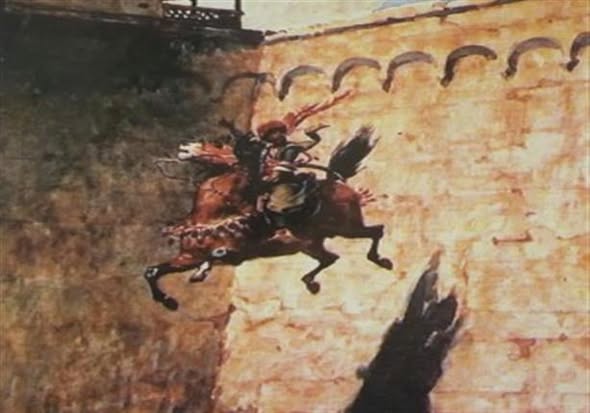
And on the day "Amin" was going to the citadel, "Jamila" asked him not to go.. because she had had a terrifying nightmare.. about a huge, enormous lion.. that would devour every Mamluk in the citadel.. so he laughed and mocked the nightmare.. and insisted on going.. so "Jamila" set about delaying him and wasting time.. until he left her and departed.. but he had in fact been late for the citadel celebration.. so when he arrived.. he was surprised to find the gates closed.. and the bullets of the massacre's executioners raining down on his head over the walls.. so he leapt with his horse from over a hill.. and the horse died and he survived.. and he tried to go back to his house.. but "Muhammad Ali" had declared every Mamluk's blood forfeit.. so he fled and hid in the desert.. and "Jamila" fled once more to Lebanon with her child "Salim".. who was lost from her along the way.
And the years passed.. and one night, "Amin" was riding alone.. on his way to Gaza.. when he came upon a young man who looked to be of a noble family.. in the hands of highway robbers.. so he rescued him from them.. and the boy insisted on taking him to his father.. and "Amin" discovered in terror that the boy's father was Prince "Bashir al-Shihabi" himself.. who had declared his blood and "Jamila's" forfeit before.. but Prince "Bashir" thanked him for saving his son and pardoned him.. and interceded for him with "Muhammad Ali".. and "Bashir al-Shihabi" was a friend and ally of "Muhammad Ali".. and indeed "Amin" returned to Egypt.. and in the depths of his despair at finding his beloved "Jamila".. he decided to go and fight in the ranks of "Muhammad Ali's" army in Sudan in order to die.
But one night the son of Prince "al-Shihabi" was telling the story to his wife, and she in turn told it to a group of her maids, among whom was Princess "Salma", or "Jamila", in disguise.. so she rushed to Prince "al-Shihabi".. and revealed her identity to him.. so he pardoned her in turn.. and asked "Muhammad Ali" to send "Amin" to Lebanon as soon as he returned from Sudan.. and indeed it was done.. and the couple were reunited once more.
As for the second story, it is less romantic.. namely that he did go at the time of the massacre.. and when it began.. he leapt with his horse from over the walls of the citadel.. and when he was about to hit the ground.. he jumped off the horse, which died from the fall.. while he lost consciousness.
Amin Bey woke to find himself surrounded by a group of Bedouins.. they beat him and stole his clothes, his money and his weapon.. and left him.. so he managed to escape once again.. and return to his house and take what money he could.. and flee to Syria and melt away among its people forever.
Unlike "Mahmoud", who failed to rid himself of the Janissaries.. with the citadel massacre, "Muhammad Ali" rid himself of the Mamluks' filth and Egypt was his, for the first time, from one end to the other, without popular leadership.. without a fifth column and without rivals for power.. in that same year.. 1811.. so he began to devote himself once more to Egypt.. and he began to imitate the Ottomans in an important matter.. which is that he went hunting for talent and geniuses.. and shipping them off to Europe to study.. in special missions.. from which they returned as doctors, engineers, teachers and agronomists.. more learned, more capable and more competent.. helping him move Egypt forward.
And then "Muhammad Ali" turned his attention to a matter of the utmost importance...
Industry.
He began to enter the stage of industrialisation.. and began searching for minerals.. and establishing factories.. and he sought God's help for the hardship, and took a bold step.. he began casting his own cannons.. and Egypt once again manufactured and developed artillery.. for the first time in more than two centuries.
And at that moment.. another mufti came out against "Muhammad Ali".. one of the senior sheikhs.. with the same old fatwa.
He declared to him in anger.. that the artillery foundry must be closed.. because fighting with artillery was forbidden.. and a form of killing by fire.. so Muhammad Ali shook his head in understanding, with reverence and respect.. then threw His Eminence the Sheikh into prison.. and he remained there until his death.. in the year 1813.
And Egypt set out for the first time.. since the era of "Qansuh al-Ghuri".. manufacturing silk, textiles, wool and yarn. And for the first time, despite the Ottomans' prohibition.. he began establishing printing presses.. the Ottomans had banned printing, by the way.. and for the first time, after two hundred years under the dark and ugly rule of the Ottoman state.. people held books in their hands... and minds returned to enlightenment.
And "Muhammad Ali" had a good advantage.. he learned from the mistakes of those who came before him.. and then in the year 1814 he took a decision of the utmost importance and gravity.
The decision to establish the naval arsenal.. and to build his own ships.. so that he would not care whether the Ottoman state sent him ships.. nor fear its fleet.
And with the return of his first mission of teachers and engineers from Europe.. "Muhammad Ali" began weapons and ship manufacturing with a strong start.. from where others had left off
At the time the Ottoman Sultan "Mahmoud II" was establishing new units in the army.. England helped him with weapons and France supplied him with experts.. and each state aspired to set him against the other.. and then he began to expand, so he enlarged the military schools and built dozens of them.. and he introduced the system of compulsory conscription for the first time, in his reign, in the Ottoman state.. and every Ottoman youth who reached conscription age had to hand himself over to the Ottoman army.. and the compulsory conscription period was ten years.
And "Mahmoud" in turn called on Austrian engineers to develop the dangerous weapon of the age.. artillery.. then he brought in experts from the masters of the seas at that time.. the Venetians, the English and the Austrians.. to modernise his fleet.
And for the first time "Mahmoud II" introduced the telegraph system into the state.. and for the first time as well.. he established railways.. that would be faster at moving equipment and soldiers if he came under attack or decided to enter a war.. and he could move his goods on them anywhere at any time.
And in Egypt, "Muhammad Ali" remained watchful.. with every mission he sent to Europe to study.. waiting for a particular mission of agricultural experts to come and solve a problem that troubled him.. namely that he might have a type of cotton.. suitable for the clothing industry.. and he began his adventure by hybridising cotton strains in Egypt time after time.
And in the year 1815, the first 100% Egyptian-made ship slid down from the land near the shore in Alexandria, on wooden planks, to meet the waters of the sea.. amid the people's cheering and their overwhelming joy.. after 198 years without a fleet.. and this was a giant step.. followed afterwards by dozens of ships.
And Egypt came to have the nucleus of a fleet.. which "Ibrahim" Pasha, son of "Muhammad Ali", used.. to anchor in the lands of the Hejaz.. on 5 September 1816 AD, corresponding to 12 Shawwal 1231 AH.. and to meet the Wahhabi armies.
And before the crushing blows of the capable military commander "Ibrahim Pasha" over two consecutive years.. the Wahhabis retreated and fortified themselves in Diriyah.. and the Egyptian army entered it in 1818 after granting its people safety.. and the Wahhabi movement came to an end temporarily.. until the Allied leadership decided to revive it once again, after the Second World War.
And in the year 1820 Egypt now had a strong armed fleet.. equipped with artillery and explosives.. passing through the Nile cataracts under the command of "Ismail", son of "Muhammad Ali", to Sudan in search of gold.. and in Sudan "Muhammad Ali" did not rest either.. he dug canals and built roads and schools and cultivated vast lands that had been among the most desolate places in the country.
And in Sudan, "Muhammad Ali" lost his son "Ismail" because of a treacherous surprise attack by "Mek Nimr".. one of the tribal rulers.. who feigned submission to "Ismail" and his men, then tried to burn them alive.. by inviting "Ismail" and his senior men to a banquet, and after loading them with food and drink, he ordered the place set on fire, and ordered his soldiers to shoot arrows and bolts at anyone who tried to escape, and he indeed succeeded in that.. but "Ismail" died suffocating from the thick smoke.. before the fire reached him.
And "Muhammad Bey al-Daftardar", the husband of "Ismail's" sister and his friend, set out for revenge.. and he did take revenge and pursued "Mek Nimr", who fled with his men to Abyssinia.. so al-Daftardar sent after him one of the tribal princes in Sudan named "Jawish" to pursue him.. and on the borders of Abyssinia.. "Jawish" caught up with King "Nimr" and his guards.. and wiped them out completely.. and was on the verge of killing King "Nimr" himself.. had the latter not pleaded with him and spoken to him of the bond of blood, of homeland and of land.
.
And "Jawish" was indeed a righteous man.. so he pardoned "Nimr" and let him continue his journey alone to Abyssinia.. and he did reach it.. and remained a refugee there until his death in 1825.
Sudan came under "Muhammad Ali's" grip and submitted to him from one end to the other in the year 1822.. and for the first time Europe looked at "Muhammad Ali" in bewilderment.. and it appeared to them that this man was not merely a follower of the Ottoman state.. he was acting on his own initiative and had certain undeclared plans.. and the Ottoman state was anxious and held the same view.. the entry into Sudan had taken place without even notifying Istanbul.
The Ottoman state's biggest problem with Egypt was "denial".. they always remained imagining that they were in complete control of the course of events there.. with their unjust laws, their keeping the people ignorant, their stripping it of its talents, their banning of printing, marriage taxes and the opening of brothels.. the truth is that Egypt, from the day of the Battle of Ridaniya despite its defeat.. was the biggest nail driven into the coffin of the Ottoman state.
The truth is they always tell us.. "Muhammad Ali was made by the West to destroy the strong Islamic Ottoman state".. the truth is the exact opposite.. the West supported the Ottomans to bring down the Mamluk state and keep Egypt in darkness.. because the Egyptian Mamluk state thwarted the Crusader campaigns one after another! Think about it and see which of them stood up to Europe in the invasion of Jerusalem.. and which of them settled the Jews in Palestine.
Now "Muhammad Ali" has an army.. and a fleet.. and he is developing them, modernising them and enlarging them.. and this is not to the liking of Europe or the Ottoman state.. which decided to plunge "Muhammad Ali" into a new quagmire.. to weaken his army and destroy his fleet.
And we will continue talking about this story later.
And there remains more to be said.. God willing.
-----------
- Previous posts are in the first comment.
- The images are imagined paintings of the citadel massacre and of the Mamluk who survived it, "Amin Bey".
---------
#The_Ottoman_Caliphate 34