We continue with the science fiction series, the one that a lot of people don't know whether it has ended or not, and it doesn't bother them either. We all love shrimp.. but few of us care about how it's cooked.
And since we're talking about science fiction in particular, we'll bring examples from types of novels that have nothing to do with this literature. But they still carry important techniques that we need to know in the architecture of the novel.
The classic novel must have a beginning, a middle and an end.. and its characters must begin to become clear to the reader, and his feelings toward them must be determined.. At the beginning, if we're going to talk about a killer, you have to make me sympathize with the victim.. If you want me to hate the killer, you have to do that at the beginning.
- The "Villain" is not the character who raises scorpions and laughs evil, broken laughs, and at the end of the story, when they defeat him, they happen to hear him saying to himself, "The fools.. they still don't know I'm hiding the drugs in such and such".. or "Hahaha.. they don't know I'm a supernatural being, a genie in disguise, and that I could die if they do such and such".. That's naïve to a nauseating degree...
From the world of science fiction whose villains are this naïve, comes the world of "Batman".. even though Batman is the closest science fiction character that could actually exist on the ground. A man who is skilled at fighting and rich enough to acquire advanced, executable technology, like the armored, armed vehicle.
- The narration of the novel must be tight.. whether the narrator is "one of its heroes, First Person".. like the story of "Dr. Jekyll and Mr. Hyde".. and this type has a flaw, which is that you know that in most dangerous or difficult situations.. the narrator isn't going to die.. he's the one telling it.. meaning he has to get past that situation in order to tell it. This narrator might die at the end of the story or after most of its events, and another narrator picks up the thread from him.. or he dies and leaves the story in a long letter, or memoirs, or a will.. or some documents.
This is called the "Epistolary novel".. like "Lucifer".. which tells its story through forgotten ancient papyri.. its writer gathered its content from all the people.. so he is an "omniscient" narrator.. likewise the beautiful novel "Antikythera" by "Amr Salah ElDien".
Amr's problem as a novelist is that he writes for one very specific reader.. meaning the titles of his novels themselves need explanation.. that is, the title of this novel refers to "a complex mechanism of gears and mechanisms of unknown function that the Romans found before the birth of Christ near the coasts of the Greek island of Antikythera, and it may be a legacy of a previous civilization, The Antikythera mechanism"..! The novel before it was titled "Yggdrasil"... which is "a giant mythical tree that connects the nine worlds in Norse cosmology.. mentioned in historical sources in the Edda poems of the thirteenth century"..!
If that's the title of the novel, you're free to imagine the events themselves. Despite how difficult it is, it makes him unique among the new writers in that type of writing.. especially since he has talent and a smooth language. But notice here that if I didn't know what "Yggdrasil" meant.. I wouldn't have bought the novel in the first place.
- This is an important point.. the title of your novel matters.. it shouldn't be too complicated.. nor too naïve.. meaning don't write a science fiction novel called "Mutation of the Deoxyribonucleic Acid of the Deadly Virus".. and don't write a horror novel called "The Scary Bogeyman Creeped Me Out While I Was Coming Up the Stairs", for example.. The title must be chosen to suit the reader, and he shouldn't feel that you're jumping on him or treating him as trivial.
- The narrator could be the villain himself.. as we read in Agatha Christie's "The Murder of Roger Ackroyd", the narrator here is the killer.. the family doctor himself.. and like the late "Omar Sharif" in "For a Woman".. where he narrates the story of his almost-perfect crime on his deathbed.
- There is also the "omniscient narrator".. and this could be the writer himself, like most of the works of the late "Dr. Nabil Farouk", or a person you often don't know until the end of the novel.. like the immortal masterpiece by "Michael Cooney" which was made into a film with the same name in 2003.. "Identity".. about a group of people who have nothing in common except their date of birth.. they gathered by pure, separate coincidence in a remote motel besieged by a storm.. and there they began to die one after another according to the order of the room numbers.
This film is also written with a fine hand in a "screenshot" style.. the literary nanotechnology.. if you glance away from the film for one minute at any moment.. you'll feel that something is missing, lost.
- There is the novel with "multiple narrators".. here, for example, the novel is divided into three parts.. the victim narrates his story until he dies.. then the killer tells how he committed his crime, for example.. and then the security man says how he reached the truth... Out of the cloak of the multi-narrator novel came "the novel with irregular narration".. You're watching a scene in a bar.. and a dancer swaying on the stage.. and a man throwing a glass on the ground in anger, and then the hero of the scene gets up and leaves and a gang chases him.. after a few chapters.. you start going back and learning a new story in the heart of the events, and why the man in the bar threw the glass on the ground in anger.. and what his story is.. from the text you go back to the beginning and from the end you go to the middle.. etc. One of the famous examples of these novels is the action film with its two parts, "Sin City".
- The architecture of the novel, if it isn't very coherent and sound in structure.. the reader will either fall asleep on you and lose you and understand nothing, or he won't finish the novel in the first place. Among the soundly built stories in the horror world were the two novels of the writer "Ahmed Magdy Galal".. "The Legacy of Osiris" and "Kafr Hares".. Remove a page from either of the two novels.. and you'll find that you didn't understand most of the subsequent events.
Among the models of distinguished architecture in the novel is the novel "Zanj".. by the writer "Amr El-Arousi".. The problem with "Zanj" is its extreme density in language, to the point that the writer makes footnotes to explain the meanings of words from the dictionary.. Unfortunately, that cost it a lot of its magic.
Remember, when you write and always use language.. the poem "The Sound of the Bulbul's Whistling" and its tragedy. The Caliph "Abu Ja'far al-Mansur" wanted to mock the poets, so he set a reward for whoever came to him with a new poem, which was that he would pay the weight of the poem in gold...
The first poet went and began to recite "Abu Sa'da al-Zanati says, caliph.... when he complained after the stab of the wolf".. so "Abu Ja'far al-Mansur" began to rebuke him.. How dare you, animal, come to me with an old poem.. and he began to carry out his plan with his vizier and his concubine.. so he repeated the line.. and after him the vizier repeated it, and after them the concubine repeated it.. and every poet began to doubt himself that his poem was indeed old and had somehow crept into his mind.. until they realized that the Caliph was mocking them.. so they went to al-Asma'i to complain about him.
Al-Asma'i ordered them to prepare 3 huge polished stones.. and to come back after 3 nights.. and when they returned to al-Asma'i.. he dictated to them and ordered them to engrave his dark poem "The Sound of the Bulbul's Whistling". Of course the poem is difficult, so no one memorized anything.. and al-Asma'i almost seized all the gold of the palace.. had he not waived that in exchange for the Caliph satisfying the poets he had laughed at.
Critics and historians doubt this story because the poem is flimsy and weak, unlike al-Asma'i's known linguistic and literary structure.. also al-Asma'i was one of Harun al-Rashid's companions, not "Abu Ja'far al-Mansur".. but it is a good general example of linguistic density and grammatical pretentiousness.. People memorize lines of al-Mutanabbi.. but no one has memorized "The Sound of the Bulbul's Whistling".
- I am not fond of "current" women's literature in general.. and I consider most of what is available on the scene a form of backwardness.. especially with the media and literary world polishing books like the book that carries the famous title "Awlad El...." or others by other women writers, most of whom may be of the hysterical feminist type, the kind of "we must hang the man from the chandelier and drive burning pins under his fingernails because he oppressed women for centuries, etc.".. and whose talent in the world of literature amounts to them having large breasts, or the writer having a tattoo.. to the end of this nonsense.. while the talented woman writer is met with disdain and neglect.
But despite that, there is always a glimmer of hope and flowers growing amid the barren land.. Among the stunning architecture in the art of the novel and women's literature in general today.. is the book "Screenshot" by the writer "Baraa Jassem".. You can read the book as separate short stories.. and enjoy it completely.. but at the same time you can read it as a complete novel with all its elements.. you can read part of a chapter as a situation and feel that the situation is enough as a short story complete in its pillars, like "A Glance" by "Youssef Idris". This story's precision surpasses the ordinary architecture we referred to.. remove a word.. a single word from the context.. and you'll feel that the meaning has lost its luster or that something is missing.. as if you're engineering a genetic code.. you can read it like "Sin City".. from the last scene.. and go back and read the first story.. despite how wonderful the structure of the work is, the language is still smooth.
- Among the interesting women writers in the world of science fiction is the Syrian writer "Lina Kilani".. and she also writes science fiction for children, and writing for children is one of the most difficult types of writing in general. The strange thing is that Syria began to care a great deal about science fiction after the war.. unlike the rest of the Arab world, which still considers it a naïve type of literature, despite the tremendous profits it brings to world cinema.
- Architecture is very important in the novel, as we said.. and at the heart of architecture, other techniques fall.. like "Deus ex machina", which we spoke about before.
This technique was actually invented by the ancient Egyptians.. The terrifying lioness "Sekhmet", whom "Ra" unleashed to punish the Egyptians for mocking him.. refuses his orders to stop after she has tasted blood, and they are forced to seek the help of the god of knowledge "Thoth", whose mind contains all the sciences, arts and literature of the universe.. He offers them a solution: he will turn the entire Nile River into beer, from which Sekhmet will drink and get drunk, making it easy for "Ra" to capture her.. But how do they convince "Sekhmet" to drink from the river of beer? The god of knowledge and wisdom himself has no other solution.. Who else would? Matters became complicated and "Sekhmet" was going to annihilate the people of Egypt, down to the last one.
The unexpected solution comes.. "Deus ex machina".. the god "Dedun".. lord of incense, colors and dyes, and he colors this river of beer with the color of blood.. so it whets Sekhmet's appetite and she drinks and falls asleep.
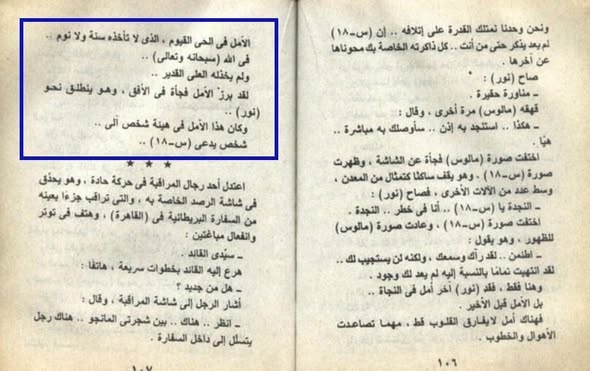
- The Greeks are the pioneers of theater.. so they used this technique on stage in a different way.. a basket containing an actor descending from the ceiling on ropes as "Zeus", the greatest of the gods.. You, go back to your wife.. and you, forget your friend's betrayal.. and you, rise from the dead.. etc. This is the technique of "unseen reinforcement".. like the super robot S18 in the novels of the late Dr. Nabil Farouk.. in the attached picture from the story "Point Zero".
If you use this technique wrongly, it becomes ridiculous and the reader feels that you have tricked him.. Among the emerging writers who are skilled at using this technique in a way that makes it exciting, sudden and ever-renewing is the rising writer "Mohamed Fakhry".
The unseen reinforcement could be the hero of the novel himself.. and that requires a somewhat difficult plot.. but in the "The Man of the Impossible" series, for example.. the unseen reinforcement for the love of his life "Mona Tawfik" and his colleague "Hossam" in the trilogy "The Touch of Evil", "The Fox" and "The Front Line".. was "Adham Sabry" himself.. whom everyone thought had died in "The Den of Terrorism".
Out of this technique came a slightly different technique.. the "Griffith rescue technique". One of the last-minute rescue techniques.. "The Avengers" are about to be defeated by the super cosmic villain "Thanos".. but suddenly out of nowhere "Captain Marvel" appears and turns the course of events. In "Jurassic Park III", the laboratory-created dinosaurs are about to wipe them out.. were it not for "Alan"'s girlfriend and former colleague, who makes her calls and pays for him at the last moment with the air force and the marines.
- There is also the "discovery technique".. the hero suddenly discovers something in himself that he didn't know.. and this is a good technique in romantic literature or the world of the realistic story.. the hero suddenly discovered that he is rich, for example.. and there is a will in his name.. but it is one of the weakest and shallowest and stupidest techniques of science fiction.. Imagine living 30 years and then discovering that you suddenly know how to fly, for example.
- The more refined technique, and a bit better in science fiction than the previous technique, is the technique of "transformation".. "They Made Me a Criminal".. the hero, under the pressure of society, turned into a killer. The dignified, kind hero.. a middle-class man.. helps an injured wolf and gets bitten, so he begins to turn into a werewolf.. "Peter Parker" is bitten by a radioactive spider, "so he transforms" into a super young man.
- There is the technique of "poetic justice". The man who tries to use the dinosaurs as a biological weapon in "Jurassic World" is devoured by those same dinosaurs at the end.. In a wonderful action film called "Lucky Number Slevin".. this technique is handled with great intelligence.
- Planting, or foreshadowing, is one of the important techniques.. The hero is skilled at using daggers.. You showed us that in your novel from the beginning and we understood it.. At the end he can hurl a dagger, killing the villain and saving his lover's life, for example. The hero is a former sniper.. so you know what he can do when he picks up a rifle. But don't bring me in your novel a university student, or an employee at the social insurance office, fleeing from professional gangsters, hurling daggers and jumping with a parachute.. Please.
There are still a few other techniques... But since the talk has run away with us this time.. we'll talk about them next time, God willing...
And the talk remains unfinished.
------
- Previous posts in the first comment.
- A video for the Griffith last-minute rescue technique.