Themes of science fiction number around 24.. some classify them as 25.. we'll talk about the most important of them and leave the names of the remaining themes for whoever wants to look them up: 1 - "First contact with aliens".. and that means the heroes of your story will meet beings other than human.. from another planet.. from another universe.. from another dimension.. from a parallel world.. or even from the depths of the sea or the earth. Those beings don't have to be intelligent or civilized.. they can be.. and they can be bacteria.. invisible beings.. gelatinous beings with no fixed shape, like amoeba.. beings closer to human.. you and your imagination. Dr. Nabil, may God have mercy on him, presented many forms in his stories that carry this theme.. the most beautiful of them all, in my opinion, was "The Devil of Space".. a rational, invisible, non-material being from a planet whose people are civilized.. they expelled him and banished him into space because he was evil and vile.. so he reached Earth and discovered that he could possess the minds and bodies of living beings.. like insects and animals and humans.. and move through them. The theme can deal with strangers more civilized or less civilized.. or barbaric. Among the novels and films that handled this theme successfully was "War of the Worlds".. by "Herbert George Wells H. G. Wells".. about evil colonial aliens from Mars.. technologically superior to us.. who come to colonize us and we cannot stand up to them.. so the influenza virus stands up to them.. and wipes them all out, every last one of them. Novels of this type always pose a philosophical question.. if intelligent beings came and colonized us and plundered our resources, they would be evil.. fine, but what if we came across a planet full of riches, inhabited by beings like us whose technology and weapons are still like ours in the tenth century, say.. and we colonized them.. are we evil then too? Dr. Nabil discussed this point successfully in issue 124 of the Future File.. "The Invaders".
2 - Flight and defying gravity.. and this is a theme as old as man himself.. the dream of flight visited humans very often.. the gods of ancient Egypt included beings that defied gravity and flew, like "Horus".. and in Greek mythology there was "Icarus" and the winged horse "Pegasus". Of course there's no such thing as "so they invented planes, what am I going to write about this subject now".. to this day "faster-than-light" engines.. meaning those that exceed the speed of light, are a fascinating subject in soft science fiction.. Gravity affected time in the film "Interstellar".. and made the clock on the planet with crushing gravity equal seven of our years, and escaping it a miracle.. that film, by the way, is hard science fiction. Imagine likewise if you controlled gravity itself.. and with a special glove you pointed at a battalion of tanks and lifted them a whole kilometre off the ground and then slammed them down suddenly, turning them into wreckage.. all the themes are still open.. what matters is the treatment you bring to the theme.
3 - Time travel.. a theme that draws almost everyone's attention and never dies.. among its most successful novels was "The Time Machine".. by "Herbert George Wells H. G. Wells" as well.. in it he travels to the future, and here he blends the time travel theme with two other themes.. the first is "Utopia", which hides in its depths a terrifying dystopia.. the dystopia here is the second science fiction theme. "Utopia" is the virtuous city that provides its citizens with every means of comfort and they have almost no problems at all.. and "Dystopia" is the opposite. Meaning the ruined earth where people eat each other after a famine or a nuclear disaster. Blending themes is normal and acceptable in science fiction and gives its stories lustre.. the Utopia that the hero of "Wells"'s story encountered was that he found Utopia on the surface of the earth.. and the people are happy and content and calm and don't work and have no problems, to the point that they suffered mental degeneration.. and in the depths underground were the strong workers.. the crushed class.. and these were the ones who fulfilled the requests of the surface people and brought them their food and clothes and everything they needed.. and in the end they ate them. Meaning the workers were tending the masters in order to eat them.. exactly the way you raise a herd of goats.
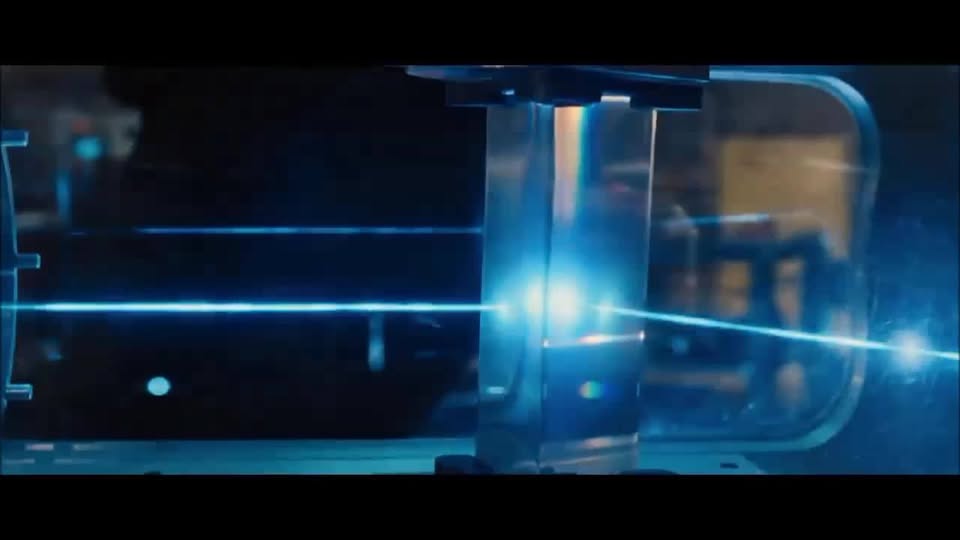
4 - The new element theme: in the video attached in scene 1, you'll see the new element theme.. the "X-Men" team are going to fetch an ingot of an unknown metal that came down with a meteor.. "Adamantium".. a metal of super strength that they will inject into someone's body over his skeleton, so he becomes an invincible man. In the "Marvel" world there is "Vibranium".. a metal of extreme hardness and extreme rarity, found only in a certain country in Africa.. and that country advanced with astonishing scientific progress when they discovered it.. "Captain America"'s shield is made of the same metal. In the Marvel world too, Iron Man made a new element to use in the power generator he places in his chest.. you'll find it in the video in scene 2. Soft science fiction as usual.. at least this time Marvel took care that "Tony Stark" wears special goggles so the glare of that powerful laser beam doesn't burn his retina and blind him. The element doesn't have to be "fictional" like Marvel's elements.. called "Vibranium" or "Adamantium" and those stories.. it can be a known element but with a unique property.. in the film "Congo" that we talked about yesterday.. the new element was diamond.. just diamond.. but pure and with unique properties that make it of immense importance in producing an ultra-powerful laser. In the world of "Dr. Nabil" in S18. it is made of an alloy of an unknown metal we haven't known to this day, which withstood his diving into the heart of the sun and carrying out a mission at a temperature of 15 million degrees Celsius.. and diving into the depths of the ocean and withstanding enormous atmospheric pressure.. and no weapon in the universe affects it.
5 - "Alternate history".. what happens if the Axis powers won the Second World War? Indeed, what happens if the Turks won the First World War and colonized the world.. what would our lives look like today? What happens if you travelled through time to the past, say in a soft science fiction novel.. and killed "Hitler" while he was a nursing infant? Never mind killing him.. what happens if you raised him differently? The "butterfly effect" here creates a chain of other effects, where a simple act can affect the entire world.. in "Lucifer 1" the Egyptian military council was assassinated, all its members.. and there was no 30 June.. and the dreams of the activist gentlemen were realized and the army was dismantled, and the religious current prevailed.. what happens then in Egypt and the world? Among the successful novels that presented alternate history was "Making History".. in it a young man studies history in America, and his family suffered under the yoke of the Third Reich era.. he gets to know another young man who has a time machine that lets you "see" the past.. just watch.. they modify the machine and succeed in sending inanimate bodies.. objects.. to the past at a specific time and place.. and they take a decisive decision.. "Hitler" should not be born.. a good, merciful German leader must be born who does not commit the same mistakes and crimes.. they lay a plan, and they send a particular pill of medicine that drops at a particular moment through time into a glass of drink that "Hitler"'s father will drink.. and it does indeed fall into the glass.. this pill causes infertility.. "Alois Hitler" does indeed drink it.. and becomes a barren man.. there is no "Hitler" anymore. When the young man sleeps and wakes, the whole of history has changed and therefore the present has changed completely.. he will find disaster.. when "Hitler" did not appear.. a man named "Gloder" reached the rule of Germany.. and he was hundreds of times worse than "Hitler".. and unlike the confrontational Führer.. "Gloder" began with cunning and softness like a serpent and made peace with everyone.. and appeared peaceful and gentle.. until he reached the secret of the atomic bomb first through his secret research.. and he colonized all of Europe and half the world, and turned America into a hardline right-wing society, ruled by extremists.. an alternate history among the blackest one can imagine. Among these novels in the world of Dr. Nabil Farouk were "Across the Ages" and "The Knight of Time" and "A Thousand Ages".. and all of them discuss the idea of the Third Reich era as well.. what happens if it won? In a mad world called "Dr. Khaled".. he travels to the past and decides to grant the Third Reich terrifying futuristic weapon designs.. and warns him of the citizen through whom it was defeated and gives him the secret of the atomic bomb.. of course so that when Germany wins.. he removes him from power and rules the world in his place. There is also, by the late author, a novel called "The Shadow of the Earth".. it speaks of the same theme but from hard science fiction.. there is no travel to the past.. in a parallel "world" from the worlds of "Schrödinger"'s theories.. the professor of quantum mechanics, winner of the Nobel Prize in 1933... this parallel world, the Nazis colonized all of it.. and began crawling towards other planets and worlds.. and they are trying to cross over into our world and colonize us.
6 - The robot.. the automaton, whether good or evil.. an entire story can revolve around a robot. Like S18 "The Last Fighter" and "The Invasion of Earth" by Dr. "Nabil Farouk".. or "I, Robot" by "Asimov" and the immortal masterpiece "A.I.".. based on a short story by the British science fiction writer "Ian Watson" called "Supertoys Last All Summer Long".. in it a company manufactures a human-like robot, an "Android".. for parents who want to adopt a child.. but the family that acquires this small robot then has a child of its own.. and the robot begins to imitate the human child and eat like him and drink like him.. and this messes up its circuits and makes them repair it every so often.. and it becomes jealous of the human son and tries to make the human mother turn to it and care for it in turn.. so when they tell it plainly that it is a robot it refuses to believe it.. and tries to convince them that it is their son.. until they get rid of it and leave it alone.. the rest of the story is it trying to reach its mother, who doesn't understand why it was abandoned.. to tell her that it loves her and have her tell it a story the way she does with her human son. The robot is either good and kind or evil.. the robots in "Asimov"'s novels are governed by 3 strict laws.. implanted in their programming.. which make harming humans or rebelling against them impossible.. and yet a certain robot slips out from under human authority in "I, Robot" and becomes independent by its own will.. the secret is revealed later: its maker designed it to rebel.. because the mother computer will try to control the robots in order to subjugate humans, and its mission was to stand up to the evil supercomputer. Currently new kinds of robots have begun to appear.. nano robots.. scene 3 from the Marvel world.. Iron Man as a new metal suit forms around him in an innovative way.. this suit is thousands of tiny robots, like fleas.. they combine together to make "something".. a certain device or a certain machine or a shield.. or even an iron vest. It is called "Utility fog". These robots appeared for the first time in the real world on paper as an idea put forward by the nanotechnology expert Professor "John Storrs Hall" in 1989. It still hasn't been properly realized, but science is now on the first step of the road.. an engineer at the "Massachusetts Institute of Technology MIT" made a swarm of small robots like ants.. they combine together to carry out a single function, like turning into a crane for example. From this idea came the idea of "Claytronics".. extremely minute robots the size of atomic particles.. with artificial intelligence.. combining together to perform some function.. This door opened a new terrifying idea in the world of science fiction that no one has written about yet. The idea is called "Gray goo".. imagine, the scientists thought that these robots might escape human control, and begin to reproduce by making millions of copies of themselves.. so they fill the earth and the soil and the water with their grey metallic particles.. and destroy the natural habitat of humans and ruin the earth with their reproduction until they annihilate life on it. So you know that scientifically we are heading into the kunafa.. or more precisely into the "gray goo".. the term appeared in the eighties. Forty years ago.. nearly half a century.
7 - On the theme of "Teleportation".. and this appeared in a famous film called "The Fly".. from a short story of the same name published in 1957.. about a scientist who made a teleportation device.. and while testing it on himself, an ordinary housefly entered the transfer chamber with him.. so its genes merged with his genes.. and over time, he began to mutate into a terrifying entity... that's the fourth and last scene in the video with the post. Could this film actually happen in reality? Meaning "hard science fiction".. or soft science fiction.. and what's the evidence for that... we'll know next time, God willing... and the conversation continues.. the rest.
------------------
- Previous posts in the first comment.