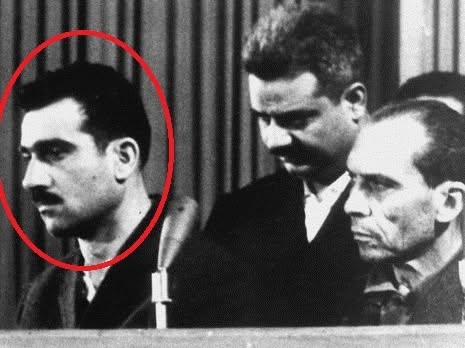
(Eli Amin Shaul Cohen).. Eli Cohen
A name that it is impossible for any Arab or Israeli intelligence man to be ignorant of, in these days, especially after dozens of books and novels have been published about him, most of them Israeli, surrounding him with a frame of strength and heroism, and weaving around him dozens of legendary stories, that make him something like a star, in this secret world, or so the Israelis tried to present him, without pointing to what befell this star..
To his horrifying fall..
And Eli's beginnings were simple and extremely ordinary, for his father (Hofi Cohen) was a modest Syrian merchant, who emigrated with his family to (Egypt), and they settled in (Alexandria). And there Eli was born on 16 December 1924, and there too he joined the French (Lycée) school.. and there too he met (Bulandi Gabi), who was the beginning of the thread..
And this (Bulandi) was one of the ladies of the wealthy Jewish families, and at the same time an active member of (HaMossad LeAliyah Bet).. or (the Mossad), which decided to establish a branch for itself in (Egypt), through the Egyptian Jewish youth movement known as (Hashirot), so it sent one of its men (Levi Avraham), to whom she recommended a number of Jewish youths, at the head of them (Eli)..
And (Eli Cohen) worked for the account of (the Mossad), before he obtained the (baccalaureate) certificate, or the general secondary certificate at that time, and he showed remarkable activity in facilitating the departure of Egyptian Jews to (Palestine) and in contacting embassies and consulates, and he mastered English, French and Italian, and he joined the Faculty of Engineering at (Fouad I) University — (Cairo) today — and obtained his certificate, despite the emigration of his entire family to (Israel).. in 1950..
And in 1953, Israeli military intelligence (Aman) sent one of its men to (Egypt), namely (Avraham Dar), who arrived with a British passport bearing the name (John Darling), seeking to form two Zionist cells, in (Cairo) and (Alexandria), and he sent five members of the two cells to (Tel Aviv), via (Paris), to receive training on detonating time bombs, then these five were returned to (Egypt), carrying a special sabotage plan... and among these five was (Eli Cohen)..
And during an operation known as (Operation Susanna), (John Darling) issued his orders to the two cells, to blow up and sabotage a number of British and American installations, with the aim of spoiling the evacuation agreement, which had been signed between the Egyptian and British sides at that time.. but one member of the two cells committed a fatal mistake, which led to fire catching in his pocket, before he blew up his target, which prompted a policeman to arrest him, and take him to the Ramleh station police station, where he was interrogated, and he confessed to the whole matter, and.. and the two cells fell.. and on the evening of that same night, a wide arrest campaign took place, in (Cairo) and (Alexandria), of all members of the two cells and suspected elements, and among these too was (Eli)..
And although the confessions of the members of the two cells included a large number of Jewish youths, they did not include the name of (Eli Cohen), which led to his release and the clearing of his way, though this did not prevent a special file being opened for him, in the Egyptian General Intelligence apparatus which was taking its first steps, in this mysterious secret world..
And the file carried the name (Eli Hofi Cohen), and this made it imperative for (Eli) to stop his activity.. then the Tripartite Aggression against (Egypt) happened.. and as a precautionary measure, everyone who had these files was arrested, without evidence of accusation, until December 1956.. when it was decided to release them, and expel them outside (Egypt), for security reasons..
And on the twentieth of December 1956, (Eli) left (Egypt), on a ship belonging to the Red Cross, which carried him to (Italy), with a large number of Egyptian Jews, where he spent several weeks in (Genoa).. and in (Bat Yam), south of (Tel Aviv), (Eli) spent his first days in (Israel), with his mother and his family, and he set about studying the Hebrew language, then before long, in the late part of the same year, he took a job in the Israeli Ministry of Defence, based on translating everything published in the Arab press into Hebrew, and preparing reports and analyses about it, for the account of the military intelligence apparatus (Aman)..
And before long he grew tired of this work too, so he submitted a request for transfer to the (Mossad) apparatus, but his request was met with refusal, which pushed him to submit his resignation, and to work in a company for marketing foodstuffs, and during this work he met (Nadia), a nurse at (Hadassah) Hospital in Jerusalem, and he married her after a short period of acquaintance..
And (Eli) did not feel comfortable in his new work, but he did not complain of it this time, or try to leave it...
True, he did not seek to resign, but the matter came about by a different means this time, as he met an old friend, who had worked with him in (Aman), and a conversation took place between them about his resignation, and after that his colleague left, after the two had agreed to meet a second time..
And on this second occasion, his friend invited him to walk along the shore, and there he suddenly asked him whether he would like to work in the Mossad, then he confided to him that he was one of the (Mossad) officers, and asked him to keep completely secret what he would hear, even from his family and his wife, then he informed him of (the Mossad's) approval of his working in their ranks..
And in the spring and summer of 1960, (Eli) passed his training programme, and prepared to receive his new work, and his extremely important mission, in (Syria)..
And although the mission was aimed at (Syria), it began in (Buenos Aires), the capital of (Argentina), which (Eli) reached on 21 March 1961, coming from (Zurich), and carrying the name (Kamel Amin Thabet), whose passport indicated his Syrian nationality..
And as soon as he arrived, (Eli) became active in getting to know the emigrant community in (Buenos Aires), and he set about consolidating their friendships with them, carrying a story that had been prepared with precision, saying: that he is a Syrian of Lebanese origin, who emigrated with his family to (Alexandria), then his uncle travelled to (Argentina) in 1946, and he followed him there with his family in 1947, then his father died there of a heart attack, in 1952, and six months later his mother passed away, and he remained alone there, working in the textile trade, then he travelled to (Europe) for several years, and now he has returned a wealthy man..
And no more than several weeks passed before (Kamel Amin Thabet) became a well-known man, in the circles of the emigrants, whose number at that period reached half a million Arab emigrants, and his ties were consolidated with the editor-in-chief of (The Arab World) magazine published there (Abdel Latif Al-Khashan), who introduced him, in good faith, to his friends and acquaintances, among the men of the Arab embassies in (Argentina), and quickly (Eli) became a permanent guest at most embassy parties..
And the strange thing is that one Syrian intelligence officer doubted the man, and sent to (the Second Bureau) in (Syria), requesting an investigation into him, but the Israelis had chosen a real story, of an emigrant family, bearing the name (Thabet), which made Syrian intelligence endorse (Eli's) story, without bothering to scrutinise it and examine it well, given that the doubts about him were not enough for that.. and after several months, specifically in August 1961, (Kamel Amin Thabet) announced his desire to return to the homeland (Syria), and submitted an application to obtain an entry visa..
And in (Damascus), (Eli) spent a full month, without carrying out his activity, so as not to raise suspicions around him, until 28 September 1961, then he began establishing an import and export company, specialising in exporting Arab furniture and wooden handicrafts to (Europe), and he set about benefiting his company with a double benefit, since the conversations he exchanged with others, by virtue of the work, brought him a plentiful amount of information, about the conditions of the economic market, which he used to send as soon as he returned to his home, to (the Mossad) directly, by way of a very small transmitter...
As for the photographs and documents he captured, he used to send them inside special cavities, in the pieces of furniture and handicrafts, which were exported to (Europe), where one of the (Mossad) officers in (Switzerland) picked them up..
As for the social side, the development was faster, and more dangerous..
(Eli) succeeded in contracting numerous friendships, with Syrian military men and media figures, and he rented a house facing the building of the General Command of the Syrian Armed Forces, where he set about monitoring the developments taking place there, which helped him send information of extreme importance and benefit to the Israelis, who considered him an excellent agent.. then (Kamel Thabet) landed the most important catch since the start of his work..
He established a friendship with a young officer, who was at the same time the nephew of the Chief of Staff of the Armed Forces, and he succeeded in drawing him in to obtain extremely dangerous information, on the pretext of ensuring the safety and security of the homeland...
Indeed, the officer took him along to the front lines, where he saw for himself the armament and fortifications of the Syrian units, and he went further the next time, so he carried a camera with him, and took several photographs of the Israeli settlements, situated at the foot of the Syrian heights, and sent them to (Tel Aviv), which identified from them the positions of the Syrian heights..
And as a member of the Baath Party, (Eli) consolidated his relations with the party's leaderships, and the Information Minister (Sami Al-Jundi), and he became one of the party cadres who are pointed to with admiration, and an almost permanent guest, at the receptions held by the Syrian presidency, especially after his proposal to make a party visit to (Argentina), during which he collected nine thousand dollars, as donations for the Baath Party, from the Syrian emigrants there, to which he added a thousand dollars from his own account.
And the name (Kamel Amin Thabet) shone, and this helped him form stronger and more dangerous friendships, and granted him greater freedom of movement, especially after he was nominated, or his name was repeated as a candidate, for the post of deputy information minister, or deputy defence minister, to the point that he was able to take several close-up photographs of the interceptor fighter (MiG-21), which was the most powerful interceptor fighter at that time.
And with his standing rising, (Eli) became one of the members of the Syrian delegation accompanying Lieutenant General (Ali Amer), the Commander-in-Chief of the Unified Arab Command, when he visited the Syrian Arab Republic, at the head of a large military delegation, in December 1964, to hold discussions with the military leaders there..
And (Kamel Amin Thabet) was almost the only civilian, who officially accompanied the military men, on that tour, with the exception of photographers and journalists..
And this was the mistake, that began the stage of the end..
For in early January 1965, one Egyptian intelligence officer was browsing some Arab newspapers, when a photograph caught his attention of Lieutenant General (Ali Amer), during his visit to Syria, with the members of the Syrian delegation accompanying him around him, and his gaze settled on a person in their midst specifically and he knitted his brows intensely, squeezing his mind, in an attempt to know when he had seen the owner of this face specifically..
When he remembered him, panic struck him, so he snatched the newspaper, and rushed towards the office of (Salah Nasr), director of Egyptian General Intelligence at that time, and placed the newspaper in front of him, to tell him that this man, who accompanies the military delegation, is not a Syrian.. he is a Jew called (Eli Hofi Cohen), and Salah Nasr was greatly alarmed, especially since that officer had been a colleague of the spy, at the French (Lycée) school, and they had obtained the baccalaureate together in 1946.. and that he had a complete file in the intelligence service, since the bombings operation, and here (Salah Nasr) requested the file, and read through it, then carried it at once, to President (Gamal Abdel Nasser)..
President (Gamal) kept reading the file for more than forty-five minutes, then he lifted the receiver of his telephone, and asked his secretariat to call the Syrian President, Lieutenant General (Amin Hafez), at once, and as soon as the call was made, President (Gamal) exchanged some phrases of courtesy with the Syrian President, then told him that he would send him a special envoy the next day, carrying a message of extreme importance and danger..
And this envoy was (Salah Nasr) himself, who travelled the next morning to (Damascus), and met the Syrian President, and presented him with the file.. and as happened to President (Gamal Abdel Nasser), the Syrian President was struck with overwhelming astonishment, as he leafed through the file, then before long he requested the presence of the head of Syrian intelligence (the Second Bureau), who arrived shortly after, and read through the file in turn, and the same stupefaction struck him..
For at that period, the wireless employees in the Indian Embassy were complaining of interference occurring on some of their messages, sent to (New Delhi), and the Syrian security men suspected the presence of a spy sending wireless signals in the area, but they were unable to determine his location, given the wide circle of the search, and the difficulty of tracking wireless signals at that time..
And with the information that (Salah Nasr) brought, the matter became clear, and settled..
And hours after this meeting, (Eli) was preparing to send one of his wireless messages to (Tel Aviv), on a night of the cold January nights, when he was taken by surprise by a number of men storming his home, aiming their pistols at him, and ordering him not to move, and when he rose up against them, Lieutenant Colonel (Ahmed Sweidani), head of the counter-espionage department in Syrian intelligence, stepped in front of him, addressing him by his real name..
And then (Eli Cohen) realised that he had fallen.. and the Israelis went mad, when they learned of (Eli's) fall, and they attempted the impossible to save him, and offered to exchange him for a group of those accused of spying for (Syria), and to pay a million dollars for his release, but (Syria) refused this insistently.
And on the eighteenth of May, 1965, (Eli Hofi Cohen) was led to the noose, which closed around his neck...
Then the executioner pushed a metal lever, and his body fell into the void, announcing the fall of a spy, and the loss by Israeli intelligence of the round ...