A lot of friends have messaged me over the past while asking about the Battle of Thermopylae, which took place in 480 BC.. and some people thought the film “300” was just a myth or a cinematic work not based on a true story.. and they asked for more documentary information on the subject..
I found this a good opportunity to talk about the generations of war, and this time in greater detail, since a lot of people talk about fourth-generation warfare.. and “so is there a first, second and third generation?” and what do they look like...
“The Battle of Thermopylae” is a first-generation war par excellence.. the pronunciation of “Thermopylae” is in the first reference, for anyone who would like to know it...
As we are used to on this page, we do not talk about anything scientific unless it is weighed, as far as possible, by the word.. that is why we said it is a first-generation war “par excellence”.. not a first-generation war and that is that...
First-generation war is the war in which “men”, in the true sense of the word, stand in any spot on the face of the earth throughout history, to repel an aggression against their land or in defence of their honour and their property.. the idea of “man to man” confrontation.. and respect for the rules of truce and the law of the mother country...
“The Spartans” were masters of first-generation war.. direct confrontation.. they were masters to the point that the use of the bow and arrow, which strikes the enemy from a distance, was — in their custom — something shameful and a kind of cowardice and unmanliness...
In first-generation wars, concepts like “man” and “honour” and “dignity” and “freedom” do not have their meanings stripped away.. they carry their original, elevated meanings as great virtues.. in Sparta there were only 3 who had the right to win a grave with their name carved on it in the utmost pride: 1 - the king; 2 - a soldier who died in battle; 3 - and a mother who died in childbirth...
Those alone had the right to be honoured.. so why is the mother who died in childbirth honoured to such a degree? Because she died while giving Sparta a new son.. she grants the state a fighter...
Women in Sparta were honoured with great honour.. the woman was equal to the man in rights and duties and could carry arms with him and fight in defence of the land..
The child, as soon as he is born, is examined.. if he is strong and healthy.. congratulations to his family.. he lives until the age of five and then joins a military school.. if he is weak or deformed or defective.. he is thrown on the slope of “Mount Taygetus” for the animals to devour.. we spoke briefly about this subject before in a previous post, available in the second reference...
The story is that the Persians decided to invade Greece — and it was a set of fragmented city-states — among them Sparta..
Friends ask, “How can 300 hold off a million?”.. the fact is this is mentioned on many sites.. true, some people said “600,000”.. and some said “a quarter of a million.. but what reached us from the closest reference to the battle.. the historian “Herodotus”, verbatim.. is that “Sparta” went out with 300 soldiers to face a million Persian soldiers...
The number may be exaggerated, but it will not be greatly exaggerated.. because if 300 went out to hold off a thousand or two thousand.. then it is not an astonishing miracle of a kind to turn into an epic and reach us from before the Common Era...
The mountain pass that the Spartans blocked, “Thermopylae”, is also called “The Hot Gates”.. because there are hot natural springs in this area...
In first-generation war there is a “psychological factor”.. or what is called “psychological warfare - PSYWAR”.. but its effect shows more in modern wars...
The king of Sparta, “King Leonidas”, went out with his own personal guard.. only 300 soldiers.. because the council of Sparta refused to go out and fight the Persians while they were on the way.. and the 300 blocked the Hot Gates pass..
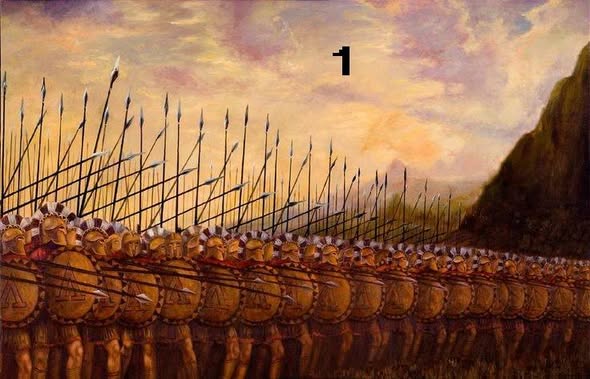
The Spartans' formation was called “The phalanx” or “al-Falanks”.. a square military formation.. the word has no Arabic root and was Arabised into “salāmi”, meaning “lined up like the joints of the fingers”...
As is clear in the first and second pictures.. the phalanx was a forest of spears and shields...
The shields in the “phalanx” had their edges braced against one another, so they became like the scales of a snake.. breaking through them was almost virtually impossible...
When they were bombarded with arrows, the Spartans adopted a formation called the “Turtle formation”.. this is clear in the third and fourth pictures...
The strength of the phalanx lay in one single point.. unity..
The formation fought as though it were one single unit.. and the ranks rotated.. the front rank blocked and pushed with the shields.. and the rank behind struck with the spear.. then it advanced and protected with the shields and the rank behind it struck with the spear from above.. and so on...
First-generation wars depend on the soldier's armament and his combat efficiency and how well he is trained.. this, of course, was the Spartans' home ground.. besides the fact that they were trained from a tender age.. they were “heavy infantry” formations.. their shields were a mixture of copper and bronze and iron, and on the inside they were made of oak wood and weighed 18 kilograms.. the soldier wore a heavy helmet that showed only his eyes and nose.. his forearms and legs were covered in bronze and he carried a spear and a sword...
The Spartan spear was heavy and made of wood that does not float on water.. it weighed about 12 kilograms and had a metal edge at the front and an edge at the back.. and the sword weighed about 8 kilograms.. short but deadly...
Of course, for the soldier to carry all that weight and at the same time move and fight and bend and dodge and charge.. he himself had to be extremely strong.. with the armour and the weapon he carried, a Spartan infantry soldier was a living human tank...
On the contrary, the Persians were light infantry.. armed with a sword and a spear and a wooden shield.. the Spartans' formation was about 6 or 7 ranks.. they blocked the narrow Hot Gates pass.. and they received the Persian waves rank by rank..
Of course, first-generation wars are not known to the effeminate, nor to revolutionary activists, nor certainly to the “clear off, you lot” brigade, nor to the “keyboard” revolutionaries and holy warriors, nor to any of the famous “falfīs” who hide behind screens and, when they see a shell, wet their chairs while sitting down..
Only men in the true sense of the word know it, value it and know how to deal with it.. not males...
The confrontation went on like that.. the Persian army had many “men”.. but the Spartans were not merely “men”.. they were “fighting men”.. and there is a vast difference between the two, if you only knew...
The bravery of the 300 and their astonishing victories.. made 7,100 of the people of Greece.. from Arcadia and Athens and others.. blacksmiths and craftsmen and artisans.. take up arms and join the Spartans..
The Spartans put these people behind them.. a last line of defence if they were defeated.. and they did not take part in the battle in any real way at all.. the whole burden was on the 300 Spartans..
The Persian king found the Spartans' training to be of a high standard.. so he sent in his personal guard, “The Immortals”.. the strongest military formation in all of Asia..
Again a direct confrontation.. but unfortunately.. as we said, the Spartans were masters of first-generation war.. so about 10,000 fighters of “The Immortals” fell.. and 30 of the Spartans fell.. and this made the Persian forces withdraw temporarily...
The Persians were baffled by the battalion of the 300.. unable to defeat them or break through them or get past the pass.. so a Greek man named “Ephialtes of Trachis” went to the Persians.. and he was after a quick gain.. effort without fatigue, like the brothers of the black market.. so he went and sold out his own people.. and showed the Persians a back road through which they could encircle the Spartans...
“Ephialtes” is a proper noun.. a human being's name.. but because of this incident it turned, in the Greek language, into a word meaning “nightmare”.. and sometimes it is applied to any traitor.. “Ephialtes”.. just as, for example, you find someone whose point is not clear and you say to him, “What is wrong with you today, you look like Abu al-Futouh”.. or you curse someone and say to him, “Go on, Baradei”...
Anyway, the encirclement happened.. the Persians began to surround the 300 Spartans from behind and from the front.. before the encirclement was complete..
Here the king of Sparta takes an extremely dangerous decision.. the great sacrifice.. one that, again, only a man can value and understand..
The king of Sparta gathered the Greeks at the rear.. the 7,100 soldiers.. and asked them to return to Greece.. and to tell its people that “Leonidas” and his 300 men would die so that no one could say that the Spartan forces withdrew.. or surrendered or fled from battle.. they would die so as not to demoralise the Greek soldiers.. and they would die according to the law of Sparta, which stipulates that the Spartan fighter neither takes prisoners nor withdraws.. he either wins or dies..
A leather document passed among the 300 soldiers.. each one of them wrote his name on it with the utmost pride.. so that it would reach Greece and symbolic “tombstones” bearing their names would be made for them.. as men who died as men ought to die...
The Greeks withdraw.. and the Spartans remain.. and they watch the forces of the Persian king's guard as they encircle them.. and a Persian messenger advances towards them on horseback from a safe distance.. demanding their surrender..
There is no choice.. surrender or death.. the Persian forces are surprised by the answer in the form of a spear flying from afar.. from the middle of the formation.. it pierces the heart of the Persian messenger and brings him down from his horse.. that was the answer.. the Spartans chose death with honour.. in the famous film.. this scene appeared at the beginning.. whereas in reality it was the last line of the Battle of Thermopylae...
The Persians attack and the fighting begins.. a real massacre takes place.. even surrounded, the Spartans are no easy prey.. and not one of them sells his life cheaply...
I will leave you with the explanatory video in the post.. it explains this subject in an easier and better way...
The battle ends with the death of the Spartans to the last man.. but this sacrifice does not go to waste at all.. because “Themistocles”, the ruler of Athens, when the news reaches him says his immortal phrase, “Leonidas and his men were not defeated.. rather they won a great victory”.. and he begins to muster his forces and unite Greece against the Persians.. and he succeeds...
This is first-generation war, whose substance is direct confrontation.. man to man and sword to sword.. an epic of fighting and courage and steadfastness and iron and blood and victory and defeat and the reverence of daring and respect for the law...
This differs somewhat from second-generation war, which we will talk about in a later post, God willing, with an example, again, from a real battle from history..
And there is more to come...
--------------
References
--------------
1 - https://www.youtube.com/watch?v=1dwjMN9HhTM
2 - https://goo.gl/bIRnJJ شامل المراجع
3 - Sacks, Kenneth S. (1976). "Herodotus and the Dating of the Battle of Thermopylae". The Classical Quarterly. 26 (2): 232–248
4 - Finley, Moses (1972). "Introduction". Thucydides – History of the Peloponnesian War (translated by Rex Warner). Penguin.
5 - Cartledge, Paul (2006). Thermopylae: The Battle That Changed the World. Woodstock, New York: The Overlook Press.
6 - Lind, William S. (January 15, 2004), "Understanding Fourth Generation War".
7 - Lind, William S.; Nightengale, Keith; Schmitt, John F.; Sutton, Joseph W.; Wilson, Gary I. (October 1989), "The Changing Face of War: Into the Fourth Generation", Marine Corps Gazette, pp. 22–26.
8 - Frost, Frank J. (1980). Plutarch's Themistocles, An Historical Commentary. Princeton University Press.
9 - الفيديو التوضيحي:
https://www.youtube.com/watch?v=8M4w-82iVXs