We watched first-generation war together.. and we stood watching the Spartan formation, “The phalanx”, and we attended the battle in which the 300 fought like demons, and the great sacrifice they made.. anyone who wants to go back to that talk will find it in the first link of the references...
Second-generation war differed somewhat.. because technology entered the picture.. there were now weapons that killed from a distance, and were more accurate and more dangerous than arrows.. “Breech-loading weapons” entered the field.. and the situation changed with them gradually...
This war was distinguished by the fact that — although it preserved the soldiers' ranks — .. they now had freedom of movement and of firing.. the intelligence element also entered it.. even though the role of intelligence at that time did not go beyond reconnaissance...
Like first-generation wars, second-generation wars had a very important psychological factor.. “Psychological warfare”.. or as “Napoleon Bonaparte” said:
“Battles are decided in the breasts of men before they are decided on the fields of battle”...
Among the examples of second-generation wars are the “Napoleonic Wars” and “World War I” and the “Boer War”.. and because the examples of these wars are many.. today we will swing between World War I and the Boer War..
Because technology was limited.. these wars depended on massive firepower.. meaning a cannon shell, for example.. it might not be very accurate.. but it causes great damage.. or ranks of soldiers firing in the direction of the enemy's ranks without precise aiming...
Psychological warfare imposed itself for the first time with force and violence as a real science in World War I.. and the Germans used to tie leaflets to small balloons that would drop after a while behind enemy lines.. containing messages of the “clear off, you lot” type.. “Your wife is waiting for you.. why die”.. etc..
Then the Germans began dropping these leaflets from aircraft, and the British followed them.. in an unprecedented psychological war based on scientific foundations for the first time in history...
By the way.. the British were unwilling about this whole psychological warfare business and did not believe in it.. until a man named Lord “Alfred Charles William Harmsworth” convinced them.. and reminded them of the defeat Britain almost suffered in the “Boer War” at the hands of one of its heroes, “Daniel Theron”, whom we will talk about in a little while...
And by the way too, brother “Alfred” is the founder of the British newspaper “The Daily Mail”.. the one your excellency publishes news about your own country from today.....!
The Daily Mail.. forgotten it? The one that said Mubarak has seventy billion dollars in the banks.. and the one that follows Bassem Youssef's news and promotes him as if he split the atom.. and the one that polished ElBaradei and others.. and the one that said a British pilot in a civilian plane in Sinai dodged a missile fired by Daesh....!
“Alfred” was skilled in the field of propaganda, so he started a formidable propaganda campaign and himself wrote leaflets that were dropped on German soldiers and had a magical effect.. to the point that the German general “Erich Ludendorff” said after the war, verbatim:
“Our soldiers were thinking exactly as the enemy wanted and appeared in the field distracted and frightened, like a mouse cornered by a snake in its hole”...
Note that up to this moment we are talking about a “second-generation” war.. true, there is psychological warfare.. but it comes at you from the enemy.. the one you know is an enemy.. the one you also meet face to face on the field...
The Boer War was between Britain and the two Boer republics; the South African Republic (Transvaal) and the Orange Free State...
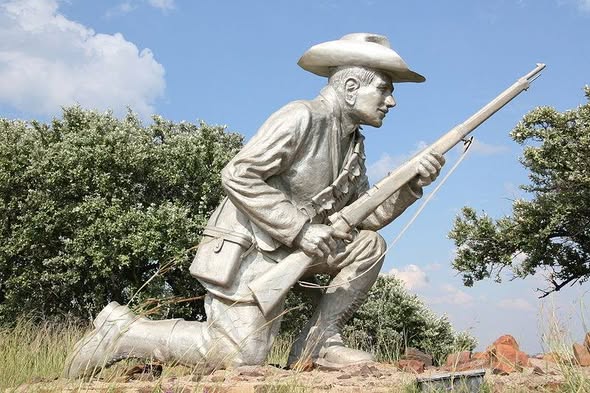
Among the heroes of this war is a man named “Daniel Theron”.. the one in this picture..
“Daniel Theron” had his own special unit.. it was called the “Theron se Verkenningskorps” or “Theron Reconnaissance Corps”...
“Daniel” used psychological warfare.. but he did not try to use it on the morale of the British.. he used it only on the morale of his own unit.. he always motivated them and encouraged them to fight with innovative methods.. and celebrated the strong, outstanding soldier.. he applied the methods of “guerrilla warfare”.. guerrilla warfare is a long war for any regular army.. especially since you do not know whether the one you are fighting is a civilian or a fighter.. with you or against you.. in addition to the fact that the Boer army had many who were not dark-skinned Africans.. no.. there were Europeans, and especially Dutch, who had been born and lived in these lands and stood up to the British...
“Daniel” applied new plans in lightning attack.. and he would withdraw with the fewest losses and anticipate where the English would set foot and attack them before they camped.. while they were still covering distance and exhausted and pitching their camps.. to the point that the British military commander “Lord Roberts” said of him: “He is the strongest thorn in the British back, preventing them from winning”...
Lord Roberts had put a reward of 1,000 pounds sterling on “Daniel's” head, alive or dead.. and dispatched forces of 4,000 soldiers to capture him.. and never managed to reach him at all...
“Daniel” was held up as the example of courage among the Boers, he was not just a fighter.. he turned into a popular legend.. like Adham al-Sharqawi and Yusuf al-Azma and Omar al-Mukhtar.. and others..
Many times he refused to send one of his men to reconnoitre.. and would scout or attack alone.. this, of course, the “keyboard militants” also do not understand.. and this is what led to his death...
So on 5 September 1900, the English forces advanced.. and they were exhausted from a long march.. and after they pitched their camp they sent a “military company” of seven men to reconnoitre and secure the area around the camp..
And in the darkness, quietly and lightly.. “Daniel” slung his rifle over his shoulder and waited for a particular moment and then pounced on the company with his dagger.. he killed 6 of them swiftly, but the last soldier raised his rifle at “Daniel” from a great distance.. which forced Daniel to draw his own rifle and shoot him..
He killed all the members of the company, but the sound of the shot reached the English camp.. and the English forces opened fire randomly on the spot from which they heard the shot.. and killed “Daniel Theron”..
The news of his death was the beginning of the end for the Boer forces.. who truly felt defeat “in their hearts”.. before they were defeated on the ground.. and the commander “General de Wet” said of him:
“If it were only a matter of courage or popularity, then men are many and I might find that among them.. but where can I find another man who combines all these skills and virtues — Men as lovable or as valiant there might be, but where shall I find a man who combined so many virtues and good qualities in one person”?
This psychological defeat was the beginning of the British victory, which indeed came about only two years after “Daniel's” death, on 31 May 1902..
This is an example of a second-generation war.. light weapons.. limited technology.. ambushes.. guerrilla warfare.. psychological warfare...
This differs from third-generation war, which we will talk about later, God willing.. and there is more to come...
----------
References
----------
1 - https://goo.gl/dJ6ojg
2 - Collins, Ross F. ed. World War I: Primary Documents on Events from 1914 to 1919 (Greenwood Press, 2008).
3 - Farwell, Byron (1989), The Great War in Africa, 1914–1918, W.W. Norton.
4 - Thomas Pakenham, page 571 The Boer War.
5 - Military History Journal, Vol 11 No 3/4 (October, 1999).
6 - Fransjohan Pretorius, 'The Experience of the Bitter-Ender Boer,' in The Boer War',' ed. by John Gooch (London: Cass, 2000), p.179.
7 - Maurice, John Frederick; Maurice Harold Grant (1907). History of the War in South Africa, 1899-1902. London: Hurst and Blackett. .
8 - Caldwell, Theodore C. (1965). The Anglo-Boer War: Why was it fought? Who was responsible?.