"Darwin's" voyage on the ship "Beagle" had many adventures in it, and its captain before "Robert FitzRoy" had committed suicide.. so we are trying to condense it here.. but anyone who wants to know the details of these stories and read more about them will find them in Darwin's book "The voyage of HMS Beagle".. in the first reference...
"Darwin" in the Galapagos Islands found a treasure of animals and forms of life.. "the Galapagos Islands" have animals that exist nowhere else in the world.. and you might find in them the ancestor of the animal.. and the animal and its cousin together.. meaning you find the grandfather.. and the grandchildren who evolved with a new trait.. and their cousins who evolved with a different new trait...
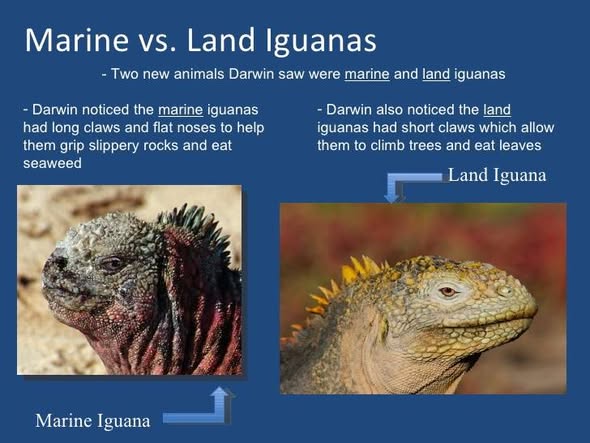
Among the first animals that caught his attention.. was the iguana lizard.. and this is a lizard with a frightening appearance that sometimes reaches two metres.. but it is peaceful and shy.. it lives on fruits and vegetables.. and does not attack humans or other animals...
This lizard is wild all over the world.. and because of its diet it prefers to live in forests and thickets and green places.. and Darwin found it in the Galapagos Islands.. and it is no different at all from the iguana in America...
But "Darwin", just a few metres away from this lizard.. when he approached the seawater.. found it a sister.. exactly like it.. but "marine"...
Somehow it came to possess the ability to hold its breath for longer periods.. and it began to dive into the depths of the sea eating seaweed and algae.. its claws grew longer so it could grip the slippery rocks and not slide off.. and its jaw grew a little smaller and became more suited to scraping the algae off the rocks..
Its colour changed a little too.. and became closer to the rocks and the algae so it could hide from enemies.. while the colour of its sister on land.. remained a mixture of yellow and green.. so it could disappear amid the forests and the grass...
The only point of disagreement between the reasonable people of the two camps.. between the supporters of evolution who do not believe in a creator.. and the supporters of evolution who believe in a creator.. is whether "this happened by chance and was imposed by nature, or by divine intervention that changed the code of these creatures and helped them change and continue".. and we will get to that later and present the views of both within the context..
Well, since the Galapagos are green, rocky and sandy islands.. with crops and sea and land.. that means that the two kinds of iguana.. the land and the marine.. were both fit to survive..
The marine one mutated and acquired new traits.. while the land one stayed as it was and still multiplied.. because the fittest, as we said before, is "the one most capable of reproducing".. and both were fittest.. the one that mutated and chose to eat from the sea grass.. and the land one..
And the two lizards have one "grandfather".. the "giant iguana", whose remains and skeleton the fossil record has preserved for us..
Imagine if we had come into the world and found no land iguana.. and found no grandfather of it in the fossil record.. it would be very hard to convince many people today that this marine iguana has a sister.. and that she went extinct..
Among the other examples that "Darwin" noticed and recorded, were the finches of the Galapagos Islands.. which Dr. "Percy Lowe" named in 1936 "Darwin's finches".. and the new name has stuck to them to this day...
Darwin's finches are a group of finches.. about 15 species.. all of them one.. exactly alike.. even their sizes are very close.. but there is an essential difference in them that happened over time.. and was inherited by the generations that came from their line..
This difference was in the "beak".. and it is noticeable with the naked eye.. so you find the bird that kept feeding on fruits.. its beak turned into something resembling a parrot's.. and the one that feeds on the tips of cactus plants.. its beak became longer.. to help it stay as far as possible from the cactus thorns.. and the one that feeds on the cactus trunk, its beak became shorter and stronger.. because the cactus trunk is thicker.. the woodpecker's beak became pointed and strong.. and the insect-eater's beak became short so the insects do not slip away from it.. and the one that eats tree leaves got a short beak with edges as sharp as a razor blade..
When "Darwin's finches" were presented to the enemies of evolution.. they said this is not "Evolution".. this is "Adaptation".. like when you travel to a Gulf country.. and you are hot and cannot stand the weather.. and over time you adapt and the heat becomes normal for you..
But if the heat goes beyond the usual you feel it and it bothers you.. and then you adapt..
And if it increases again you feel it...
Meaning your ability to adapt itself evolves..
Meaning "adaptation" is part of evolution.. not its opposite, nor does it negate it..
Let us make do with these two examples from the "Beagle" voyage.. and go back to Darwin.. who began writing his book and called it:
"On the Origin of Species by Means of Natural Selection, or the Preservation of Favoured Races in the Struggle for Life"
What we call "On the Origin of Species"..
"Darwin" sat writing this book and refining the theory for about twenty years.. from 1838 until he published it in 1858.. reluctantly.. feeling that the theory was not yet complete.. and that he was not ready to publish it...
Of course, because we are talking about two centuries ago.. the nineteenth century.. and people were for the most part ignorant, neither reading nor thinking.. the book fell into the hands of the believers and the atheists.. who saw it as a means to scheme against one another.. and it fell into the hands of the few scientists that existed...
What we said at the beginning happened.. and the press pinned on "Darwin" that he said "man's origin is an ape" and that he "denies the existence of God".. even though "Darwin" never addressed these subjects at all...
And the tragedy began...
Some scientists, unfortunately, fell into the trap.. and took the words of the common people.. because personal whims and preconceived bigotry dominated them.. to the point that a debate took place called the "1860 Oxford evolution debate".. in which the great clergyman the Reverend "Samuel Wilberforce" stood addressing the great biologist "Thomas Henry Huxley".. and said to him:
- "So you accept that your grandfather was an ape?"
And the biologist replies to him:
- "Yes, I accept that he was an ape.. better than my grandfather being a lying man who exploits religion to swindle people!"
A venerable clergyman and a great scientist butting heads because one is denying and the other is defending something that never happened and was never said..
A debate about something that does not exist at all...
And the funniest thing is that the one being attacked and defended.. the author of the theory.. was not present at the debate at all and nobody invited him to speak...!
All that "Charles Darwin" said was simply.. that the whole chain of living beings on Earth are close to one another in biological composition.. and that is indeed true and we have seen it before in the human hand.. and the dolphin's hand that became a flipper.. and the bird whose hand became a wing.. and the hand of the lion and the tiger and the wolf and the dog.. five fingers and the same digestive system and the same reproductive system and circulatory system and others...
And that these species have a "set of ancestors".. and these ancestors have some relationship to one another.. some of them have a direct common ancestor.. like the brown bear and the polar bear.. and like the marine and land iguana.. and like Darwin's finches.. and we have seen and met their ancestor in the fossil record..
And sometimes the ancestor is still there and alive.. like the closest ancestor of the crocodiles.. which is the Nile crocodile.. which exists and lives among its descendants, the sea crocodiles and the dwarf caimans and the Cuban crocodile and so on..
And some of them have a kinship but an indirect one.. meaning relatives.. but distant.. like the cat and the dog..
And in the end.. all these ancestors have a common ancestor..
What did this common ancestor look like??
Was it a single-celled organism.. like sperm cells.. that set off in millions on the journey of life and met other cells and began to multiply in several directions into multicellular ones.. one becomes the ancestor of humans.. and the multicellular one becomes the ancestor of the ape.. and likewise for the dog and likewise for the hyena.. and so on?
Or what happened? What did this ancestor look like...
Here lies a surprise.. and not many, unfortunately, know it either..
Darwin did not describe this ancestor nor ever speak about it in detail.. and he avoided this point entirely in his book and his studies...
Did we and living beings evolve? Yes.. and is there a relationship between our ancestors? Yes.. what did these ancestors look like and what did this common ancestor look like and how did it work? Darwin said nothing..
And the struggle over this "ancestor" began..
Then out came the group who do not believe in a god and believe only in evolution, and they are called "Evolutionists", and they said: "No.. man is nothing but a few elements and salts and minerals.. that came together by chance and made a primitive cell.. which divided over time and multiplied.. and made the first human.. who kept evolving over time.. losing most of the hair on his body.. and losing control of the ear muscles.. and reached the current civilized human..."
And out came the believers' group, "later called: the Creationists", saying "No.. man was created from clay suddenly.. in this very same shape and form...
And a third group appeared.. that tried to reconcile the two theories.. and they debated the group of pure evolutionists.. and said to them.. "Man was made from a set of elements.. substances and acids and salts and minerals.. that merged under certain conditions..and made a living cell that began to divide and was formed and shaped a human form"
They said: yes, it happened over millions of years..
They said to them "well, what is the definition of clay? Is it not also a set of elements and salts and minerals? Meaning the two theories are not contradictory.. there is a certain power that gathered these elements and created a cell and made it divide into several cells.. and formed it and it became our great ancestor Adam"
These people are called "the supporters of Creative evolution".. and they combine biology and philosophy together..
The whole struggle became about "did this happen by chance"? or "did it happen through a rational power that controls the universe"..
From this group there later emerged a man named "Henri-Louis Bergson".. who refined this theory.. and formulated it in a scientific-philosophical way.. and told us "there must be a force in the universe.. that pushed the wheel of evolution and controlled it"..
And he called this force the "creative force, or the élan vital".. and he said, just as Akhenaten said in ancient Egypt, "that this force.. is the one that controls the disc of the sun.. and sends surges of its powers through it"..
The evolutionists met this talk with disdain.. and said it was naive philosophical talk..
But this philosophical theory of "Bergson's" won the Nobel in 1927...
But the evolutionists insisted on their point of view.. that all of this happened by chance.. and they took us into the monkey and the typewriter hypothesis...
And the "Infinite monkey theorem".. says in brief that if you gave a monkey a typewriter.. for an unlimited time.. and left it banging out any words on it.. you would find it has written you the complete works of Shakespeare through the law of chance alone.. and this is the hypothesis that "Huxley" put forward at the Oxford debate...
Meaning the cell could have come about by chance...
Of course this talk did not pass so well.. and mathematicians in particular do not let anything pass.. nor does anything escape them..
So the mathematicians of the modern age picked up this hypothesis.. and actually brought a group of monkeys.. about 6.. and locked them up for a month.. with computers.. after teaching them to tap on the keyboard and try to write words..
After the month.. it turned out that the monkeys had written 53 pages.. but there was not a single page with one comprehensible letter in it.. so the mathematicians did an extremely complicated calculation - I honestly do not understand it well - and multiplied the month by the number of monkeys by the pages by billions of years and divided them and flipped them around..
And they concluded from their calculations that for this to happen by chance.. the probability of it happening even once is 1 in 10 "Ducentillion" and the ducentillion is the number 1 with 603 zeros next to it..
In short, and by another calculation.. this exceeds the entire age of the Earth..
So the mathematicians told the evolutionist brothers and the creationist brothers.. that this whole business of the monkey and the typewriter and chance is down the drain.. say whatever you want and grind each other up however you like, but keep away from mathematics please..
And because none of the parties thinks in a scientific manner most of the time.. and is busy scheming against the others for the sake of religion or atheism alone.. they went back on their words and said no, we did not say that.. and "Huxley" did not put forward this hypothesis.. and the typewriter had not even been invented yet in 1860 when the debate took place..
But the typewriter was invented by the Italian "Francesco Rampazzetto" in 1575.. and developed by the Englishman "Henry Mill" in 1714....
So this was the "scientific climate" for discussing evolution since the 19th century, and it continues to this day unfortunately.. an atmosphere of insults and scheming and error and refusing to apologise for it and insisting on it.. because teams are trying to prove or deny the unseen.. with a scientific theory.. and in their midst are real scientists whose voice is not heard, telling them "I swear to God, Darwin never said that at all"...
The evolutionists said: no, even so.. this "Darwin" himself lost his faith and became an atheist after he discovered and laid the foundations of his theory.. which contains not one wrong letter, nor does his book "On the Origin of Species".. and that is proof of the correctness of what we say..
But "Darwin" had in store for everyone an astonishing surprise with which he proved to them that they were doing the work of children scheming against one another.. and that nobody had examined his book properly.. we will talk about it later, God willing, and the talk will have a conclusion...
-----------
References:
-----------
1 - http://www.gasl.org/refbib/Darwin__Beagle.pdf
2 - Lack, David. 1947. Darwin's Finches. Cambridge University Press (reissued in 1961 by Harper, New York..
3 - B. Rosemary Grant and Peter R. Grant 1989. Evolutionary dynamics of a natural population: the large cactus finch of the Galápagos. ..
4 - Grant, Peter R. 1999. Ecology and evolution of Darwin's finches. Princeton NJ.
5 - "Huxley, Wilberforce and the Oxford Museum" - American Scientist...
6 - Jensen, J. Vernon (1991). ""Debate" with Bishop Wilberforce, 1860" - https://goo.gl/bHq088
7 - Previous posts:
I - https://goo.gl/oUPAOO
II - https://goo.gl/WHw9rZ
III - https://goo.gl/P2O1jj