Still with "Darwin" and his slandered theory, and with people who popped up suddenly.. saying it is a theory with no need and no use...
Knowing how evolution works, whether it happens and how it happens.. makes you able to ward off many diseases that parents pass on to their children.. makes you able to deal with new strains of bacteria that evolve suddenly.. and could cause you pandemics and wipe life off the face of the Earth as we know it..
The key to confronting these problems is the "theory of evolution".. origination and advancement...
Before "Darwin" there was a theory; it originally came from ancient China and Greek civilization, and "Hera" and "Medusa" and "Lamia", in the days of magic and the belief that there were super dragons fighting non-earthly tigers to control the universe.. This theory is called the "theory of impossibility, or the theory of Transmutation"...
And under this theory.. cats, over time and over hundreds of millions of years.. could evolve into tigers.. and the lizard evolves into a crocodile.. and mice evolve into rabbits.. and the gorilla evolves into a human...
According to the theory of transmutation.. the cat only needs a billion years to turn into a tiger.. this is not a separate, independent creature.. no, they are one.. do they not have claws and fangs and fur and whiskers, and look exactly alike?? Then they are one.. and tomorrow the cats will grow and transform and become lions and tigers..
So if you believe that "Darwin" said cats become lions.. and fish become reptiles.. and the ape becomes a human being (we just need a few billion years).. allow me to tell you.. that this talk is "nonsense"...
This talk of yours is exactly the theory that "Darwin" rejected and corrected.. and yet.. half of those convinced by Darwinism today.. actually believe in the theory of "Transmutation".. and so they strike Darwinism a fatal blow.. and they are talking about something else entirely...
The theory of transmutation found its way into the 19th century as we said.. though of course it was heavily amended and revised from what it had been before Christ.. and several theories branched off from it.. among them spontaneous generation and Lamarckism...
And spontaneous generation, you will find traces of it to this day.. in the cultures of all peoples.. and you will hear an educated person say that "wet wood shavings produce cockroaches"...
Not that it becomes a shelter for cockroaches.. no, it "produces" cockroaches.. banana peel "produces insects and Midges "...
Of course this is pure nonsense.. science denied it long ago.. nothing "produces" anything on its own.. the shavings or the banana peel has to contain some of the eggs of these insects.. so that they appear in it later, and the sterilized wood shavings locked in a box in the laboratory.. produced nothing and will produce nothing even if left for a billion years...
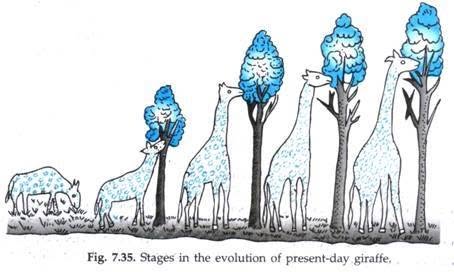
As for the theory of "Jean-Baptiste Lamarck", which is called "Lamarckism", it was a little more developed.. In it "Lamarck" said that the organism develops certain traits through use.. and passes these traits on to its offspring, and so the coming generations take them as a dominant trait..
And "Lamarck's" famous example was the giraffe.. He told us that the giraffe was an ordinary creature.. with a short neck, more like a goat.. and then came a time when there was no more grass, and the only food was on the branches of trees, so this creature tried to stretch its neck generation after generation.. until its neck grew long and it could eat from the trees...
This theory hit a gap here.. and it did not explain to us why, when there was no grass, the rabbits did not go extinct or grow long necks.. nor did it explain what this creature, if you will excuse the expression, was eating during the several million years in which it was stretching its neck to eat from the tree branches, and how it lived during that period?
This theory pours into one channel: "the organ you use grows and enlarges.. and the organ you neglect atrophies and disappears"..
This theory also told us that snakes once had limbs.. and then, because they crawl a lot and do not use their limbs, these limbs atrophied.. and disappeared.. and again it did not explain to us why in many reptiles, such as the "skink" lizards, among them the "sandfish ", their limbs did not disappear even though they do not use them much and their life is closer to that of snakes...
Science took Lamarck's theory and ran thousands of experiments, all of which proved its failure.. and along came a scientist named "August Weismann".. he brought mice into the laboratory and cut off their tails.. he cut them off for six consecutive generations.. and yet the new generations kept being born with tails..
Scientists came out and objected and said no.. "Weismann's" tail-cutting experiments are not an example of "disuse" of the organ.. the organ has to be present and the creature has to neglect it of its own accord...! Of course this talk found no echo and no consensus among scientists..
There is no such thing.. a weightlifter's son is not born with strong arms and shoulders.. because his father used these organs in his life.. and a man with amputated legs could father a champion runner.. even if the traits of using or not using an organ.. were passed down for 100 generations in a row...
And the case of "polydactyly" in the X-ray image with this post.. does not appear because the person tried to have extra fingers.. nor does this finger grow and get inherited through use and disappear in coming generations if neglected.. it is a birth defect...
And a generation of scientists could have a stupid grandson.. perfectly normal...
Meaning the matter has nothing to do with atrophy and use...
But Lamarck's theory might have meaning if we look at it in another scope..
In the scope of the genome and DNA..
In single-celled organisms, they really do pass new traits to their offspring.. as evidenced by antibiotic-resistant bacteria.. and heat-resistant fungi..
But that is within the scope of DNA.. and without the original traits of the organism as a whole changing.. meaning it does not turn from a bacterium into a virus.. it stays a bacterium.. but it has new characteristics..
And there are studies on different genes found in children born to a mother exposed to nervous stress during pregnancy.. or to a smoking father...
Meaning Lamarck's ancient theory could be developed, and its idea looked at with interest, but in a different way...
And that is a kind of evolution..
And very close to the evolution Darwin meant...
And science is actually researching this today...
Until now we agree that evolution between existing species from one creature to another does not exist.. true, you might find "Polymorphism" within a single creature.. so you find the desert, mountain, black and spotted leopard.. and a species emerges from a species.. and evolves over millions of years and differs in many traits from its ancestors.. but in the end they are leopards.. they are still leopards..
You will find the baboon and the mountain monkey and the orangutan and the gorilla and the mandrill.. and some of their kinds are more evolved than others.. and they differed from the species of their ancestors and evolved and changed.. but they are all apes.. the same species...
And Darwin, on his voyage on the ship "Beagle", arrived at this truth, and also pointed to the importance of heredity, but in a different way from Lamarck..
Darwin dissected dozens of living creatures, and thought about the matter differently...
And Darwin's observations as he was dissecting animals on board the "Beagle" recorded something very strange that caught his attention.. we will talk about it later, and the talk will have a continuation...
----------
References
----------
1 - The previous post: https://goo.gl/oUPAOO
2 - Secord, James A. 2000. Victorian sensation: the extraordinary publication, reception, and secret authorship of the Vestiges of the Natural History of Creation..
3 - Desmond & Moore 1994..
4 - Gould, Stephen Jay (1980). The Panda's Thumb: More Reflections in Natural History (1st ed.)..
5 - Ghiselin, Michael T. (September–October 1994). "The Imaginary Lamarck: A Look at Bogus..
6 - Weismann 1889, "The Supposed Transmission of Mutilations" (1888), p. 432 - PDF file: https://goo.gl/NplXrJ
7 - Jablonka, Eva; Lamb, Marion J. (2008). "Soft inheritance: Challenging the modern synthesis" (PDF). Genetics and Molecular Biology. Ribeirão Preto, Brazil: Sociedade Brasileira de Genética. 31 (2): 389–395.