The narrative says that our master "Ali", may God be pleased with him, knew the leaders of the faction that killed "Uthman".. and he saw fit to wait, because they had all but occupied Medina with weapons, spreading out and entrenching themselves in it.. and it would have been dangerous to fight them on the spot, because that would have spilled the blood of many innocent people and civilians.. so he preferred to wait until things settled, until he held the reins of the state.. and laid a plan to take revenge on them.
And because the leaders of the Kharijites knew that "Ali" would take revenge on them sooner or later.. as soon as matters settled for him, they had resolved that matters should never settle at all.. and when the Imam moved to Iraq, they slipped in stealthily.. on the principle of "there is no escape from the lion except into his den."
The best of stories relates that "Lady Aisha", may God be pleased with her, was returning from performing the Hajj, and while on her way back she met an army of some twenty thousand fighters, led by "Talha ibn Ubayd Allah" and "al-Zubayr ibn al-Awwam".. The Sunni sources contradict one another here, and say "they did not go out to fight.. they went out to urge the Imam (Ali) to take revenge."
They are going to urge him with 25,000 men? The Sunni sources and the Shia sources on the point of the Great Sedition and the dispute between "Ali", may God be pleased with him, and "Muawiyah", turned the matter into whim, not history.. and each one, in many places, decided to author history to his own taste.. and to justify one side to his own taste.. and you might find in the two sources.. that they reject certain narrations because a particular Companion appears in the text.. while they impugn the narrations of that Companion.. and then rely on other narrations that support their belief, with the very same Companion in the text! You might find in the Sunni sources prophetic hadiths supporting a particular view, transmitted from "Ibn Abbas", may God be pleased with him, as the first narrator of the hadith.. and then you investigate the matter and find that "Ibn Abbas" at the time of this narration was a year and a half old.. You find Shia narrations about the heroics of "al-Hasan", may God be pleased with him, and how he stood up to a hundred armed men and so on, and then you find that al-Hasan at the time of this narration was six years old... something very regrettable.. and the common people, like me and like you, fell into confusion.. and it made them doubt a great deal.. may God keep us firm, and we were able to investigate and reach the truth to some extent.. but there are others.. this idiocy drove them away from religion entirely.
Investigating this phase historically was very difficult and exhausting.. but the truth is.. that "Talha" and "al-Zubayr" went out to fight.. and their aim was to fight those who killed "Uthman" and purge Medina of them.. not to fight "Ali".. and when they met Lady "Aisha", she advised them that revenge by this method.. might escalate and set two groups of innocent believers to killing one another.. and the argument went on.. so she told them that she would come with them, so that if the forbidden came to pass, and it did.. and with the moral authority she had as Mother of the Believers.. she could reconcile between the two groups.. and she advised them to head for Iraq, to unite the word and the forces with "Ali".. and from there, everyone would begin to eliminate the ringleaders of the Kharijites there.. so they did indeed move there.
And the great army moved.. and the news reached Iraq.. and while the group was on the outskirts of Basra, one of the Kharijites, who were called the "Sabai'ites", if you remember, went to the governor of Basra, "Uthman ibn Hunayf", and told him that Aisha had come at the head of an army to occupy Basra.. so he too mobilized an army of 30,000 men against her.. under the command of "al-Ashtar al-Nakha'i" and "Muhammad ibn Abi Bakr".. and the two forces met on the outskirts of Basra.
When the companions of "Aisha" saw "Muhammad ibn Abi Bakr" at the head of the commanders of Basra, they were seized with enormous rage and intense fury.. because it had come to their knowledge that he had been among those who stormed the house of "Uthman ibn Affan" on the very night he was killed.. and the atmosphere became electric and a state of belligerence and hostility arose.. and the companions of "Aisha" decided that preventing them from entering Basra amounted to a declaration of war on them.. so "Talha" and "al-Zubayr" came forward and addressed both sides together.. and their own people backed their words.. while the forces of Basra rejected them.
And here Lady "Aisha" rose and addressed the two camps in turn.. and this time.. her camp backed her, and about five thousand of the forces of Basra.. joined her camp, so the strength of the army under the command of "al-Nakha'i" and "Ibn Abi Bakr" became about 30,000.. facing 20,000.. which was all the force of the governor of Basra.
After Aisha's speech, a man from the forces of Basra named "Hakim ibn Jabala al-Abdi" came forward, and he was not one of the Kharijites, but his mind was a little unsound.. so he decided to escalate the matter into a battle.. so "Aisha" once again played the role for which she had originally left Medina.. she restrained the people from fighting.. and the brother "Ibn Jabala" was inflaming people's feelings and calling for battle.. so Lady Aisha shouted at him and accused him of trespassing against her sweeping authority as Mother of the Believers.. so "Hakim ibn Jabala al-Abdi" went and cursed Lady "Aisha".. and when the people reproached him for cursing her.. he raised his weapon against them.
The atmosphere grew more charged, and the two sides began pelting each other with bricks and stones.. an envoy from "Ali ibn Abi Talib" himself, who had learned of the matter, arrived, and began calling on the crowds to stop the exchange of insults and the brawling.. but no one heard him.. and massive chaos broke out, with "Ibn Jabala" continually shouting curses at "Aisha", so the blood boiled in the veins of "al-Zubayr", and he launched with a battalion of horsemen against the forces of Basra, in a successful raid.. in which "Ibn Jabala" was killed.
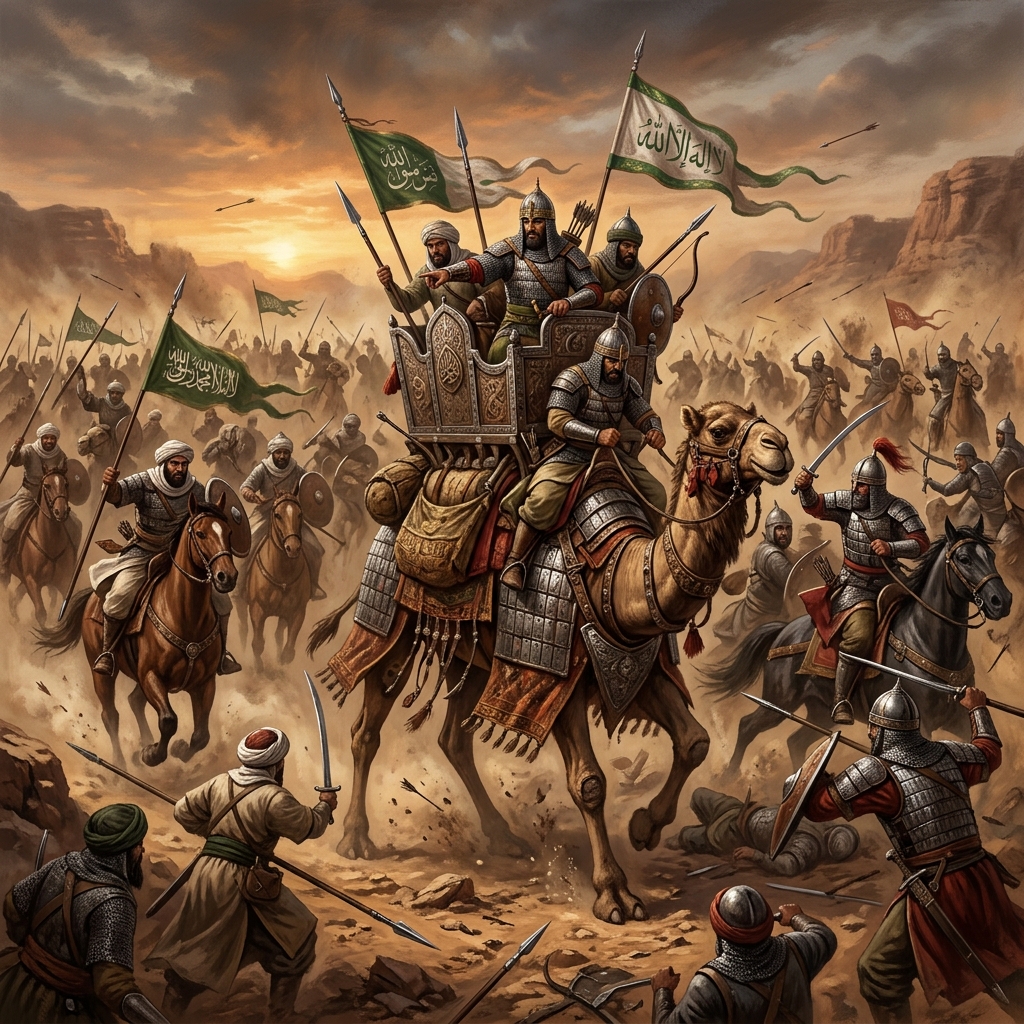
This battle that took place happened in front of the camel of Lady "Aisha", while she was screened inside a howdah of iron.. which is why it came to be called the "Battle of the Camel". The Shia sources insist that had it not been for this event.. "Siffin" would not have happened later between the army of "Ali" and the army of "Muawiyah".. The truth is that "Siffin" has nothing to do with it.. "Muawiyah" was in all cases covetous of the seat of power.
The strange thing is that with the killing of "Ibn Jabala", the two sides calmed down.. and the envoy of "Ali" spoke with "Uthman ibn Hunayf", and he decided to allow the forces of "Talha", the companions of "Aisha", to enter Basra on one condition.. that all these soldiers keep away from the public facilities and official residences.. such as the treasury and the seat of the emirate.. otherwise.. they could settle anywhere they liked.
And at the same time, the Imam "Ali" was moving toward Basra to resolve the crisis.. and he sent ahead of him "al-Qaqa ibn Amr" to look into the matter.. so "al-Qaqa" went in to "Aisha", greeted her and asked her: "O mother, what brought you to this land?" And she replied to him, saying: "O my son, reconciling between the people", and "al-Qaqa" was a seasoned military expert, so he realized that "Aisha", may God be pleased with them, was truthful and had no intention at all of fighting.. so he began to work for reconciliation between her and "Ali ibn Abi Talib".
When the reconciliation was concluded.. the Kharijite group did not like this story.. so they sent two of their men to the dwelling of Lady "Aisha" to stand at her door and curse her, as if they were envoys from the Imam "Ali" himself.. so the Imam "Ali" learned of the matter.. and ordered that they be stripped of their clothes and flogged in public.. and "Ali" addressed the people with a sermon about solidarity, unity, love and brotherhood.. and so on.. and indeed reconciliation was concluded between the two sides.. and they began to agree and consult on the question of taking revenge on the killers of "Uthman".
And this was of course a catastrophe for the Kharijite group, in whose hands the blood of Uthman was still fresh.. so the Sabai'ite group decided that the matter had to escalate further.. so they resorted to a plan of extreme cunning and cleverness.
And this plan we will talk about later.
And there remains more of the talk.. to come.
-------------
Previous posts:
-------------
1 - http://bit.ly/2Rm5tBs
2 - http://bit.ly/2RACrOV
3 - http://bit.ly/2NeseJs
4 - http://bit.ly/2XoDruI
5 - http://bit.ly/2IAYulr
6 - http://bit.ly/2IYrjHm
7 - http://bit.ly/2IKnM0s
8 - http://bit.ly/2FBavFz