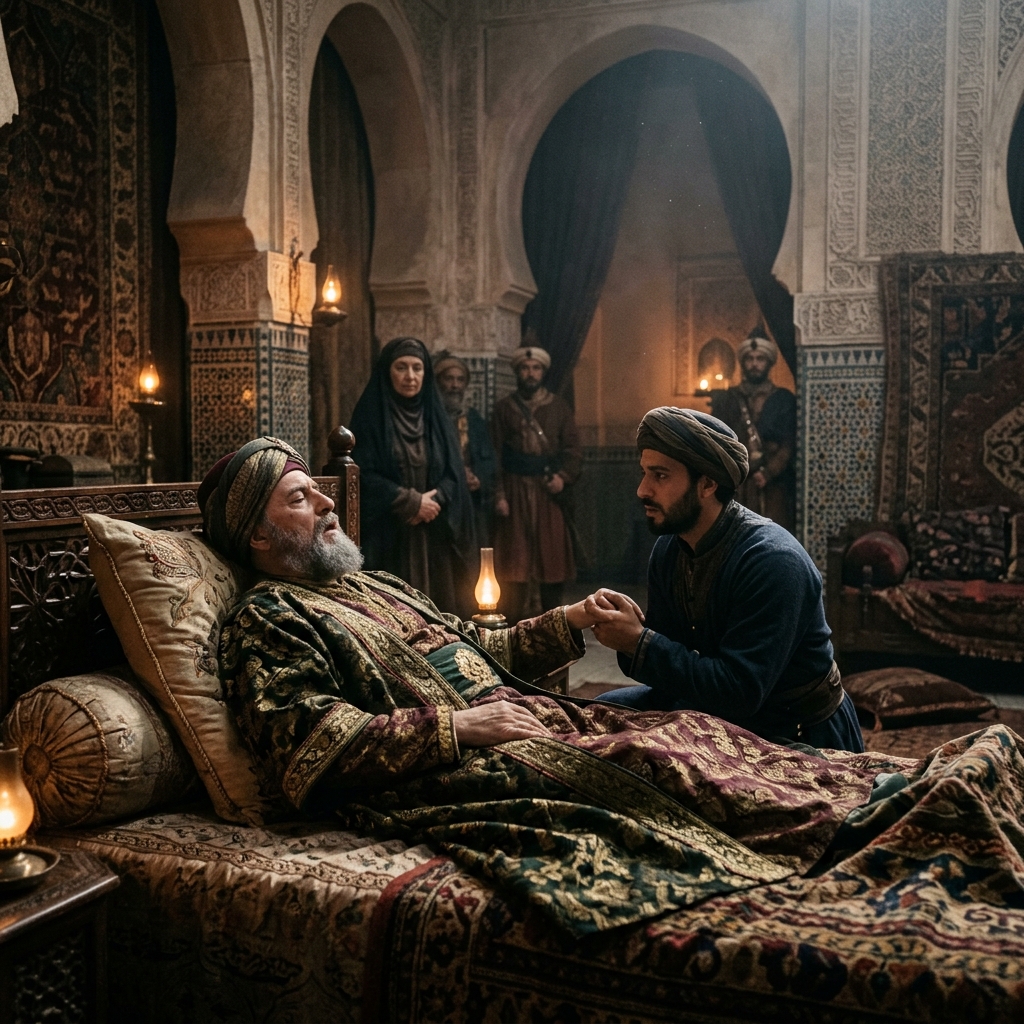
With the rule of "Mu'awiya ibn Abi Sufyan", the Rightly Guided Caliphate, as we know it, comes to an end.. and we begin to enter the era of the Umayyad state.
And we enter the game of hereditary succession to power.
The moment "Mu'awiya" reaches the seat of the caliphate.. he closes the whole question of "the blood of Uthman", which he had supposedly fought for.. and he does not speak of this story and shuts this file completely.. and from that time there seeped into the conscience and into jurisprudence and literature the phrase "the shirt of Uthman".. to refer to "Mu'awiya's" act when he displayed the shirt of "Uthman ibn Affan", may God be pleased with him, stained with blood, on the pulpit and demanded retaliation for him.. and from that time the phrase came to be taken as proof of every person who raises a slogan he does not really care about, in order to reach a personal goal.
Many of the jurists of Syria gathered around "Mu'awiya" and flattered him violently.. and as a result of Shiite extremism on the part of the partisans of "Ali ibn Abi Talib", may God be pleased with him, a counter-extremism arose.. to the point that special hadiths were fabricated for "Mu'awiya".. describing his greatness and majesty and warning against touching him.. and raising him above all the Companions to the rank of the prophets.
To the point that there is a complete, detailed chapter of jurisprudence.. called "The Chapter on the Virtues of Mu'awiya".. and virtues means "praiseworthy traits".
There is nothing like this chapter, in this manner, in jurisprudence even for our master Ibrahim, peace and blessings be upon him, the father of the prophets himself.
The Shiites fabricated similar accounts and hadiths for our master "Ali".
In a hadith it says: "Do not mention Mu'awiya except with good, for I heard the Messenger of God say: O God, make him a guide, guided, and guide others by him".. The jurists said of that hadith: "It has no basis".. and "Ibn al-Jawzi" cited in al-Mawdu'at some of the hadiths they mentioned.. then he related from "Ishaq ibn Rahwayh" that he said: "Nothing authentic has been established on the subject of the virtues of Mu'awiya", and "Ibn al-Jawzi" also reported through the chain of "Abdullah ibn Ahmad ibn Hanbal": I asked my father.. what do you say about "Ali" and "Mu'awiya"...?
He lowered his head, then said: Know that "Ali" had many enemies.. so his enemies searched for a fault in him and found none.. so they turned to a man who had fought him and praised him, as a trick of theirs against "Ali".
And "Mu'awiya" had two of the great opponents.. "al-Husayn ibn Ali ibn Abi Talib" and the more ferocious opponent "Abdullah ibn al-Zubayr", may God be pleased with them both.. and he realises that one of them might rally people around him and win and depose him.. so he decides to abolish consultation.. and turn the system of rule into direct hereditary succession.. and it was said that he resorted to this because the people of Syria — the seat of the caliphate — rejected anyone who was not Umayyad.. and indeed in Damascus "Mu'awiya" announces his choice of "Yazid", his son, on the pulpit.. and all the people of Damascus pledge allegiance to him without objection.
And in Syria and Basra and Mecca allegiance is given to Yazid.. but the people of Medina refuse the pledge.. and the people of Iraq and Egypt refuse it.. despite that.. "Yazid" is proclaimed caliph during "Mu'awiya's" lifetime.. and "Mu'awiya" begins to turn his attention away from worldly matters and is struck by a strange asceticism.. to the point that when "Abdullah ibn Amr ibn al-As" reminded him of Siffin.. he said that he fell silent and wept.. and "Abdullah" took his silence as regret.. and he said to him: "Leave me and the Most Merciful of the merciful".. and he would always say to those around him this phrase: "Leave me and the Most Merciful of the merciful"... no one has any business with me.. leave me to God, the Most Merciful of the merciful, to decide my affair.
And the strange thing too is that shortly before his departure, "Mu'awiya's" testament to "Yazid" was even stranger.
"Mu'awiya" tells Yazid that there are four who could dispute his rule.. "al-Husayn ibn Ali", "Abdullah ibn Umar", "Abd al-Rahman ibn Abi Bakr" and "Abdullah ibn al-Zubayr".
And "Mu'awiya" explains to "Yazid".. that "Abdullah ibn Umar" abandoned the world since "Siffin" and occupied himself with worship.. and "Abd al-Rahman ibn Abi Bakr" occupied himself with women.. and "Abdullah ibn al-Zubayr" is a looming danger.. he must beware of him.. and if he gets hold of him.. then he must tear him limb from limb.
And "Mu'awiya" speaks to his son "Yazid" about the last man who is a source of danger.. "al-Husayn ibn Ali".. and he enjoins him that if "al-Husayn" comes out against him and fights him.. and "Yazid" defeats him.. then let him pardon him, and let him respect his kinship and his sanctity...!!
And it was a strange position from a man on his deathbed.. one who had come out against the father of "al-Husayn" himself and afterwards against his brother "al-Hasan".
"Mu'awiya" dies in the year 680 AD.. at the age of nearly eighty.. and his son "Yazid" takes the reins of power.
And the people of the provinces who rejected the caliphate of "Yazid" begin to communicate with "al-Husayn", may God be pleased with him.. and they begin to gather.. for they had rejected the idea of hereditary succession.. and on that basis they rejected the existing caliphate.. and they decided to fight "Yazid ibn Mu'awiya".
And "Ubayd Allah ibn Ziyad" was the governor of Iraq on behalf of "Yazid".. and he was in an unenviable position because the people of Iraq rejected him and rejected the one who had appointed him.. so he begins one by one to seize the notables of the city who had any connection with al-Husayn and kill them.. and the news reaches "Muslim ibn Aqil", who was the cousin of our master "al-Husayn".. so he goes out at the head of a group and they begin a fierce fight with "Ubayd Allah's" guard.. and the guard is unable to hold them off.. so they withdraw into the palace.. and "Ubayd Allah" orders the doors to be shut.
They went on besieging the palace for hours.. and then they headed for the mosque.. and the door of the palace opened again.. and "Ubayd Allah's" men came out, having rallied their scattered forces.. and they head for the mosque.. and besiege those gathered in it.. and tear off the roof and attack them with bows and arrows.. so most of them die.. and "Muslim ibn Aqil" is seized alive.. and they take him to "Ubayd Allah".. who says to him: "You came to snatch away my authority?".. and orders him killed on the spot.
With the killing of "Muslim", "al-Husayn" is enraged with a tremendous rage.. and he prepares his men and followers and they form a small group of about 150 men.. from among those who rejected the hereditary succession of "Yazid".. and he sets out from Mecca heading for Iraq so that they may gather with the rest.
And on the way.. "al-Husayn" receives letters from senior Companions.. among them "Abdullah ibn Amr ibn al-As".. who said that "by God, had I reached him, he would not have gone out unless he overcame me".. and "Ibn Abbas", may God be pleased with them, said that when "al-Husayn" spoke to him about going out against "Yazid" he said to him: "Were it not that it would disgrace me and you, I would have grasped my hand in your hair".. were it not for the talk, I would have seized you by your hair so that you would not move.. because the country cannot bear a new civil war.
And on the outskirts of Iraq, the voice of reason prevails over anger deep inside "al-Husayn".. and he decides to change direction.. and go to meet "Yazid" in Syria.. and ask him to exact retribution for the blood of "Muslim ibn Aqil" from "Ubayd Allah".. and then pledge allegiance to him.. and the matter would be over.
But "Ubayd Allah" was watching the roads between Syria and Iraq.. and he had many spies from among the Bedouins.. they learn of the intention of "al-Husayn", may God be pleased with him.. and they inform "Ubayd Allah ibn Ziyad".
And "Ubayd Allah" realises that the pledge of allegiance of "al-Husayn" to "Yazid" is of enormous value.. and "Yazid" would welcome it most warmly.. even if the price were his own head because of his killing of "Muslim ibn Aqil".. the pledge of allegiance of "al-Hasan" means the Hejaz and Egypt and Iraq.
Accordingly he decides that "al-Husayn" must not reach "Yazid" at any cost.. so he sends three of "Yazid's" most loyal men.. namely "Umar ibn Sa'd", "Shamir ibn Dhi al-Jawshan" and "al-Hurr ibn Yazid" at the head of units of the army.. and they meet "al-Husayn", may God be pleased with him, at Karbala.
And when the army meets "al-Husayn" and his men.. "al-Husayn" tells them that there is no need to fight.. because he is already on his way to pledge allegiance to "Yazid".. but the order of "Ubayd Allah ibn Ziyad" had already been issued.. a death sentence with no appeal.
And "al-Husayn" inspired awe in people's souls.. the grandson of the Messenger of God, peace and blessings be upon him.. and he had not come to fight in the first place.. so what was the point of killing him? This drives hesitation deep into "Umar ibn Sa'd" and he refuses to fight "al-Husayn".. and at the same time, when "al-Hurr ibn Yazid" realises that "al-Husayn" is going to pledge allegiance to the caliph.. he supports him and joins him.
And the parties sit down to talk it over in the middle of the desert.. and the black news reaches "Ubayd Allah ibn Ziyad".. the people he sent to kill "al-Husayn" are sitting chatting with him and one of them has joined him! So "Ibn Ziyad" sends a man named "Juwayriyya ibn Badr al-Tamimi" at the head of another force.. and orders him to kill "Umar ibn Sa'd" if he refuses to kill "al-Husayn".
And with the arrival of "Juwayriyya" he addresses his men.. and begins his attack at once.. and the battle was indeed short.. because "al-Husayn's" force was fewer than two hundred men.. and it is over quickly.. and with the killing of most of "al-Husayn's" men, and his own martyrdom.. "Juwayriyya ibn Badr" carries his severed head to "Ubayd Allah ibn Ziyad".. and he began to toy with it with his staff and say that he was "ugly".. so "Anas ibn Malik" grew angry and said to him: "He was handsome.. the most resembling of them to the Messenger of God, peace and blessings be upon him."
And "Ibn Ziyad's" men set out and take the family of the Prophet captive.. and "Ibn Ziyad" sends them off with the head of "al-Husayn" to "Yazid ibn Mu'awiya".
The moment "Yazid" sees the head of "al-Husayn" he realises that he has failed to carry out his father's testament.. so he says in rage of "Ibn Ziyad": "If there were kinship between the two of them, he would not have done this".. meaning if "al-Husayn" had been a relative of "Ubayd Allah ibn Ziyad", the latter would not have killed him.
And a little later the family of the Prophet is presented to him.. so he consults those around him on how to act.. and "al-Nu'man ibn Bashir" tells him that he should do with them what the Prophet would have done had he been alive.. and the brother "Juwayriyya" says to him: "Let us take them as captives."
So Lady "Fatima bint al-Husayn" calls out to him: "O Yazid! The daughters of the Messenger of God as captives?" And he weeps and those present weep with him.. except for the cold-hearted "Juwayriyya", probably.. and he orders clothing and gifts and honourable lodging for them.. then orders the crucifixion of "Juwayriyya ibn Badr al-Tamimi" as the killer of "al-Husayn".. because "Yazid" at this period could not challenge the influence of the real killer.. namely "Ubayd Allah ibn Ziyad".
And at the same time the news reaches "Abdullah ibn al-Zubayr".. who begins to rally his men and the opponents of "Yazid" and adds to them the partisans of "Ali" and the supporters of "al-Husayn", may God be pleased with them.. and forms an army with which to fight "Yazid".
And here events enter a hotter and more ferocious curve.. and talk of this period we shall come to later.
And there remains more to be said.
-----------
The previous posts are in the first comment.
The picture is of Karbala in Iraq.