"From Caesar, the great king of the Romans, to Mu'awiya: We have learned of what passed between you and Ali ibn Abi Talib, and we see that you are more entitled to the caliphate than he. If you command me, I shall send you an army that will bring you the head of Ali.
From Mu'awiya to Heraclius: Two brothers quarrelled — so what business have you meddling between them! If you do not fall silent, I shall send you an army whose first ranks are at your door and whose last ranks are at mine, and they will bring me your head, which I shall present to Ali."
A story that spread on social media some time ago.. and it ended with the phrase "when we were great".. The truth is that the story, as it stands, has no chain of transmission and no origin.. Some jurists said:
"And what is apparent is that it is one of the tales told in sermons and exhortations without any chain of transmission."
"Mu'awiya ibn Abi Sufyan" is one of the most controversial figures in history. Especially since the jurists of his age cast him in a mould: "if you criticise him, you are a Shiite".. or a "Rafidi", in the more recent term.. The truth is that the position I personally leaned on in this matter is the position of "Abdullah ibn Amr ibn al-As".. of whom it was said that he was "among the most learned of the Companions in jurisprudence".. So his conduct, which we recounted in the previous episode, represents me exactly.
The first day was Wednesday, 1 Safar 37 AH..
History at this stage is hesitant and confused.. and it feared the tongues of many historians and men of religion, their accusations of unbelief and their inquisitions.. so it was cautious and terse.. its description of the events of the battles is contradictory and conflicting, and most of it is lost.. except for the last two days.. but the fighting was more or less evenly matched.. and it went on from morning to evening most of the time.
The fact is that when "Mu'awiya's" army arrives, most of it does indeed hesitate.. The opposing army contains very great Companions.. "Ali ibn Abi Talib", "Ibn Abbas", "Salman", "Qays ibn Sa'd", "Hashim ibn Utba", "Ammar ibn Yasir" and "Abdullah ibn Budayl", may God be pleased with them.. Companions to whom the definition of "Companion" fully applies.. while their own army contained "Mu'awiya" and "Amr ibn al-As" and practically no one else.. Even the man who was among the most learned of the Companions in jurisprudence.. "Abdullah ibn Amr".. refused to fight the caliph.. and laid down his weapon.. Add to that the fact that Imam "Ali's" army contained a great many of the "Qurra" we spoke about.. and those enjoyed a great deal of respect in people's hearts.
And here.. "Amr ibn al-As" rises to address the army.. and tells them: "The brave men and champions of the people of Kufa died on the Day of the Camel, and those left with (Ali) now are few of them.. they can be defeated with ease.. "The stalwarts of the people of Kufa and Basra perished on the Day of the Camel, and none but a few remain with Ali.. and the caliph, the Commander of the Faithful Uthman ibn Affan, has been killed, so fear God for your right, lest you lose it, and for your blood, that you may demand it."
On the other side, the Companion "Ammar ibn Yasir" addresses the soldiers of Imam "Ali".. and "Ammar" was one of those of the same age as the Prophet, peace and blessings be upon him, so on the day of Siffin he was past ninety years old, and he fought standing as much as he could.. He was tall, dark-skinned, broad-chested, his features not wrinkled as befits his age.. and his hair had thinned and receded somewhat from the front of his head.. And there was an authentic hadith about "Ammar", may God be pleased with him, spoken during his lifetime and many years before Siffin.. that "the transgressing faction will kill him".. So what happened that day was that the presence of "Ammar" in the army of "Ali", may God be pleased with them both, made many Companions who were hesitant or unwilling to fight.. join under the banner of "Ammar".. among them, for example, "Khuzayma ibn Thabit".
And "Khuzayma" had withdrawn from the fighting.. but the presence of "Ammar" made him fight against "Mu'awiya" afterwards.
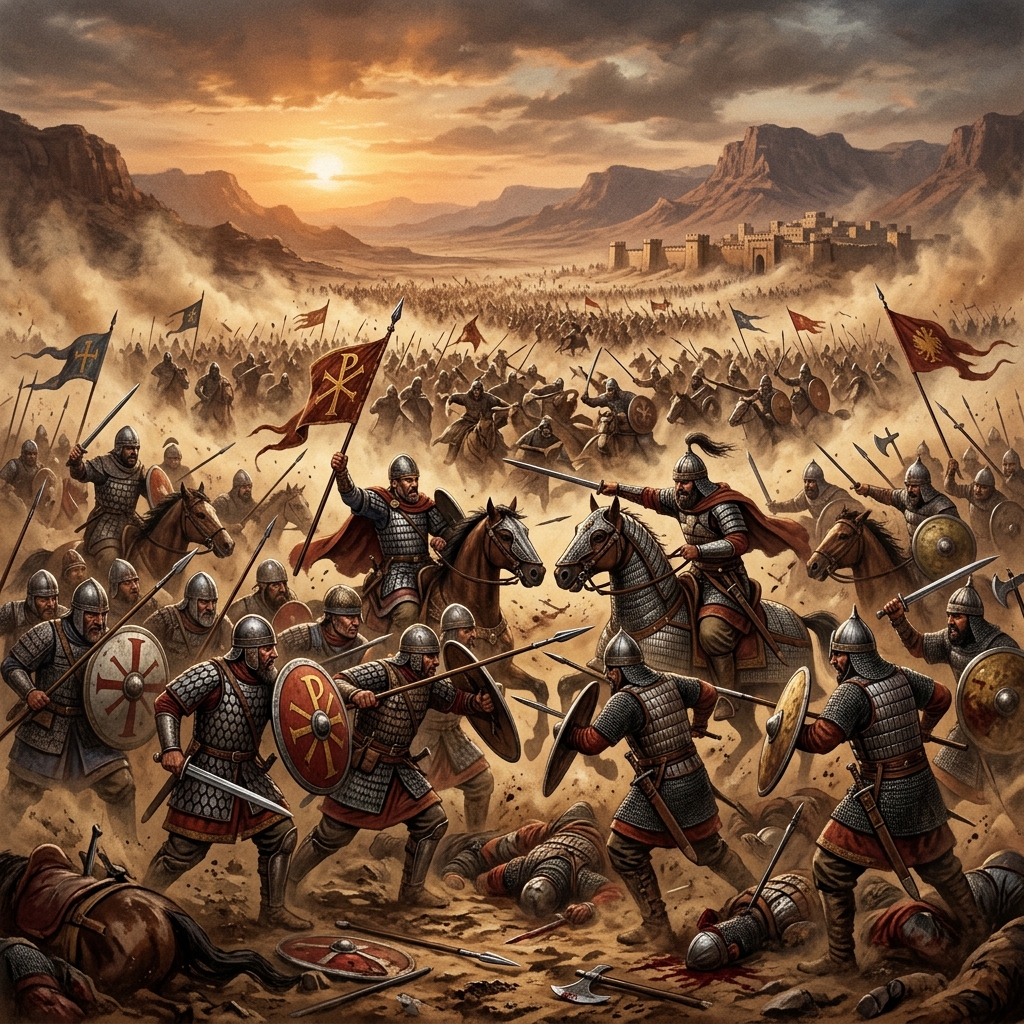
From the army of Imam "Ali", the commander "al-Ashtar al-Nakha'i", may God be pleased with them both, sets out.. at the head of a group of cavalry battalions.. and a comparable force advances towards him from "Mu'awiya's" army led by "Habib ibn Maslama".. and the ground trembles beneath the hooves of the horses, which stir up a storm of dust, to sketch in the air the features of the first true civil war in the history of the Islamic state, since the end of prophethood.
The battles go on for long days.. On the fourth day "Muhammad ibn Ali ibn Abi Talib" comes out, the son of "Ali" by "Khawla bint Ja'far al-Hanafiyya", and that is why he was called "Muhammad ibn al-Hanafiyya".. to distinguish him from "al-Hasan and al-Husayn".. and he comes out leading battalions from "Ali's" army, may God be pleased with them.. and the latter's plan was to change the commanders day after day and the attacking units day after day, so that he would not exhaust everyone at once.. and this technique did not work very well because "Mu'awiya" copied it exactly.. and the fighting went on for days choked with dust and blood.. until "Ammar ibn Yasir" falls.. and we reach the seventh day.. and in it the fighting ends with bitterness in the throats of both sides.. "Ammar" died at the hands of "Mu'awiya's" forces.. at that moment "Khuzayma ibn Thabit" joins the army of "Ali ibn Abi Talib", reminding everyone of the hadith of the "transgressing faction".. and declaring that he now knew on which side the right lay.
Everyone stood in awe of "Ammar", even his enemies.. Our master "Ali" prays over him and buries him in his clothes, as a martyr.. because a martyr is neither shrouded nor washed.
And on the seventh night "Ali", may God be pleased with him, takes his decision to mobilise the entire army against "Mu'awiya's" army.. and "Mu'awiya" takes a similar decision.. the two armies encamp and the verses of the Holy Quran ring out in the two camps at night in a thunderous voice, and hands are raised to God in supplication by each side.. and each faction prays for victory for itself.. and each side begs God to grant it victory over the other.
And Mu'awiya's army was in a strange position.. for with the killing of "Ammar".. and their knowledge that he would be killed by the "transgressing faction".. they feel a sharp pang of conscience.. and their morale is thrown into utter confusion.. but "Amr ibn al-As" was a master of eloquence.. and a skilful military commander.. so he addresses them.. and that night they pledge allegiance to him unto death.
And on the eighth day, as the first knife-edge of dawn splits the curtains of darkness.. the caliph "Ali ibn Abi Talib" sets out himself at the head of his army.
And from the other camp.. facing him, "Mu'awiya ibn Abi Sufyan" advances at the head of his army.
The two armies join in a terrifying, dreadful battle.. and before the crushing blows of the Iraqi army.. "Mu'awiya" withdraws temporarily as night falls.. and waits for tomorrow to resume the fighting with a new plan.
And on Thursday, 9 Safar 37 AH, our master "Ali" prays the dawn prayer and resumes the fighting, with "Abdullah ibn Budayl" on his right wing and "Abdullah ibn Abbas" on his left.. "Abdullah ibn Budayl" spots a gap in "Mu'awiya's" left wing and advances towards it.. and the truth is that it was an ambush.. in which "Abdullah ibn Budayl" falls.. as a martyr. And the right wing of the Iraqi army is laid bare.
With the right wing exposed, "Mu'awiya" launches an overwhelming attack.. and with Mu'awiya's attack.. "Ali's" army is exposed to the point that "Mu'awiya's" forces almost finish him off indeed.. had he not fought with desperate ferocity.. and it is said that in this assault he killed five hundred men single-handedly.
But with the fall of "Abdullah ibn Budayl", "al-Ashtar al-Nakha'i" advances in his place.. and "al-Ashtar" succeeds in rallying the right wing once more.. and at the same time "Abdullah ibn Abbas" exploits the headlong advance of the Syrian forces.. and pierces "Mu'awiya's" army through its heart.. and the forces push forward from "Mu'awiya" himself.. to the point that it was said that between his neck and the sword of "al-Ashtar al-Nakha'i" there were two horsemen's lengths.
And for the first time since the breaking of dawn that day.. "Mu'awiya's" army begins to fall back and retreat.. and "Mu'awiya" realises that he is on the brink of defeat.. so he calls out to "Amr ibn al-As" for rescue.. before the Iraqi army advances.. and ends the war victorious.
Here "Amr" comes out with a clever, brilliant plan.. one that could only have come from the craftiest of the Arabs.. and he sets about executing it at once...
And this plan we shall speak of later.
And there remains more to be said.
-------------
Previous posts:
-------------
1 - http://bit.ly/2Rm5tBs
2 - http://bit.ly/2RACrOV
3 - http://bit.ly/2NeseJs
4 - http://bit.ly/2XoDruI
5 - http://bit.ly/2IAYulr
6 - http://bit.ly/2IYrjHm
7 - http://bit.ly/2IKnM0s
8 - http://bit.ly/2FBavFz
9 - http://bit.ly/2YkwqIt
10 - http://bit.ly/2JbJqdh
11 - http://bit.ly/2ZZj84v