"Themistocles" was planning to push Athens' fleet out to face the Persian forces while they were at sea, far from land, so the Egyptian asked him to send a spy who could find out the number of the Persians' ships and their equipment.
And indeed, a merchant ship carrying fine Greek wine passed by the Persian ships, and while it stopped to sell wine, a Greek man slipped off it, fluent in Persian, the right-hand man of "Themistocles", and vanished among its crew.
And after a few nights, during which the Persian ships drew close to the Greek shore of Marathon, a few nautical miles away, the Greek spy jumped secretly from the leading Persian ship into the sea, and swam several kilometres, until he met a boat that was waiting for him according to the plan, to carry him back to the shore.
And with the information that poured into the ears of "Themistocles" — the field commander who had been promoted in a confused, improvised way to lead the soldiers and die instead of the king of Athens — and his Egyptian friend, the matter became perfectly clear.. Athens would never be able to fight a naval battle against the Persian ships, and its fleet would be smashed and sunk, an hour or less after the fighting began.. before the enormous Persian ships and their terrifying armament.
Then came the mad plan. "Themistocles" had to let the Persian ships anchor on the shore of Marathon, and make a land landing of soldiers and equipment!
The discussion must have taken several nervous hours, during which "Themistocles" exploded dozens of times, before he agreed at the end of it, and gave the Egyptian his word to agree to another matter: to allow a special Egyptian battalion, camped nearby, to take part in the fighting as a kind of training and a sharpening of resolve and hearts.
And the time drew near, and the Persian ships anchored under the command of the army's commander, the Persian general "Artaphernes", brother of the king of Persia.
And the shore was empty, with no trace of any life, and the landing began, and the Persian soldiers set about pitching their tents and lighting their fires, then they actually ate their food, and were about to settle down to sleep, when "Themistocles" attacked suddenly, with his keyed-up men, the Persian soldiers worn out by the long sea voyage, stuffed with food, and overcome by sleep.
And "Themistocles" won at Marathon. He won a crushing victory that vaulted him from a mere soldier to the summit of political leadership and the seat of decision-making.
And a new task lay before "Themistocles", part of the plan: to unite all the fleets and armies of Greece against the Persians.
And the hero of Athens set off on his mission, and his horse raced him from one city to another, and he sent dozens of messengers to every corner of Greece, and released dozens of Athenian writers, men of letters and poets, to sing of the heroism of the Battle of Marathon.. and drive enthusiasm into hearts.
But before he could achieve what he wanted, and all of Greece could unite, the Persians were preparing a second campaign, heading for him in particular, in revenge for the defeat at the Battle of Marathon.
And the Egyptian intelligence man smiled, around five hundred years before Christ, and reassured "Themistocles" that he had what could stall the Persian campaign, until he finished uniting Greece.
And while the Persians were preparing their terrifying campaign, Egypt rose up suddenly. A violent revolution, striking every street of its streets, against Persian rule, and everyone who could carry a weapon took whatever he found in his path, a spear or a dagger, or even an axe or a wooden stick.
And the Persian campaign halted, and the bulk of its effort and its soldiers turned toward Egypt to crush that violent revolution, which gave Greece its chance to unite, and indeed to repel the second Persian campaign.
And with the Persians' defeat in Greece, their reputation began to shake in every corner of their empire, so Egypt and Greece set about supporting the people of Anatolia — present-day Turkey * — with an inexhaustible flow of information, techniques and plans, to weaken the Persians and defeat them.
And the priests of Amun in Egypt spoke of a vague prophecy, a legend attributed to the god Horus, about one of the sons of Amun, who was never defeated in a battle his whole life, who would come from the east, from beyond the sea, and free Egypt from the Persians.. and people kept passing the prophecy around for a long time.. and fought the Persians and resisted them generation after generation, and the matter took a long time, until a man came, from beyond the sea, who was never defeated in a battle his whole life.. to sweep away the Persian Empire entirely beneath the hooves of his enormous army's horses at the "Battle of the Granicus".
Then he set about advancing toward Egypt from the east indeed, to bring down the Persian garrisons one after another, until he reached Pelusium.
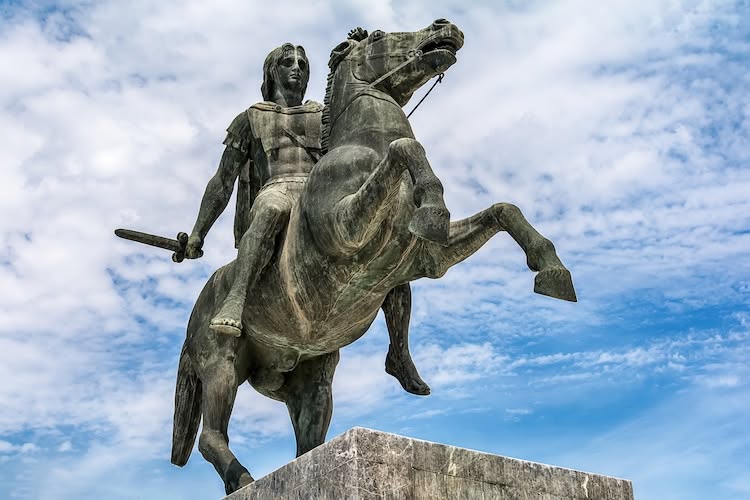
And this man's name was "Alexander the Great" of Macedon.
Alexander reaches "Pelusium", the eastern gate of Egypt, at today's Port Said.. the very place where the Persians had defeated the Egyptians, by treachery and betrayal.
And in the autumn of the year 332 BC, "Alexander" enters Egypt through "Pelusium", sweeping away the Persian forces, and the Egyptians receive him as a hero, as the man of the prophecy, the son of Amun mentioned in it.. and Alexander settled in Egypt, and built the city of Alexandria, which was destined to be a capital and a seat of rule for several centuries.
And after several centuries, "Amr ibn al-Aas" comes from the Arabian Peninsula to conquer Egypt, and there was a group of its people who had already entered Islam, and a group that remained on Christianity.. the first group welcomed "Amr's" arrival.. and the second opposed him violently, and decided to defend the land, and that plunged the two groups into civil strife, which enabled him to conquer Egypt easily, so that he came to a stop at the walls of the last steadfast city, which held out against him.
The same city that Alexander had built several centuries earlier.. and which had turned into a port, a world trading centre, a military barracks, and an object of desire for those greedy to enter Egypt through the northern gate,
Alexandria.
And "Amr ibn al-Aas" drew close to the walls of Alexandria, and it bombarded him with catapults, so he retreated far beyond the range of the catapults, and encamped before its impregnable walls and its fortified gate.
And the siege of "Amr ibn al-Aas" dragged on.. and his army was worn out, and the siege mingled with watchfulness and anxiety, for Alexandria would open its gates, and violent raids would come out of it, attacking his army and drawing it into the range of the catapults and arrows, and the raids grew more intense and more frequent, until he ordered the prayer of fear for the first time, a special prayer that Muslims pray when they feel danger: one group prays behind the imam, and the other group guards them with weapons, then they swap roles.
And from Medina, Imam "Umar ibn al-Khattab", may God be pleased with him, sent word, in running-out patience, asking why "Amr" was taking all these long months to enter Alexandria.. especially since he had not stinted on money or equipment or soldiers for him, so "Amr ibn al-Aas", the craftiest of the Arabs, decided to resort to an intelligence trick that would open the gates of Alexandria for him.
So in an exchange-of-prisoners operation, "Amr" sent a few Egyptians, loyal to him and welcoming of his arrival and cooperating with his army, as prisoners; they entered Alexandria and stayed there for some time.. then they set about persuading the gate guards to open them, and telling them of the pardon and the privileges awaiting them.. and with constant insistence.. the guard of one of the gates weakened, his name "Mina ibn Bassama".. and he asked for safety for himself and his family if he obeyed the order, and the message reached "Amr ibn al-Aas".. and he granted the man safety for his life and his family's lives.
And the gates of Alexandria opened before "Amr's" army indeed.
That was neither the only intelligence operation nor the only trick that Alexandria went through, for after several more centuries, on the ninth of October, in the year 1365.. history pauses to record for us an unforgettable day.. the day Alexandria fell.. and turned into burnt ruins.
But this story would take long to talk about.. so we will continue our talk later.
And there remains more to say.
---------
- The previous posts, first comment.
#Intelligence_Operations_That_Changed_World_History4