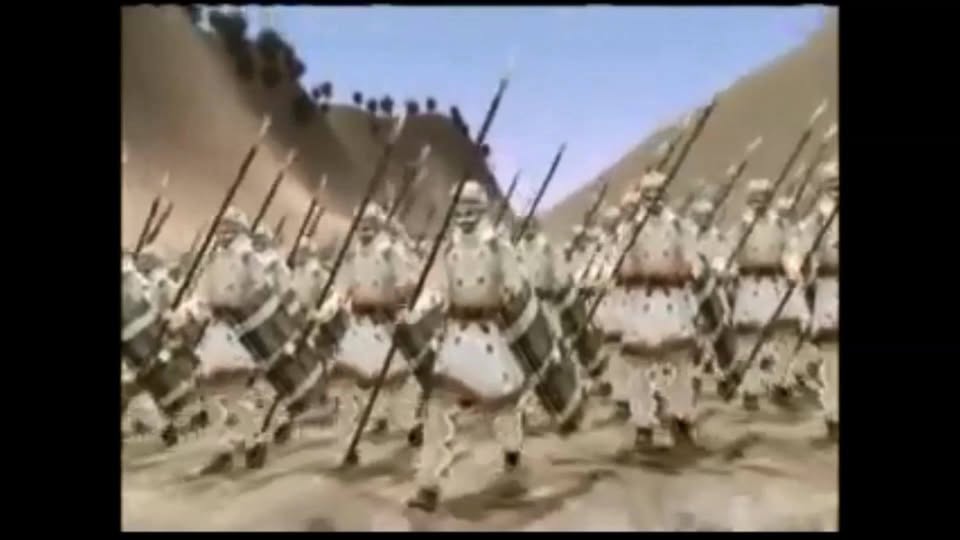
With the third part: the king of Egypt, "Ahmose II", had a brilliant man named "Phanes".. this man was of Greek origin, he was educated and grew up in Egypt and became a strategic expert in the true sense of the word, and he knew every big and small thing about every inch of Egypt's land.. he knew how to develop things.. he had memorised the maps and the terrain of the land.. he understood military, financial and governance affairs.. he was promoted until he became the king's adviser. One day "Phanes" aspired to sit on the throne of Egypt itself, so he asked to marry the daughter of "Ahmose II", but the girl refused.. so he tried to make her father force her into the marriage.. and of course he refused.. so the adviser stole several items from the king's treasury, and fled to the land of Persia. And there.. in "Persia", "Phanes" drew close to the Persian king "Cambyses II", and taught him a great many things, a very great many.. he developed his army.. he helped him put an end to the state of disintegration and unrest he had.. and he gave him every piece of information he knew about the Egyptian army.. and he began to form for him battalions trained to speak the Egyptian language and dialect.. raised on it from the tenderest of nails.. and they dressed and spoke and even slept and dreamed like Egyptians, but they were originally Persians and their loyalty was to their country.. he prepared sixty thousand of them... and through mountain paths and corridors he knew well.. he sent them to surround the Egyptian army from the mountain peaks and from the rear and the two flanks.. the commander of the Egyptian forces meets the commander of these forces and stops him sternly, and asks him about their identity.. who are these and where did they come from.. so their commander tells him, in sound Egyptian, that they are an additional delegation.. sent by King "Psamtik III", and he produces for him a papyrus deed confirming that.. sealed with a seal impossible to forge at the time.. a royal seal that "Phanes" had stolen before his flight from Egypt and no one had noticed.. this deed allowed the Persian intruder to encamp his forces around and above the Egyptian forces.. until the Persian forces came openly into confrontation.. and just before the attack, the Egyptians were surprised by the support divisions they had thought were theirs, carrying the king's seals, wearing the same clothes as them, speaking their language and armed with their armament.. slaughtering them without warning along with the Persian attack.. and they no longer knew who was against whom and who was with whom. The army is defeated and utterly wiped out, 49,000 soldiers die, and only a thousand soldiers of the whole army remain because of this sudden betrayal; they withdraw to "Memphis".. the king of the Persians sends them 4 ships loaded with soldiers and messengers, asking them to surrender, so they board the ships, and slaughter the Persians on them completely.. the king of the Persians is enraged, and attacks Memphis and kills them.. except for a few hundred who managed to escape.. so for every Persian who died of the fighting sailors and the messengers he kills 10 innocent Egyptians.. and he takes "Psamtik III" prisoner and effectively rules Egypt. And Egypt falls into the hands of the Persians, except for a few of the men of its army and its intelligence experts, who divided themselves into two parts; some of them fled to the far north, between the island of Pharos.. or "Alexandria" and "Marsa Matruh" as we know it today.. and the others to the south of Upper Egypt as far as Nubia, and they melted in among the people, and set about secretly training the fishermen and the peasants to fight, and founding the nuclei of resistance cells.. which grew and grew. History recorded the story that "Cambyses", king of the Persians, after he entered Egypt, Nubia with its people was packed and shut its walls against the Persians. And because his soldiers were exhausted, he decided to bribe the Nubians.. so he sent them priceless gifts in return for their surrender.. but the ruler of Nubia sends the messengers back with the gifts and asks them to convey a message to "Cambyses": "Come back to us when your army is strong.. and you can fight us".. an odious, provoking phrase that made him furious, so "Cambyses" marches on Nubia, and besieges it.. but he never breaks through it.. day after day.. and the days became weeks.. then they became months.. and Nubia's defences held firm, and the Persian soldiers began to be worn out by the desert heat by day and its terrible cold by night.. and their provisions ran out.. and the soldiers began to eat the animals and the rodents and the grasses and the desert weeds and the insects and the scorpions. Then they began to prey on one another. First they started with the bodies of those of them who had died.. and then they began to kill the weak among them and eat them. If that was the situation before he even broke into Nubia, then what would happen at the hour of fighting itself? "Cambyses" is forced to cancel the campaign and turn back.. and he had sent in parallel some 50,000 soldiers to Siwa, to subjugate its people and destroy its temples.. so he returns and inquires about this campaign.. and what it had carried out and achieved of its objectives. But the Siwa campaign had met the resistance men in a terrifying surprise ambush, and the desert too had risen against them with its storms and its sands, and not one of them returned.. so much so that "Cambyses" never found their bodies at all. And with the successive victories, the Egyptian intelligence men began, in cooperation with the priests, to spread a true piece of news that fate had gifted them, one that would raise the morale of the Egyptians and strike the morale of the enemy a mortal blow. And in psychological warfare, all the skill lies in your using "real events".. if you use a rumour, your lie will be exposed sooner or later.. but the bare truth.. is what truly raises morale or demolishes it. And the news that the Egyptian intelligence men exploited at the time, the first professors of psychological warfare in history, was true news, extremely simple, about the birth of an ordinary animal, of the bovine kind. With the return of "Cambyses", he found the Egyptians celebrating his defeat in Nubia and Siwa, before news of the defeat had even arrived.. so when he summoned the Persian rulers of "Memphis" and asked them how the Egyptians knew of his defeat before he knew it himself.. they told him a strange story.. what they had learned from the common Egyptians.. that the god "Ptah" sends the Egyptians glad tidings from the greatest god when their enemy is about to be defeated.. this sign is represented by the birth of a small calf, whose mother has carried no other, and on the day of its birth lightning comes down from the sky even if the time is summer.. and this calf is entirely black in colour, except for a white triangle on its forehead, the hair of its tail extremely thick; and on its back a white mark resembling the eagle, and it is a sign from the god "Horus", meaning that victory is near.. this calf is called the "Apis bull"... "Cambyses" sees for himself the faint-heartedness and the anxiety and the terror on the faces of his men, after this successful psychological operation, and in his rage.. "Cambyses" asks his men to bring him the Egyptian priests along with this calf, and when they appear before him, he draws his sword and orders the killing of the calf, so the chief priest warns him, agitated, that if he kills the Apis bull, the curse of "Ptah" will strike him, and he will meet his fate in the same way he kills the calf. But "Cambyses" does not care and stabs the little calf a painful stab in its thigh, and raises the bloodied blade to the priest and mocks him and the god who sends an animal glad tiding of flesh and blood, then orders his men and they rain blows on the priest, and throw him out with the calf, both of them wounded and in pain. The priests of Egypt take the calf and try to treat its wound, but the wound becomes infected and gangrene sets in, and the "Apis bull" dies after excruciating torment, and a lowing that tears the heartstrings, and the priests bury it secretly. And the morale of the Egyptians plunged to zero. But what happened to him after that was truly strange.. and it was recorded historically as an incomprehensible incident in thousands of references.. and the Egyptians at the time used it as a terrifying psychological operation against the Persians, which brought their morale down to zero.. or, to be precise, below zero. So about a year after he killed the calf, "Cambyses" was on the outskirts of Persia among soldiers and his procession and on the back of his horse, when he decided to dismount for rest and food, and after the rest ended, as he was mounting the horse, the blade of "Cambyses's" sword drove unintentionally into his own thigh. And at once the Persian doctors hurry and clean and bandage "Cambyses's" wound.. and he returns to his palace calmly without problems. But two days later.. and exactly as had happened to the calf, "Cambyses's" wound became infected. And gangrene struck him too. And the fever rose to his head.. and he began to hallucinate and lose his conscious mind, and scream speaking of unknown visions, of "Anubis" the god of the scales and embalming, as he tears out his heart and places it on the scales and then casts it into eternal hell where the painful torment is.. and after immense suffering, and terrifying nightmares, "Cambyses" dies exactly twenty days after he was wounded, drowning in torment and fever and hallucination. And with the spread of the terrifying news, Persian morale plunged in every corner of their empire... and here was the golden opportunity for a new intelligence operation, so the men of Egypt became active, and turned their faces toward a new ally, waging war against the Persians, and passed on to him their expertise and knowledge. The fourth day of the month of August, of the year 480, before the birth of Christ.. the lands of Greece, dismembered and scattered into small city-states, and 300 soldiers from Greek Sparta, going out to stand against the largest armies of the earth in number at the time, the army of the Persians.. with forces said to have been 400, or 600 or 800 thousand, and Herodotus said they were a million Persian soldiers. For the enormous Persian army to pass to Greece it had to cross a narrow mountain pass on its border, called the pass of Thermopylae. This battle is where history will stop and record it under this name.. the "Battle of Thermopylae". The Spartan council of elders was originally the body charged with declaring war, and the council refused, and decided to resort to negotiations, so the king took his decision, and left the country with 300 fighters, to protect the borders alone.. later some 3,000 or 5,000 Greeks joined them, but the number was still incomparable to the armies of the Persians. The fighters of Sparta were usually "heavy infantry" formations.. their shields a mixture of copper and bronze and iron, and from the inside made of oak wood and weighing 18 kilograms.. the soldier wore a heavy helmet that showed only his eyes and his nose.. his forearms and legs covered in bronze and carrying a spear and a sword... the Spartan spear was heavy and made of wood that does not float in water.. weighing about 12 kilograms and with a metal edge front and back.. and the sword weighed about 8 kilograms.. short but deadly... of course, for the soldier to carry all that total weight and at the same time move and fight and bend and dodge and charge.. he himself had to be extremely strong.. with the armour and the weapon he carried, a Spartan infantryman was a living human tank... the formation of the Spartans was called "the phalanx formation" or "the phalanx".. a square military formation.. the word has no Arabic root and was Arabised into "salāmī" meaning "standing in rows like the joints of the fingers". The shields rest on one another, like the scales of snakes, so they become almost impossible to penetrate.. in short.. the Spartan formation was a heavy metal forest, of spears and shields. The 300 soldiers stand in the pass of "Thermopylae" across its width.. estimates say they were 6 rows.. 50 men in each row.. and they wait for the Persian forces in the pass; the pass cannot be crossed by large forces; they pass row after row, and the Spartans hunt them wave after wave. And when the first row of Sparta's men is worn out, it retreats to the rear and the second row advances, then the third, and so on. And Persian losses began to increase, and confidence shook and anxiety settled into souls and morale collapsed, so the king of the Persians decided to resort to an intelligence trick that would secure him a manifest victory. His luck put him in the way of a man from the Greek elite, one of those seeking quick wealth, and he was an expert in the region's roads and paths, and they agreed that he would guide him to any road by which he could surround the men of Sparta, and be able to kill them and pass. The deal was done quietly, and the spy collected the price for his betrayal, and the brave Spartans were surrounded by enormous Persian forces, from elevated positions, raining down on them hundreds of thousands of arrows, and their strong, hard-to-penetrate formation was torn apart, and they died to the last man on the battlefield.. and the road to the heart of Greece became open.. and the Persians moved on to the next victim.. Athens. But this operation had an extremely dangerous consequence.. because the Egyptians exploited the Persian intelligence operation against Sparta, and while the Persian ships were heading to "Marathon" in Athens, the men of ancient Egyptian intelligence had already reached "Themistocles", the hero of Athens, and offered him a dazzling plan, involving strange intelligence tricks the like of which had never been heard, securing him victory over the Persians. Were it not for this plan, and had this matter ended well for the Persians.. the idea of democracy would have died out from the world, and perhaps we would not hear today at all of a country called "Greece".. and it would have become an effaced history like Yugoslavia.. and perhaps the Persians would have dominated for long centuries. And these tricks we will talk about later. And there remains more to say. ----------- - The previous posts, first comment. #Intelligence_Operations_That_Changed_World_History3