Historically.. "Ertuğrul" is not a name.. the name of the figure himself.. the father of "Osman I".. the founder of the Ottoman State.. is unknown.
Even the ancient Persian historical books in their oldest editions could not determine his real name.. "Ertuğrul" is an epithet meaning "face of the crow".. in old Turkic "er" means "man".. and "tuğrul" means "crow".
Of course we have learned that "Osman I" enlisted the help of writers and historians and decided to compose for himself a glorious family history.. so they turned the word "Ertuğrul" into "the eagle soldier, the bird of prey, the strong-bodied hero"...!
What is your name, son? "My name is the eagle soldier, the bird of prey, the strong-bodied hero.. tomorrow I will tell you my father's name".
That is why you will never find another historical figure in the world named "Ertuğrul".. because it is not a name in the first place.. meaning that in the Arabian Peninsula you will find in Saudi Arabia, long ago, a man named "Saud".
You will find five thousand men from the same spot with the same name.. because it is "a human being's name".. in ancient Egypt you will find "Merit".. and five thousand women named "Merit".. in the Assyrian state, in "Nirari".. there are 10 people historically recorded in that state in those periods named "Nirari".. "Qutuz" was named "Mahmoud".. there were a million people in the world at that time named "Mahmoud".
But "Ertuğrul" simply does not exist except for this unknown person. The closest name is "Tuğrul Beg".. the third ruler of the Seljuks.. "Rukn al-Din Tuğrul".
"Osman", in order to establish the new information.. that his father's name had a very proud meaning.. makes an extremely clever move.. and he truly was a clever man.. he begins minting coins bearing these dates and pieces of information.. the people circulate them.. and they become a common thing they see and know daily.
The point is that this "Ertuğrul" fled at a young age from his tribe, as we said before.. and formed a small gang, to steal livestock.. and carry out some other petty thefts.
At that time all the tribes in Anatolia were fighting one another all the time.. and two tribes might kill each other over a goat or a head of livestock.. "Ertuğrul" tried to enter the arms trade.. but in reality weapons were not a trade at the time.. because the people were extremely primitive.. their weapons consisted of stone and wooden branches.
But he discovered that the people never stopped doing two things.. sex and eating.. and since the second was not quickly profitable.. he decided to professionalise the first.
Brokering concubines.. deceiving young girls or those fleeing the hell of oppression in Persia.. and the tribal chiefs paid well for them.. and gradually "Ertuğrul" began to grow rich.. and came to have guards and followers.
And within 10 to 15 years.. "Ertuğrul" becomes a young man of twenty-five or a little more.. and he has a small army.. taking orders from him.
That is why historically, when you try to pin down the beginning of this figure.. you find that he suddenly emerged at the age of 35 or 36.. in the year 1227 AD.
"Osman" made a historical mistake amid the hasty, improvised falsification operation he carried out.. so he attached Ertuğrul's lineage to the Seljuks of Rum.. and that is a sultanate of the Turkish Seljuks that existed in the Middle Ages in the period between 1077 and 1307, on the ruins of the Roman state.
And at the same time he told you that his grandfather.. the father of "Ertuğrul", is "Suleiman Shah".. while "Suleiman" was originally Persian.. and was not one of the men of the Seljuk state of Rum at all!
If you go looking for the biography of "Ertuğrul's" own tribe.. the Kayı tribe.. you will find.. like everything surrounding this figure.. mysterious.. and the Turkish historians themselves wrote about it:
"The early political life of this clan is shrouded in mystery".. and they added, "and its history is closer to legends and the fables of grandmothers' tales than to the facts"...!
This is the talk of the Turks themselves, not my talk, see.. like "Halil İnalcık".. professor of Ottoman history at Bilkent University in Ankara.
They said, "The chief of this tribe was (Gündüz Alp), people.. and after he died (Suleiman Shah) took it over.. and after him his son (Ertuğrul) the Ghazi". That is what the historian "Yılmaz Öztuna" wrote, to the letter, in the first volume of his book "The History of the Ottoman State".
"Karamanlı Mehmed Paşa" says the opposite.. he tells us that "Gündüz Alp" is the grandson of "Suleiman Shah".
Meaning the son of "Ertuğrul", not his grandfather.
And the book "Bahjat al-Tawarikh", written in the year 1459 AD.. tells us that he is the grandson of "Kaya Alp".. the founder of the tribe.. and the father of "Suleiman Shah".
And the book "Kitâb-ı Cihannümâ" by the Turk "Mehmed Neşrî", who died in the year 1520 AD.. says that he is the grandson of "Suleiman Shah".
And in the book "Tawarikh Al-i Seljuq".. our brother "Ertuğrul".. turns out to be the son of "Gökalp".
And "Aşıkpaşazade" tells us in his book "Tawarikh Al-i Osman".. that there is no one named "Kaya Alp" at all.. in the lineage of "Ertuğrul".. and that his lineage is "mysterious and unknown".
The new historians solved the dilemma in a charming way.. so they told us, "No, he is the grandson of (Gündüz Alp) and he had a child whom he also named (Gündüz Alp).. so there are 2 (Gündüz)s in the life of (Ertuğrul).. his grandfather and his son".
Fine, where is this son of "Ertuğrul", people, there is no talk of him at all, no sources, no trace of where he went or what he did? He tells you, "No, well, his life was shrouded in mystery".
Really? Again?
In any case, there is nothing more apt than the words they themselves said.. that the history of this tribe.. "is closer to legends and the fables of grandmothers' tales than to the facts".
The point is that this "Ertuğrul" they convinced us united his tribe.. which at the time numbered 340 people, all in all, including women and children.. and "he launched raids on the neighbouring Byzantine towns.. to secure the borders of his new state".
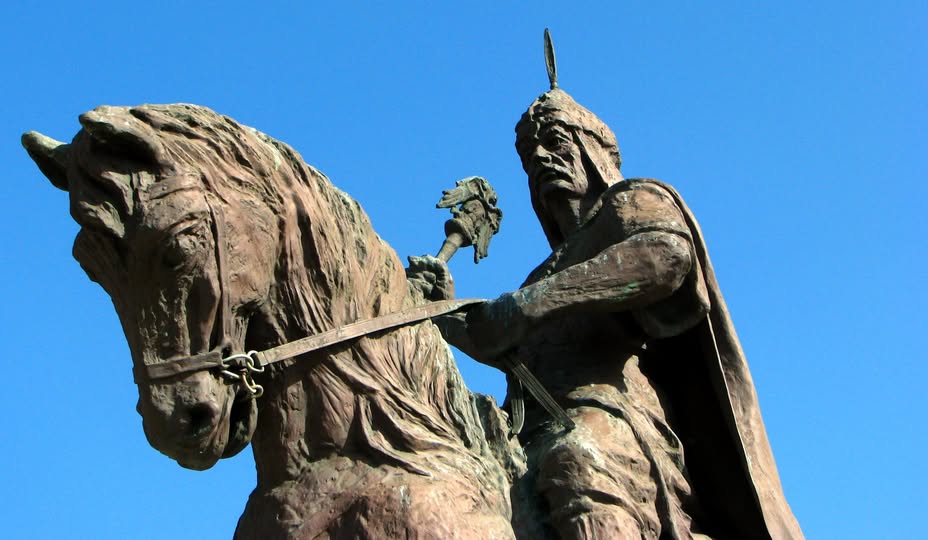
But in order to do this and dress up this heroism for our brother "Ertuğrul".. they had to eliminate the figure of the warrior Sultan "Alaeddin Kayqubad".. the one in this picture.. who actually did this thing.. and expanded into the neighbouring Byzantine towns.. and extended Seljuk influence in the Mediterranean.. and won with his army against the Byzantine forces led by the Byzantine Emperor "Theodore II Doukas Laskaris".. emperor of Nicaea.. the largest statelet the Byzantines founded after the fall of Constantinople.
And the truth is that if you review all the heroic deeds attributed to "Ertuğrul" now.. you will find they are in fact the deeds of the warrior "Alaeddin Kayqubad".
And to solve this problem.. they told us: no, well, "Alaeddin" achieved these victories with the help of "Ertuğrul" and his men.
And the truth of the matter is that "Ertuğrul" used to exploit the preoccupation of "Alaeddin Kayqubad" with his wars against the Byzantine forces.. and raid the villages neighbouring him and plunder them.. and subjugate their people.. and take them sometimes by violence.. and sometimes by gentleness and gifts.. until he annexed a large number of villages to himself.. and the number of his followers and soldiers increased.. and at that point he felt strong.. and returned to his original homeland, which he had abandoned years before.. the Kayı tribe.
And there he meets his mother "Khayma Hanım".. and he snatches her from the depths of humiliation and honours her.. and he proclaims his sovereignty over the tribe.. and he continues raiding the villages around him.. and imposes an annual tribute on them so that he will protect them from "himself".
But the affair of "Ertuğrul" reaches the Sultan "Ghiyath al-Din Masud ibn Izz al-Din Kaykaus ibn Kaykhusraw".. and he was a strong man.. the sultan of the Seljuks of Rum.. so he sends him a force of five hundred professional horsemen.. the very sight of which gives him diarrhoea.. so he declares his submission to the Sultan "Ghiyath al-Din".. and goes with them laden with gifts and gold and jewels.. presenting them to "Ghiyath al-Din", who is pleased with him.
"Ertuğrul" keeps courting "Ghiyath al-Din" most of the time.. until he takes a bold step.. and asks him for the hand of his daughter.. "Halima bint Ghiyath al-Din Masud ibn Izz al-Din Kaykaus ibn Kaykhusraw".. and she was indeed a virtuous lady of noble lineage.. and perhaps this marriage was an attempt by "Ertuğrul".. to erase, through her lineage, some of the shame that had attached to his history.. and indeed "Ghiyath al-Din" agrees.. and "Ertuğrul" becomes the husband of his daughter.
Unfortunately, the scribes of "Osman" tampered with the history of "Ghiyath al-Din" as well, for a trivial reason.. which is that he wanted to say that "Ertuğrul", when he married into his family, was not a sultan.. meaning he was not coveting anything.. so you will find them writing that he ruled for two periods.. the first period from 1284 to 1296 AD - meaning he was not a ruler when we married into his family, see - and the second period from 1302 to 1308. And then he died in 1306...
Meaning he carried on ruling for two years after he died!
And then the Mongol forces come.. and "Ghiyath al-Din" submits to them.. and surrenders.. so they leave him as ruler just as he was.. in exchange for a tribute and soldiers he pays annually.
But "Ghiyath al-Din", despite his surrender, was determined to resist the Mongols.. so he begins to establish resistance units.. and engages in conspiracies against the Mongol Khan in secret.
And one night "Ghiyath al-Din" and his son-in-law "Ertuğrul" and his army commander gather.. and he lays out with them a plan to assassinate the Mongol Khan.
And for a reason "unknown and shrouded in mystery", again, this secret plan reaches the Mongols.
And they kill the commander of "Ghiyath al-Din's" army and take his men captive.
And for a reason "shrouded in mystery", "Ertuğrul" of course survives.. and the Mongols strip "Ghiyath al-Din" of his throne and decide to execute him.. but "Ertuğrul" - who had become the Khan's darling for a reason likewise shrouded in mystery - intercedes for him.. it is not plausible that the grandfather of his sons should be executed and it become a scandal.. so the Khan pardons "Ghiyath al-Din" and settles for stripping him of his throne and his authority. And "Ertuğrul" is confirmed in his emirate over the villages and lands he had seized and extended his influence over.
And with the death of the Mongol Khan and the coming of the new Khan.. note that this region had 500 rulers and princes and sultans, and he decided that the situation did not need any more noise and nuisance.. so he decided to sweep all of that away.. but "Ertuğrul" made peace with him as well.. and paid him whatever he wished in gold and slaves and concubines and supplied him with soldiers.. so he was pleased with him and kept him as ruler over the Kayı tribe and its surroundings.. and the Mongols passed from Anatolia smoothly into Syria.
You wonder, after all this, "from which direction exactly was (Ertuğrul) a Ghazi, people?" Meaning he did not even repel the Mongols from his land and they crossed it with the utmost ease.. and unfortunately you find no answer except "well, it is shrouded in mystery".
And because this biography gives me "an unknown condition shrouded in mystery" along with a desire to vomit.. and I am a man of ailments to begin with.. we will continue our talk on this subject later.
And there remains to the talk that is shrouded in mystery.. more to come.
-----------------
- Previous posts:
1 - http://bit.ly/32Q5W4t
2 - http://bit.ly/2SJESze
3 - http://bit.ly/2YmsINT
4 - http://bit.ly/2KekUZo
#OttomanCaliphate 5