We're still with the Wahhabi movement, its beginnings, and where it led us — to the state of "Muhammad Ali"... The Ottoman Empire's anger and rage at "Muhammad Ali", after it confirmed his rule over Egypt in 1805 against its will, made it draw up a plan and harbour ill intent toward him... and try to depose him at the first opportunity, at any cost.
At the same time, the Mamluk emir loyal to the English, "Muhammad Bey al-Alfi", decided to attack Cairo, at Britain's instigation... to take control of it once again and detach it from the Ottoman Empire, in exchange for special privileges he would grant the English... and they, in turn, would install him in the rule of Egypt and thus protect him.
And from the heart of Upper Egypt, "Muhammad Bey al-Alfi" began sending his spies to Cairo, to try to win over the officers and the commanders of the troops, to betray "Muhammad Ali" and open the gates of Cairo, without the latter knowing.
And the commanders of the troops and the officers of the Egyptian army agreed to open the gates to "Muhammad Bey al-Alfi", the English protégé... and to allow him to take control of Cairo.
And in August 1805, on the day of the "Feast of the Nile Flood", "Muhammad Bey al-Alfi" set off with the Mamluk army toward Cairo, which appeared heedless and asleep... not knowing what awaited it... its gates open, with no guards or soldiers.
And "Muhammad Bey al-Alfi" entered Cairo, promising himself rule and power... but his dreams dissolved when the Egyptian forces fell upon him and his men suddenly, in cooperation with "Muhammad Ali's" Albanian contingent, and it became clear that the army commanders and the officers of the troops had informed "Muhammad Ali" of what had happened with "al-Alfi"... and had agreed with "Muhammad Ali" to play along with his plan, lure him in, and finish him off.
And amid a tightly drawn ambush, and a sudden, unequal battle... the Mamluk forces were crushed under the blows of the Egyptian army... so "Muhammad Bey al-Alfi" was forced to withdraw after losing most of his troops... but "Muhammad Ali" decided to press on with the attack... and he seized the opportunity, clearing Giza of them, and they withdrew to the heart of Upper Egypt.
And here something strange happened.
Instead of the Ottoman Empire rewarding "Muhammad Ali", it issued a firman deposing him from the rule of Egypt... and appointing him to govern the Greek province of "Salonica Thessaloniki".
"Muhammad Ali" stalled in carrying out the decision... and turned to the sheikhs and the notables... so they submitted a petition, led by Sayyid "Omar Makram" — the Naqib al-Ashraf (head of the notables) — to the Sultan, saying they wanted "Muhammad Ali"... and that this would help stability and drive back the Mamluks.
The Sultan agreed reluctantly... on condition that "Muhammad Ali" pay him 4,000 purses a year as tribute... and send his son Ibrahim to Constantinople as a hostage... until they paid the first instalment.
And a new firman was issued confirming "Muhammad Ali" in the rule of Egypt, in 1806.
But meanwhile "Muhammad Bey al-Alfi" made a wide detour... and slipped north and began a plan to take control of the city of Damanhur... whose people defended it desperately... so he could not enter it and was forced to besiege it.
The news reached "Muhammad Ali", so he sent him a detachment of the army, which met the Mamluks at al-Rahmaniya in late July of that same year, 1806... and for the second time "al-Alfi" was defeated and withdrew to Menouf.
And as soon as the army detachment returned to Cairo... "al-Alfi" went back to besieging Damanhur!
Here "Muhammad Ali" realised that this strategy of guerrilla war and hit-and-run would exhaust him badly... especially since he had no army... there was hardly an "Egyptian army"... it was fragmented and collapsing... he had only the "remnants of an army"... still trying to build it... so he left a garrison to protect Damanhur and left "al-Alfi" besieging it, unable to enter.
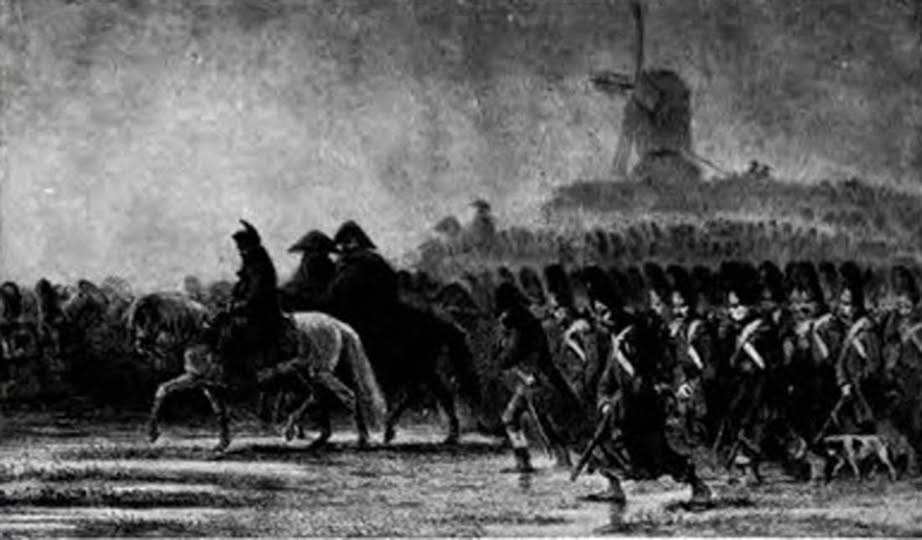
This strategy has been carried out many times throughout history... the Romans carried it out against "Hannibal of Carthage"... and the people of Nubia carried it out against "Cambyses"... and Russia against "Napoleon"... You want to besiege the city? Go ahead, sit out there with your soldiers in the open... the sun scorches you by day and the cold freezes you by night... while we sleep in warmth... inside our lands we have our food, our water and our resources... while your supplies dwindle and your soldiers fall ill and tire themselves out sleeping in the open.
And every time this strategy was applied... it succeeded...
Indeed, "al-Alfi's" soldiers began to grumble and mutiny... so he was forced to lift the siege and withdraw to Upper Egypt... and during his return... news reached him of the death of the other Mamluk emir and his ally "Uthman Bey al-Bardisi", and with the length and hardship of the siege, the length of the journey after it, and the alarming news raining down on his head, "al-Alfi Bey" himself died... and both pieces of news were reported to "Muhammad Ali".
"Muhammad Ali" found it a golden opportunity to finish off the Mamluks, so he set out from Cairo at the head of an army... and began liberating the cities along his way from the Mamluks until he clashed with them in Asyut and liberated it too.
And England had not yet received news of the death of "al-Alfi" or "al-Bardisi"... it had only been told of the battles... and it found its Mamluk allies collapsing, so it decided to rush to their rescue... and at the beginning of 1807 it moved its fleet toward Egypt, led by a highly skilled military man who had previously taken part in the "Cape of Good Hope" campaign and besieged "Gibraltar".
That man is General "Alexander Mackenzie Fraser"... who fitted out a huge fleet and set off for Alexandria with the aim of occupation, in what British history knows as the "Alexandria expedition of 1807"... and what our history records as the "Fraser expedition".
The news reached the people of Alexandria, so they began arming themselves for resistance, waiting for the English... and the Ottoman governor of Alexandria, "Amin Agha", made them a place to store their weapons... until the English arrived and the hour of the attack began.
And the English ships reached the shore of al-Ajami on 17 March 1807... and waiting for them was the Turkish governor "Amin Agha"... who ordered the Ottoman garrison of Alexandria to lay down its weapons... and welcomed the English and handed them the city and pointed them to the weapons and ammunition depots belonging to the resistance men!
And Alexandria fell without resistance... and without finding time to swallow the betrayal and turn to fight.
And days later... by 21 March, England had laid its hands on Alexandria completely... and this was a heavy blow to "Muhammad Ali"... who became besieged from the north by the English and in the south by the Mamluks.
And here "Muhammad Ali" decided to draw up a new plan... to get out from between the hammer and the anvil.
And we will talk about that plan later.
And there is more to come.
----------------
Previous posts.
---------------
1 - http://bit.ly/30anGpF
2 - http://bit.ly/2Q7e6zv
3 - http://bit.ly/2VVkcrX
4 - http://bit.ly/2WdncAb