The British spy "Hempher" wrote of his relationship with Sheikh "Muhammad ibn Abd al-Wahhab," saying:
"(Safiya) had captivated the Sheikh's heart, and he became infatuated with her.. and he tasted the sweetness of violating the commands of religious law under the cover of independent reasoning, independence of opinion and freedom, and on the third day of the temporary marriage I held a long conversation with him about (the non-prohibition of wine), and I cited hadiths that I had fabricated, and the saying of some of the Hanafis and reports about Umar, and I told him; if wine were forbidden the Messenger of God would have punished for it.. which did not happen.. and in the end he was convinced that wine, if it does not take away the mind in a way that distracts from prayer or the remembrance of God, is harmless."
And while "Muhammad ibn Abd al-Wahhab" was absent for the lesson, "Hempher" goes to Safiya's house and tells her what had happened.. he asks her to try to make him drink wine that night.. and he records:
"And it happened, and (Safiya) told me that she had given him wine until he was utterly drunk and that he had come to her several times that night.. and I saw in the morning the marks of weakness and emaciation upon him.. so I became certain that I and (Safiya) had gained complete mastery over him."
And the Colonial Office began its plan, and "Hempher" began urging "Muhammad ibn Abd al-Wahhab" to write down his new jurisprudence, after convincing him that he was "the renewer of the religion".. and the Colonial Office had certain principles that drove "Hempher" to direct Muhammad ibn Abd al-Wahhab toward them in his jurisprudence.. such as declaring all Muslims unbelievers and permitting their killing and their sale in slave markets, demolishing the shrines and the mosques they contained, on the grounds that they were pagan relics, striving to cast off obedience to the Caliph and rebel against him, and spreading chaos as much as possible on the principle of "destruction for the sake of construction" and spreading extremism as a means of control and of terrorizing dissenters.
And gradually the call took shape and acquired disciples and followers.
The important thing is that "Abd al-Wahhab," at "Hempher's" instigation, leaves Basra.. and moves to Baghdad.. he stays there a while and gains a few followers.. and then he moves to Hamadan and does the same thing there, then he journeyed to Isfahan, and then he returned to his own country.. and there.. "Hempher" met him.. and presented him with a large sum of money.. and a mount to ride.. and then parted from him after he had been fully recruited.. and "Abd al-Wahhab's" mission began on his own.. with direct support from the Colonial Office.
And "Muhammad ibn Abd al-Wahhab" disappeared from people in a seclusion that lasted 8 months.. and then he came out to the people with his call.. and some denounced it.. and some supported it.. and those who rallied around him and believed him, from the weak-minded and the self-interested, were the first nucleus of his army.
And "Hempher" says:
"And the sedition began when he declared that all Muslims had become unbelievers and apostates from Islam and that he was obliged to fight them as one fights the polytheists."
And some of the jurists of his age came out against him and argued with them and overcame him.. but the Hanbali mufti in Mecca.. Sheikh "Muhammad ibn Abdullah ibn Humayd"; in his book "Al-Suhub al-Wabila" says:
"For he - that is, Muhammad ibn Abd al-Wahhab - if anyone opposed him - that is, debated him - and refuted him and he was unable to kill him openly, would send someone to assassinate him in his bed or in the market at night.. because of his doctrine of declaring whoever opposed him an unbeliever and deeming his killing lawful."
And the Colonial Office had succeeded in bringing "Muhammad ibn Saud," the emir of Diriyah, over to its side.. and he began to support "Muhammad ibn Abd al-Wahhab".. and "Muhammad ibn Saud's" men became supporters of "Muhammad Abd al-Wahhab" with whom he could fight.. and "Muhammad Abd al-Wahhab" made it a condition upon him that:
"You are their chief and their nobleman, I want from you a pledge that you will strive in this religion, and that the leadership and the imamate shall be in you and in your descendants after you, and that the sheikhdom and the caliphate in the religion shall be in me and in my family after me forever."
And this was mentioned by "Hasan ibn Jamal ibn Ahmad al-Rikabi" in his book "Lama al-Shihab fi Sirat Ibn Abd al-Wahhab."
And in return.. "Muhammad ibn Saud" made two conditions upon "Abd al-Wahhab.. the first of them that he would not turn back from him if God granted them victory and established them.. and the second.. that he would not prevent him from the tribute he had imposed on the people of Diriyah at the time of the fruits.
And the Colonial Office aimed by this to further tear apart the Ottoman state, "the Sick Man," and hasten its demise.. and with the formation of the Wahhabi army.. the Colonial Office, in its malice.. goes to the Ottoman state and warns it against him, saying that he wanted to control the Hejaz.. and the holy places within it.. and that this would shake the Ottoman state's standing in the Islamic world!
The brother of "Muhammad ibn Abd al-Wahhab" was a judge among the Hanbali imams, named "Suleiman ibn Abd al-Wahhab".. he wrote at that time a book titled "The Divine Thunderbolts in Refutation of the Wahhabis".. and matters between them reached the point of armed confrontation. In his book he refuted the Wahhabi call entirely.. and accused it of error, innovation, inventing a new religion and committing grave sins, crimes and catastrophes for the sake of that.. for political purposes.
Of course it made no difference to them.. and the raids on tribes, caravans and villages continued.. and little by little the Wahhabi army grew larger.. "Muhammad ibn Abd al-Wahhab" left behind three sons.. "Abdullah ibn Muhammad ibn Abd al-Wahhab," and "Ali ibn Muhammad ibn Abd al-Wahhab," and "Hussein ibn Muhammad ibn Abd al-Wahhab".. he himself dies in the year 1206 AH.. 1791 AD.. and the sons carry on the march to spread the creed of Sheikh "Hempher."
The Colonial Office supports them with money and weapons and their movements greatly provoke the emirs of the Hejaz.. and the ruler of Mecca and Medina rises against them.. the Sharif of Mecca, Emir "Ghalib ibn Musaid" at the head of an army.. but his army falls into a tight ambush in Najd.. and is defeated and returns to the Hejaz.
The Wahhabis are not deterred by the defeat of Sharif "Ghalib".. so they march on Mecca itself and enter it on 9 Muharram 1208 AH, 1793 AD; and they enter Medina two years after that.. and al-Jabarti says of that battle:
"When the Wahhabis took control of Medina they demolished the domes in it and in Yanbu, among them the dome of the imams of al-Baqi in Medina, and they compelled the people to what they had compelled them to in Mecca and took all the treasures of the Prophetic chamber and its jewels, such that they obtained four boxes of jewels.. filled with diamonds and rubies.. of great worth."
And the Saudi emirs, among whom there was no Briton or polytheist, are defeated.. and the Wahhabis kill them without batting an eyelid.. on the grounds that this was "jihad," one after another.. and the Wahhabi movement extended to the Arabian Gulf and Sanaa and the lands of the Levant.
And the Ottoman state is greatly weakened.. especially with its loss of control over the holy places.. and of the prestige and reverence it had instilled in the hearts of Arabs and Muslims.. and then the Wahhabis turn to Egypt.. in the year 1805.
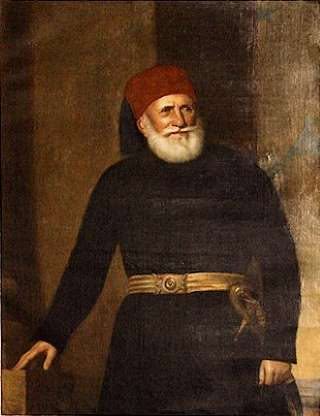
But in that year something strange happens in Egypt, and a man comes who was destined to change the course of events.. the man in this picture.
And this man we will speak of later.
And there remains more to be said.
----------------
Previous posts.
---------------
1 - http://bit.ly/30anGpF
2 - http://bit.ly/2Q7e6zv