The truth is that the "Battle of Navarino" had roots and causes.
Even when you read.. the massacres of the Ottomans and their torture of the Greeks when they were under their control are tragic and regrettable.. and pearls are written about them.. and over time this drives the Greeks to revolt.
This is one of the few revolutions in history of which you can say that it was an honourable revolution.. because it was a necessary evil against an occupier. With the mounting pressure on the Ottoman state and the growing danger of the revolution.. then.. the Sultan "Mahmud II" asks "Muhammad Ali" to head for Greece and work to keep the situation under control.
Now.. we are in the year 1825 AD.. and by orders from "Muhammad Ali".. "Hassan Pasha," the boon companion of "Muhammad Ali," heads out across the Mediterranean, with a campaign that lands on the island of Crete.. and he succeeds in suppressing the crowds of rebels in it.
The strong, seasoned military man, "Ibrahim" Pasha, catches up with him in the same year.. and heads for the plains of "Morea".. and on his way he clashes with the Greek fleet and destroys it.
And "Ibrahim" makes a successful land landing on the shores of Greece.. and he begins first by relieving and rescuing the ships of the Ottoman fleet, which the Greeks had besieged in the port of Koron.. and he succeeds in that.
And then "Ibrahim" advances and the strongholds of the rebels fall before him one after another, and he takes control of "Hydra" and "Aegina" and the port of "Nafplio" and "Missolonghi".. and the Algerian fleet joins him to cover him at sea, by orders from the Ottoman state.. and he reaches "Navarino" and besieges it and takes control of its port.
Here Europe feels anxious.. and it intervenes and asks the Ottoman state to grant Greece self-rule and some rights, while remaining subject to the Ottoman state.. but the Sultan refuses with arrogance and pride.. because he was seeing the victories of "Muhammad Ali."
And Europe decides to intervene by force.. so England, France, Russia, Prussia and Austria move.. although among them there are enemies of one another.. but the threat to a shared interest made them unite.. and they surround the hot zone of war with their ships.. and prevent supplies from reaching the Egyptian, Algerian and Ottoman fleets.
With the shortage of naval supplies and the length of the battles and the exhaustion of the Egyptian soldiers and the Algerian sailors.. for two whole years.. during "Ibrahim's" control of the situation.. and specifically on 20 October of the year 1827.. the ships of the Ottoman state open fire on the European ships.. so the ships of the European alliance open their artillery without any prior warning.. and they engage with the Egyptian and Algerian fleets in a terrible battle.. in the aftermath of which the Algerian fleet is destroyed down to the last ship.. and this is what causes Algeria to lose a great deal of its defensive power and leaves it exposed to the French occupation later on.. and the Ottoman fleet and most of the Egyptian fleet are destroyed.
"Muhammad Ali" thinks of responding with violence, and of building and sending new ships.. but France, Russia and England begin negotiating with him and convince him to withdraw.. and this was a move that angered the Ottoman Sultan greatly.. because it had become clear that Europe no longer gave him any consideration at all and was negotiating directly with "Muhammad Ali."
And "Muhammad Ali" becomes convinced that the policy of the Ottoman state and the policy of Egypt have reached a fork in the road.. so he gives his orders to withdraw his forces and he evacuates his son "Ibrahim" and his men gradually on the remaining ships.. and they return to Egypt.. and the last Egyptian soldier leaves Greece on 7 September of the year 1828.
"Muhammad Ali" asks the Sultan to reward him for his efforts in the Greek war.. so the latter grants him the island of Crete.. and this does not convince "Muhammad Ali".. especially since the people of Crete are fierce, troublesome and constantly rebellious.
With the European powers negotiating with "Muhammad Ali" himself and ignoring the Sultan.. the Sultan keeps "Muhammad Ali" in his mind.. so when "Muhammad Ali" asks the governor of Damascus to supply him with wood so that he can rebuild the fleet anew.. the Ottoman Sultan instructs the governor of Damascus to refuse.
And this governor of Damascus had, at an earlier time, had a violent crisis with the Ottoman Sultan.. and he had almost been accused of treason and dismissed and executed.. had it not been for the intervention of "Muhammad Ali" and the easing of the atmosphere.. so when the governor of Damascus refused to send the wood.. "Muhammad Ali" became extremely angry.. and the pace of the dispute and the exchange of insults between them escalated.. to the point that it reached the knowledge of the general public.
And with "Ibrahim" Pasha's establishment of the system of compulsory conscription, a large group of Egyptian peasants flee from military service.. and they find no place to shelter them except Damascus, knowing of "Muhammad Ali's" dispute with its ruler.. so they indeed flee to Damascus.. and its governor welcomes them!
This story was preserved for us by history under the name "the affair of the peasants".. those who refused compulsory conscription and fled.. and the governor of Damascus welcomed them and sheltered them.
This conduct, after the moment of anger had passed.. pleased "Muhammad Ali" greatly.. because it gave him a pretext he had been dreaming of in order to satisfy his voracious ambition.. and to carry out a plan for which he had been looking for a strong pretext.. the plan of marching on the Levant.
The truth is that history has transmitted from "Ibrahim," from his father "Muhammad Ali".. an explicit statement of his desire to save the Arab peoples from any oppressive or terroristic rule.. and of his dream of forming a unified Arab army.. that would constitute a formidable force.. in the face of Western ambitions.
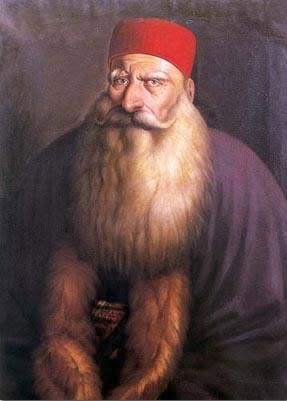
And in the year 1831, "Ibrahim" Pasha begins his march on the Levant.. and he enters Lebanon simply, easily and smoothly, without firing a single bullet.. because the prince of Lebanon, "Bashir II al-Shihabi the Great," who is in this picture.. was an opponent of the Ottoman Sultan and an ally and friend of "Muhammad Ali".. so he accordingly supports him in the march on the Levant.. and opens the doors before him and joins his forces to the forces of "Ibrahim Pasha".. so "Ibrahim" takes control of Tyre and Sidon and Beirut and Byblos and Tripoli...
And the Ottoman state becomes intensely alarmed by "Muhammad Ali's" march on the Levant.. the ruler of Egypt has stepped out of obedience to it and is marching on lands under its control.. so it pushes Ottoman forces against him alongside the forces of the Syrian army under the command of "Uthman Pasha."
But the Syrian forces stand back, reluctant and slack.. and do not take part in the war against "Ibrahim Pasha".. because they had grown fed up with harsh Ottoman rule.. and in truth they supported "Muhammad Ali's" march to deliver them from the Ottomans' repulsiveness.. added to the fact that they regarded the Egyptians as kin.. so they do not raise weapons against the Egyptian army.. and "Uthman Pasha" and his forces find themselves alone.. and he is defeated before "Ibrahim Pasha".. and he withdraws.. and with his withdrawal.. "Ibrahim Pasha" finds himself before the walls of "Acre."
Acre the strongly fortified.. which, when it meets someone thought to have worked a miracle, says to him "so you conquered Acre?".. Acre, which held out against the French forces at the height of their glory under the command of "Napoleon Bonaparte" himself.
And events develop suddenly, without any prior warning.. when an official firman is issued by the Sultan, declaring "Muhammad Ali" and "Ibrahim Pasha" traitors to the Caliph and rebels against legitimate authority.
And the whole Ottoman state and its governors unite against "Muhammad Ali."
And the Ottoman state pushes enormous forces, under the command of the seasoned military man.. the Serasker "Hussein Pasha," to destroy the Egyptian army and prevent its advance.
And matters become complicated.. and this knot appears to have no solution.
And it seems that talk has carried us away today and the conversation has grown long.. so we will continue our story later...
And the conversation continues.
---------
(Previous posts in the first comment)
---------