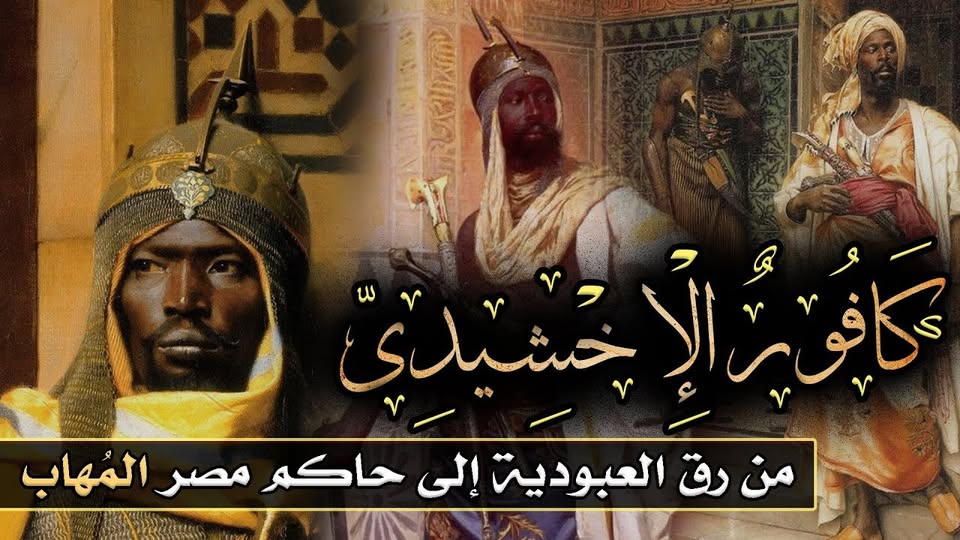
The first thing "Abu al-Misk Kafur" thinks about is reuniting the scattered pieces of the Egyptian army anew.. relying neither on Turks nor anyone else.. so he begins looking for the old military commanders.. he finds one who had become a drunkard.. one who had become preoccupied with women.. one who could no longer find anything to eat.. so he gathers them and begins to revive in them the creed of defending the land anew.. and he succeeds at that.. and he comes to have the nucleus of an army whose loyalty is to the land, not to some stranger.
And this army had fallen apart twice.. once in the days of "Muawiya", to ward off the evil of Egypt's soldiers after they had stood on the side of "Ali", may God be pleased with him, at Siffin.. and once in the era of "Khumarawayh ibn Ahmad ibn Tulun".. when he brought in the Berbers and made their word higher than the word of the army.
And "Kafur" opens the door to recruitment and allocates good sums for it.. and he begins to build an army anew.
This move changes the course of all history, because the Turks were a cause of the collapse and fall of the Abbasid state.. and that was exactly what would have happened to us.. had it not been for "Kafur al-Ikhshidi".
As soon as Egypt's army begins to stand on its own feet, the Fatimids attack it.. and although it was not yet at full strength.. it still repelled them.. and that encouraged "Kafur" to pay it more attention.. and it drew the notice of the Abbasid state and the Fatimid state to something.
If you want to stand on your own feet, Egypt with its army and its resources must be on your side.
And "Kafur" maintained a balanced relationship with the Abbasid state.. the Abbasid caliph would be prayed for on the pulpits on his behalf.. but at the same time he was completely politically independent.. and he refused the Abbasid caliph's requests that he send him forces to fight on his behalf in Anatolia.. where the Byzantines had advanced and occupied part of it.. and despite that.. "Kafur" was committed to protecting the Abbasid caliph in Baghdad.. and he saved the caliphate there with his assistance several times.
And with the strength of the army, "Kafur" extends his control over the Levant.. and he holds firm against the attacks of the Turkish Ghaznavid state.. and the Turkish troops.. and he stands up to the ambitions of the Hamdanid and Buyid states.
And in the year 974 AD.. the Turks revolt in the Buyid state.. and they depose the caliph and pledge allegiance to his son "al-Ta'i Lillah".. and he was a foolish kid.. he degraded the state and weakened it.. so its danger diminished and its voice faded.. and the voice of the Turks rose within it.
And the Abbasid state once again thinks about annexing Egypt as a province politically subject to it.
And in the other camp the Fatimids think about the same thing.. there is no quick solution to doing away with the Abbasids except by seizing Egypt.
But it is not possible.. "Kafur" would neither appease nor allow anyone to come near the Egyptian borders.. and that made the Abbasids and the Fatimids agree on almost one phrase.. with one meaning.. the Abbasids would say "between us and Egypt stands the black devil".. and the Fatimids would say in fury: "between us and Egypt stands the black stone".. and "the black stone/devil" is "Kafur".
The Fatimids tried to occupy Egypt 3 times in his era and failed completely.. and al-Maqrizi described the anguish of "al-Qa'im bi-Amr Allah" over his failure to occupy Egypt, saying: "He endured terrors of wars over the land of Egypt.. and he died without attaining it, and he commended to his son al-Mansur what had been his resolve."
"Kafur al-Ikhshidi" was greatly wronged and his record was distorted because "Kafur" kept the poets - the media of the age - away from him.. every poet was like a media channel today.. and every poet would go and praise the ruler with a couple of words and snatch gold and gifts and leave.. "Kafur" shut that door from the very first day.. no freebies, my dear.. off you go, you and him, out of here.. and he did something better.. he brought writers and scholars close to him.. so they gave him literature and art and culture and.. they developed literature and culture for him and taught people and brought about a leap for him in medicine and engineering and advanced his equipment and machinery and weapons.
His disregard for the panegyrist poets made many of them curse him.. to the point that one of the greatest poets of the age at the time.. "Abu al-Tayyib al-Mutanabbi".. came to Egypt angry with his friend "Sayf al-Dawla al-Hamdani".. al-Mutanabbi was a millionaire by the standards of our age and his own age.. but that was his livelihood.. he would praise kings and they would pay him.
"Al-Mutanabbi" arrives in Egypt.. and asks to enter "Kafur's" court.. and he delivers to him a poem among the greatest poems of praise.. beginning with "Sufficient for you is the disease of seeing death as a cure..... and enough for destinies that they should be hopes".. for whoever likes to look it up.
The poem is long.. but "Kafur", when the poem ends, looks at al-Mutanabbi with a faint smile.. and says to him "thank you". And that's it.. so, my lord, no purse of dinars.. gold.. anything? So "Kafur" tells him that "may God make it easy for you".
We don't take money out of the state treasury for someone who praises the ruler, my dear.. the freebies are over and the tap is shut.
Al-Mutanabbi goes out and complains about Kafur to people in the markets, and finds that the people defend him and love him.. so he begins a bout of the most hideous bouts of satire against "Kafur" and "Egypt" and "the people of Egypt".. this was one of "al-Mutanabbi's" particular methods.. and it used to force rulers to summon him and give him money to shut up.. and despite that too.. "Kafur" ignores him completely.
In "Kafur's" era the power of Egypt grows to an astonishing degree and in a short time.. so much so that throughout his rule.. 23 years.. not a cricket could come near the border without the permission of "Abu al-Misk Kafur".. and despite that.. he maintained religious allegiance to the Abbasids and kept up protecting them.. and that reassured the people of Egypt "doctrinally".. they were still with the Prophet's household.
The Abbasids and the Fatimids used to give "Kafur" the title "the Master".. that word was only attained by one who excelled in 16 branches of knowledge at one and the same time. "Kafur" was so strong that once a Fatimid man wanted to provoke one of the men of the Abbasids.. so he said to him "may God have mercy on al-Hajjaj ibn Yusuf".. and the Abbasid replied "may God have mercy on Kafur al-Ikhshidi".
That is why "Kafur" was wronged historically.. nobody knows what he did.. and nobody knows how he raised Egypt up and made it a state after it had been collapsing and falling apart.. because the information that reached us reached us from the media of the age.. the poets.. and especially the poems of al-Mutanabbi.. who, when "Kafur" ignored him, turned him into a "worthless black eunuch with a pierced lip".. along with a stream of poetic invective like garbage.. you can look it up under the words "al-Mutanabbi's satire of Kafur".
The important thing is that "al-Mutanabbi" died a few years before "Kafur".. he hated him madly but he still esteemed and respected him.. and shortly before his death he wrote some lines of praise about him and asked that when "Kafur" died they be inscribed on his grave.. so when "Kafur" dies, almost all of Egypt walks in his funeral procession.. and when they go to his grave they find a headstone inscribed with lines by al-Mutanabbi.. which the gravedigger had prepared:
"What ails your grave, O Kafur, that it stands alone....... on the barren plain after the crowded army
The lowest of men tread upon your grave, when....... the lions of the earth once feared you from nearby".....
Meaning, now your grave is in a desolate empty place.. men who will pass away walk over it.. after the beasts of the world used to fear coming near you.
With the death of "Kafur".. the protection is lifted from the Abbasid state.. and the Seljuks mount it and take complete control of it.. and the Seljuks are a people of warrior nomadic Turks.. and the Umayyad caliphate falls in al-Andalus.. and then the Seljuks rule officially and the presence of the Abbasids becomes honorary and nothing more.. and this is called in the life of the Abbasid state "the era of the Seljuk family".
And in the collapsing Abbasid state.. the Abbasid "al-Muqtafi li-Amr Allah" seizes the opportunity of a dispute and wars breaking out among the Seljuks themselves, since each one wanted to monopolize rule.. and he makes himself independent in Baghdad.. and he revives the Abbasid caliphate.. at a time when "the black stone".. "Abu al-Misk Kafur", may God have mercy on him.. had cleared out of the Fatimids' way.. so they entered Cairo at the hands of "al-Mu'izz li-Din Allah".. and his commander "Jawhar al-Siqilli".
And Egypt becomes subject to the Fatimid caliphate.. until the Fatimids appoint over Egypt a man named "Saladin Yusuf ibn Ayyub".
And this man we know as "al-Nasir Salah al-Din al-Ayyubi".. who reunites the scattered pieces of Egypt's army for the third time.. and builds a strong army.. he founds on his own instinct in Egypt "the Ayyubid State".. and it expands and sweeps away all of humanity and occupies the Levant and the Hejaz and Yemen and parts of the Arab Maghreb.. and the Fatimid caliphate collapses.
And Europe was not in a better state than all the mess you have read about.. assassinations and occupation and conquests and intrigues and poison and conspiracies.. but they had learned from us a valuable lesson in al-Andalus.
Say "Judgment belongs only to God" and I am coming to rule by God's law.. and you will be just fine.. if you were in second year of middle school and you said that.. you would find human cattle walking behind you and peoples submitting to you without war, with just those two words.. so they raise the same banner.. judgment belongs to God.. we have come to implement the Lord's law.. and they raise the banner of the cross.. and the Crusades begin.
And the Ayyubid state enters the Crusades.. and at the same time the Ismaili Shiite sect splits and an extremist terrorist faction emerges from it.. under the leadership of a man named "al-Hasan ibn al-Sabbah".. we will all know it later by the name "the Assassins".
And the Ayyubids' relationship with the Abbasids was somewhat lukewarm.. given that the Ayyubid state was the strongest state in the region and was not supposed to be subject to anyone.. and that makes the Abbasids seize on the weakness of the Ayyubid state at the end of its life.. and send "al-Mu'izz Izz al-Din Aybak".. to rule Egypt.. and a new era begins there.
The era of the Mamluk State.
And "al-Nasir Yusuf al-Ayyubi", king of Damascus, tries to enter Egypt by force and fight "Aybak".. but "Sayf al-Din Qutuz" comes out to face him and defeats him.
And the last Abbasid caliph "al-Musta'sim Billah" thinks of intervening.. but Hulagu the Mongol comes along to sweep away all this rubbish.. the Abbasids and the Seljuks and the Assassins and all these people, under the hooves of his horses.. until he enters the Levant and approaches the borders of Egypt.. which at the time was in a civil war.. between the land Mamluks and the sea Mamluks.. after the Mamluk state had split against itself.. and each of them saw that it had the right to be caliph.
And despite that.. and for the first time the Mongol army is defeated in Egypt.. and the myth of the Mongols comes to an end.
And with that "the caliphate" formally comes to an end.. until al-Zahir Baybars revives the "Abbasid caliphate" once again in an honorary form in Cairo.. in order to lend religious prestige to his rule.. so he brings one of the sons of the Abbasids named "Abu al-Qasim Ahmad ibn al-Zahir bi-Amr Allah".. and "Baybars" pledges allegiance to him as caliph.. on the basis that he be a kind of "blessing man" who neither loosens nor binds.. after a while this man tries to intervene in governance in his capacity as caliph.. so they kill him.. and "Baybars" brings a caliph in his place named "Ahmad ibn al-Hasan ibn al-Mustarshid Billah".. and this one sits politely.. until he dies a natural death.. and the caliphate effectively ends.. and becomes entirely honorary, and we enter new eras.
If you were left gasping in the last 3 episodes at the speed of events and how thrilling and strange they are.. then that is to some extent not intentional.. especially since they are real events, not fabricated.. we will chat about this story next episode.. in our talk about the caliphate.
And there will be time for the talk then.. The end.