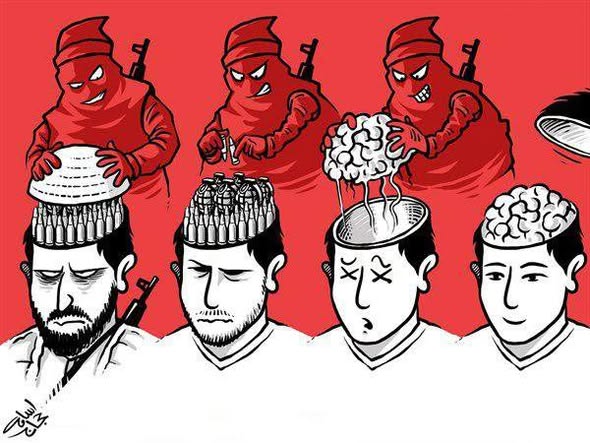
There was an American intelligence man named Edward Hunter, who came to us with a new term he coined for the first time in 1953, called "Brainwashing."
What inspired Hunter with this term was war.
That war was not World War II, as you might imagine. No. It was the Korean War. People applied this label retroactively once they came to know it through Nazi propaganda, but he emerged from the furnace of the Korean War, not the World War, when North Korea, with China's support, invaded South Korea.
The United Nations formed a coalition and began sending multinational forces, the largest part of them American. Since America was the biggest participant in that coalition, after it had bared its fangs as a new singular power on the world stage, and had begun sticking itself into every disaster on the back of the planet.
Hunter noticed that the prisoners released from the grip of the North Koreans came back strangely changed.
In other words, they had turned into communists.
The American government assigned our friend Hunter to study these soldiers "returning from captivity," interrogate them and examine them.
And Hunter began his work.
At first Hunter imagined this was a natural reaction to the horrors they had seen in Korean captivity, especially since it is common for a prisoner to glorify his captors, or to pretend to embrace their ideas, in order to gain their approval and better privileges in prison, or to gain their trust, and be able to escape later. And he assumed it was a phase they would remain in for a few days out of inertia, and then return to normal.
When he found them insistent on communist thought, he went back and enlisted psychiatry, and decided they were probably suffering from "post traumatic stress disorder."
The interviews and interrogations continued gently and calmly, with attempts to win the prisoners over, on the basis that they were suffering from trauma, and to court them with expensive cigarettes or drinks they liked. But what happened was that the prisoners saw these courtesies as "despicable bourgeois capitalist things" and rejected them completely.
The worst part was that some of them went on to deny entirely that they had been tortured or captured at all in the Korean prisons, and affirmed sternly that they had been there willingly, and that they wished to return once again to life among their "comrades"!
And here Hunter was struck with panic, so he carried his papers and recordings and set off to his commanders with the new results.
And everyone was shocked that these returning prisoners had indeed turned into fanatical communists.
Communists on the path of the Maoist lords of communism, and sometimes more fanatical than the original communists, those who had embraced this thought their whole lives.
Hunter says later that he was stunned by the words of these prisoners, and that it was, in Hunter's literal description:
"Strange, stiff, wooden speech, as if it were the speech of a person without feelings, recorded on a cylinder, repeating itself and repeating recorded ideas, without modification or pause, as if the person were under immense coercion to chant and repeat and elaborate on words, even if they seemed illogical or ridiculous to normal, ordinary people."
To the point that one of them was shackled in chains to the wall, and the Korean soldiers were beating him constantly. He said coldly that he had not been shackled, and that the situation had not happened at all.
The experts came back and sat with Hunter, and they imagined it as a new condition of disorder that we might call "war madness," especially since there is an allusion to it in the Bible, in the Book of Judges, about a defeated army that was struck by madness and frenzy, in addition to Shakespeare having referred to the same subject in his writings.
And this leaked the idea of the existence of such a condition in reality into the human collective conscience. So why not?
Why shouldn't there be a real medical condition like that?
But the scientists with Hunter discovered that the matter was not like that at all.
These prisoners were normal and logical in all their behavior and life affairs, until it came to the ideas they embraced.
Especially since they were completely stupid ideas, illogical to a terrifying degree, not normal or ordinary.
The experts went back to studying the matter and researching it dozens of times, and in the end they surrendered to Hunter's opinion.
These people had undergone some process that caused the distortion of their identity, their ideas and their patriotism, and it appeared to have been a complex and extremely successful process, especially with the American obsession and terror at the time of "communist thought," which was planted deep inside almost every American, along with American values and the American dream of scientific leadership and superiority.
So there was some treatment, extremely skilful, terrifyingly focused, that shook all these ideas loose.
Imagine that your son, your daughter, your husband, comes to you one day and tells you coldly, with a glassy stare, that he does not know you and is seeing you for the first time, and that you are not related to him and that he despises you, and that his family is the "Yilmaz" family in Turkey, for example, and that you are a treacherous enemy who must be killed. And when you argue with him he keeps repeating the same words, chanting them like a cassette player. And in the end he raises a knife at you and decides to kill you.
A terrifying thing.
Some incomprehensible treatment, as Hunter literally said of it: "A traitor was planted inside the prisoner's skull."
It made him not recognize his homeland, bereft of his identity, confused in his concepts, and heading with all his being toward the enemy, and throwing himself into his embrace, considering him to be the homeland.
The homeland became the enemy, and the enemy became the homeland.
How did this happen? And what is this treatment, its methods, and how to confront it?
We will continue talking about that later, and there remains more to say.
-----------
References:
-----------
1 - Edward Hunter: Brainwashing: The Story of Men Who Defied It.
2 - Lifton, Robert J. (1961). Thought Reform and the Psychology of Totalism: A Study of "Brainwashing" in China.
3 - Lifton, Robert J. (2000). Destroying the World to Save It: Aum Shinrikyo, Apocalyptic Violence, and the New Global Terrorism.
4 - Taylor, Kathleen (2004). Brainwashing: The Science of Thought Control.