Can a writer reveal reality, or make the tablet of fate become manifest?
Or is the writer sometimes able, in some way, with his superior mental energy and the spark of his mind, to travel with his mind through time to the future?
Traveling to the future is permissible physically and scientifically.. especially if it is in the form of energy.
And everything in the universe is energy, as you knew if you have been following this page for a while.
Even matter.. is energy.
Even the cup in front of you, and the sofa you are on, while you read these lines.
"Oscar Wilde" considered writing the mother of the arts, and said that "nature imitates the artist."
In 1838, the American writer "Edgar Allan Poe" wrote a long novel, after he had failed with his short stories and achieved no sales.
He put its final touches, and called it "The Narrative of Arthur Gordon Pym of Nantucket."
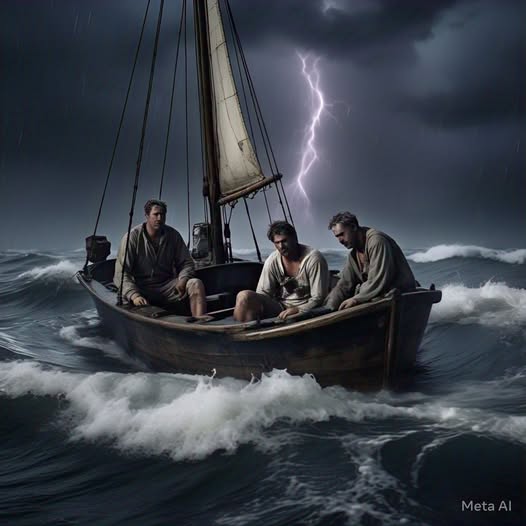
The story is about a large ship that sinks, and on a lifeboat, a few sailors survive.
With the emergency biscuits on the boat running out, and over time as they are lost in the ocean, they decide to kill and devour their companion, the sailor, the weakest of them in build.
He was a young man of 17 years, named "Richard Parker."
And indeed they do that.
And the novel fails...
It fails despite its quality, because critics saw it as violent and bloody.
And 48 years after the novel's publication, and more than 35 years after the death of its author, a real fishing boat sinks.
And a group of real sailors survive in a small lifeboat.
And with hunger, illness and cold, they find no solution but to devour one of their companions.
And they kill him and devour him for real.
And the victim was a young sailor boy of 17.
And his name was likewise "Richard Parker."
The writer "Octavia E. Butler" was writing a trilogy called "Parable."
And she died before completing it, in the year 1993, but she speaks of exactly what we see now, of the decay of art, the rise of political correctness, the absence of justice, and even the problem of global warming and climate, and the melting of the poles.
The famous dystopia of "George Orwell," which bears the name "1984," which he published in 1949 about a black future some forty years later, in which the citizen lives in a state that counts his breaths and monitors all his movements and behavior.
True, we have not reached that level of crudeness in most countries of the world, but in countries like North Korea, they are actually doing that.
"H. G. Wells" wrote his novel "The World Set Free".. in 1913.
And in it.. he described a new weapon that did not exist.
The atomic bomb.
He even called it by the same name.
Herbert's description of the bomb, its effect and its range matched, with astonishing accuracy, the equations and predictions of German scientists during their pursuit of manufacturing it, and before the production of the bomb itself.. to the point that the Germans during the Second World War sought to arrest him.. and he was at the top of the wanted list if Germany entered London.
"As for Sinclair Lewis," in the novel "It Can't Happen Here," published in 1935, he describes the "Barack Obama" era exactly, as president of the United States.
And he tells of the tension in its relations with the countries of the world.. but his description of a person and the features of the president's face matched the features and build of "Donald Trump."
"John Brunner" in 1969 also described the "Obama" era exactly.
And the rise and growth of international terrorism.
And the formation of the European Union.
And the non-criminalization of marijuana and the allowing of same-sex marriage.
And the decline in the popularity of tobacco...
All of that in his novel "Stand On Zanzibar."
And in it he named the president of America with a name that may ring some bells in your mind...
"Mr. Obomi"!
And in the novel "Debt of Honor," published in 1994, the story reaches its climax, when a passenger plane is hijacked and swoops down on the tallest building in the country to explode and destroy it, about seven years before the events of 9/11.
As for the story "The Machine Stops".. its strange thing is that it was written in 1909.
Before the First World War.
And in it the writer imagined a world where humans live in their rooms.
There is no social life, no going out with friends, no occasions.
And everyone communicates through strange square pocket devices, that work by touch and voice commands!
People in this novel, over time, are afflicted with a phobia of direct social life, and turn into something like monsters living in total darkness, with the small machines they carry, and they become detached from the world of reality.
The novel was written before the invention of television.
But the strangest has not come yet.
For in the year 1898, the American writer "Morgan Robertson," writes a short novel called "Futility."
The novel is about a gigantic ship, whose makers claimed that God Himself was unable to sink it, 240 meters long; and with a tonnage of seventy thousand tons, and it does not carry enough lifeboats, because its makers believed that it could not sink for any reason.
So it carried lifeboats sufficient for only 1,178 passengers.
And while this gigantic sea monster is plowing through the ocean, the helmsman suddenly sees a huge mountain of ice in the middle of the fog.
And he sounds the alarm.
And the captain hurries to the bridge and tries to turn the rudder and reverses the engines to avoid the collision.
And the helmsman does succeed in reducing the ship's great speed to 25 nautical knots; but despite all efforts, the side of the ship scrapes against the iceberg.
And the gigantic sea giant - which he called in the novel "Titan" - begins to sink in the North Atlantic.. on one of the nights of April, at a distance of 400 nautical miles, or 740 kilometers, from the Canadian coast.
The passengers flee.. the boats are not enough.. the steamer fills with water.. the music plays.. and the captain prefers to stay in his cabin until the last moment, to sink with his steamer.
And fourteen years after this novel, on April 15, 1912, a real gigantic ship sinks, 240 meters long; and with a tonnage of seventy thousand tons, and it does not carry enough lifeboats, because its makers believed that it could not sink for any reason.. so it carried lifeboats sufficient for only 1,178 passengers.. after scraping against an iceberg, which the helmsman failed to avoid, after he had succeeded in reducing the ship's great speed to 25 nautical knots.
And in the end, with the music playing, he preferred to stay in his cabin and sink with his ship.
And the real ship's name was "Titanic."
As for the novel "The Sultana's Dream," in it the writer imagined a world without men, and therefore free of cruelty, violence and wars, with all the men exiled or imprisoned, and the earth for women only.
Although that of course did not happen.. the novel contains an accurate description of technologies that had no existence at all.. such as solar power cells, and video calls. The novel was written in 1905.
The novel "A Song for a New Day," in which "Sarah Pinsker" imagines, in 2018, governments in the future, preventing gatherings of people, and encouraging distancing and communicating, dealing and even trading over the internet.
And that is because terrorism spread and became catastrophic, and with it, a mysterious deadly epidemic appeared, which soon turned into a highly contagious pandemic!
And there remains hanging in the ceiling of the room, that frightening question.
Can a writer reveal reality, or make the tablet of fate become manifest?
Can he?